Reviewed · LONDON TOURS
Royal Observatory Greenwich & Prime Meridian Entry Ticket London
Standing with one foot in the eastern hemisphere and one in the western hemisphere is the Royal Observatory’s big photo moment, but the clocks tell the more fascinating story. At Greenwich, you see how sailors, astronomers, and inventors slowly solved the problem of measuring time and finding longitude.
I like the Prime Meridian courtyard for its simple, memorable appeal, and I like the old instruments because they show practical science at work. The view across Greenwich Park toward London is another strong reason to make the uphill trip.
The catch is the hill. The observatory sits high in the park, and the walk can be tiring, especially in rain or for anyone with limited mobility. This is also a self-guided visit, not a scheduled tour with a guide waiting at a meeting point.
Key points to know before you go
- Stand on the Prime Meridian: Take your classic east-and-west photo in the Meridian Courtyard.
- See Harrison’s famous clocks: These inventions helped solve the problem of longitude at sea.
- Step inside Wren’s Octagon Room: This elegant room is one of the best-preserved Christopher Wren interiors in London.
- Look for the red Time Ball: It began sending a public time signal in 1833 and still operates.
- Allow about two hours: Add Greenwich Park, the Queen’s House, the National Maritime Museum, or Cutty Sark for a longer day.
- Plan the hill and ticket entry: Public transport gets you to Greenwich, but the final walk rises steeply, and some visitors have had trouble scanning third-party vouchers.
Why Greenwich time still matters
The Royal Observatory is not simply a place to point at a line on the pavement. It is where the modern world’s system of time and longitude took shape.
Before reliable clocks could travel aboard ships, sailors struggled to calculate their exact position east or west. Latitude was easier to estimate by observing the sun and stars. Longitude required accurate time. A clock that kept the time at a known starting point could be compared with local time at sea, helping sailors work out how far they had traveled around the globe.
That makes the observatory’s story surprisingly practical. You are not just looking at old scientific equipment. You are seeing tools that helped ships cross oceans more safely and helped the expanding world coordinate its clocks.
The attraction is part museum, part historic building, and part viewpoint. The Prime Meridian provides the easy photo. The clocks, rooms, and instruments provide the substance.
A few more London half days worth a look
- Stonehenge, Windsor Castle, and Bath from London
★ 4.5 · 18,662 reviews - London Big Bus Hop-On Hop-Off Tour with Optional River Cruise
★ 3.5 · 10,803 reviews - London Small Group Tour of Historical Pubs
★ 5.0 · 10,422 reviews
Reaching the observatory through Greenwich Park
The Royal Observatory sits on a hill inside Greenwich Royal Park. From the lower part of Greenwich, you walk uphill toward the buildings, with the slope becoming a real factor for many people.
Give yourself more time than a map app may suggest. The route is straightforward in principle, but visitors have found the approach confusing when paths or areas are closed. A ride to Greenwich by public transport is practical, and one visitor especially liked arriving by Thames ferry because it made the journey part of the day.
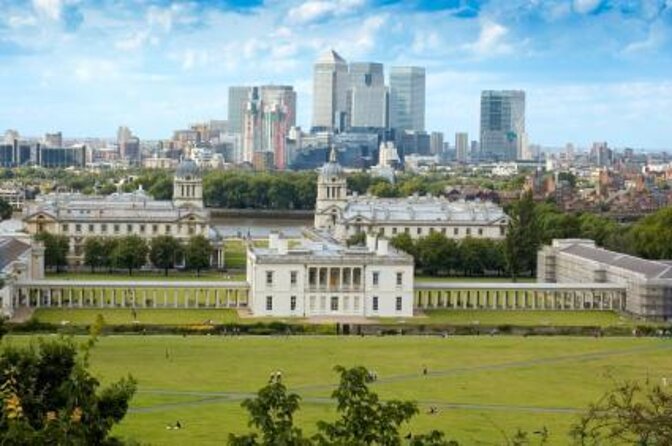
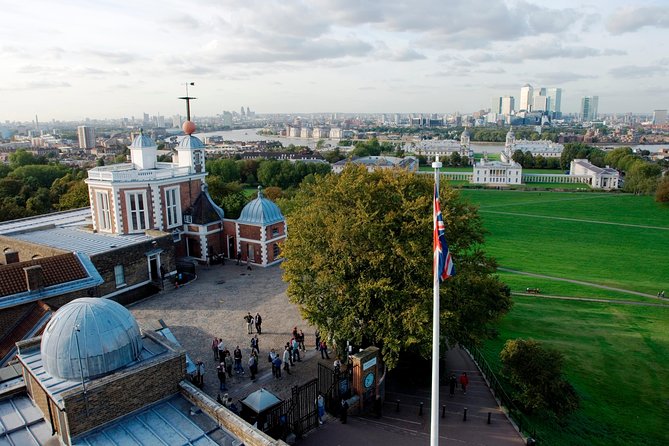
The climb rewards you with broad views over the park, the River Thames, and the City of London. On a clear day, this outlook may be as memorable as the museum itself. The setting also helps explain why the observatory was placed here, above the river and away from the crowded center of London.
Wear sensible shoes. In wet weather, the outdoor walk is less enjoyable, and the hill can feel much harder on the way back down. If someone in your group has mobility concerns, contact the attraction before visiting. Certain parts are not fully accessible, and the building has stairs with limited lift access.
The Meridian Courtyard and the famous line
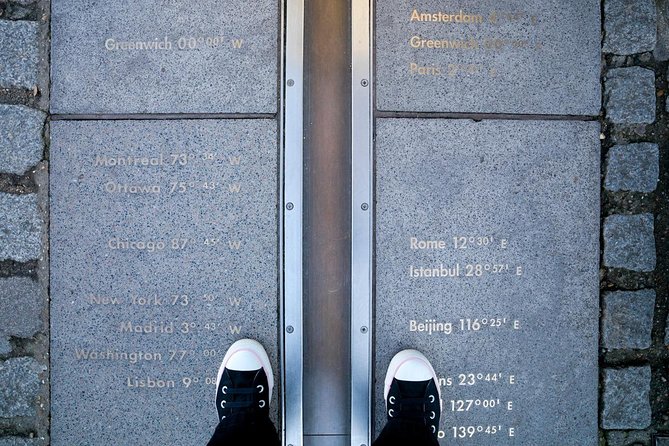
Your visit begins in the Meridian Courtyard, where a marked line identifies the historic Prime Meridian. This is the point traditionally used as zero degrees longitude, dividing east from west.
The photo is wonderfully simple. Put one foot on either side and you can explain the whole idea in one picture. It is a popular stop, so make it your first priority if you want an unobstructed photograph. The courtyard can fill quickly, especially soon after opening.
There is also a useful lesson here: the line is a human agreement, not a visible crack in the earth. The importance comes from the observatory’s role in defining Greenwich Mean Time and the longitude system used for mapping and navigation.
Do not spend your whole visit waiting for the perfect photograph. The line takes a minute to understand. The surrounding buildings explain why it matters.
Flamsteed House and the Astronomers Royal

From the courtyard, you enter Flamsteed House, named for John Flamsteed, the first Astronomer Royal. The rooms connect the building to the scientists who worked here and to the long effort to improve astronomical observation.
The route introduces figures linked with the observatory, including John Harrison, Isaac Newton, Edmond Halley, James Bradley, Annie Maunder, George Biddell Airy, and Albert Einstein. Their connection to Greenwich varies, but together they represent the changing work of astronomy, from charting stars to understanding time, gravity, and the universe.
The audio guide is useful here. You can download it in multiple languages, listed as ten languages in the ticket information. Another on-site description refers to seven available languages, so check the current arrangements when you arrive. Either way, the audio format lets you move at your own pace rather than follow a fixed group.
This matters because the rooms are compact and can become noisy. An audio guide helps you hear the explanation even when other groups are nearby. The visit is mainly self-guided, though staff and volunteer talks may add extra color when available. One especially well-received talk was led by Ross, who explained the observatory in an engaging way and answered questions.
A completely different sort of day out in London:
- Stonehenge, Windsor Castle and Bath with Pub Lunch in Lacock
★ 4.5 · 7,402 reviews - Tower of London and Crown Jewels Exhibition Ticket
★ 4.5 · 6,677 reviews - Thorpe Park Admission Ticket
★ 4.0 · 5,915 reviews - Stonehenge, Windsor Castle and Bath Full Day Guided Tour
★ 4.5 · 5,346 reviews
Wren’s Octagon Room
The Octagon Room is one of the visual highlights. Designed by Sir Christopher Wren, it is a handsome historic interior with tall windows and carefully proportioned details.
The room was built for astronomical observation and conversation, but you should not expect a modern planetarium show here. It is a historic room that helps you picture the Astronomers Royal at work. Look up, look out through the windows, and notice how the architecture frames the Greenwich setting.
This stop suits visitors who enjoy buildings as much as machines. If you came expecting a large space exhibition or a planetarium included with admission, adjust your expectations. The standard entry described here focuses on the observatory buildings, collections, timekeeping, and astronomy displays.
Harrison’s clocks and the search for longitude
The clocks are the heart of the visit. John Harrison’s marine timekeepers helped solve one of navigation’s hardest problems: finding longitude at sea.
The basic idea is elegant. You compare the time at your current location with the time at a fixed reference point. The difference tells you how far east or west you have traveled. That only works if the reference clock remains accurate during a long sea journey, despite motion, temperature changes, and other difficult conditions.
Harrison’s inventions made that goal practical. The displays turn a technical subject into a human story about patience, precision, and a problem that affected sailors and entire nations.
I would give the clocks more time than the Prime Meridian line. The line is fun, but the clocks explain why Greenwich became so important. The audio guide also helps make sense of what you are seeing, particularly if mechanical instruments are not usually your thing.
The Shepherd Gate Clock and the Time Ball
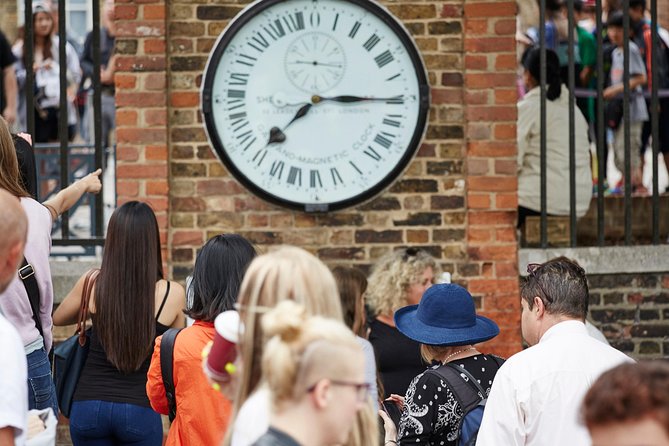
Outside Flamsteed House, look for the Shepherd Gate Clock. It was the first clock to show Greenwich Mean Time publicly.
That detail gives GMT a face. Time was once local and varied from town to town. Public clocks and railway schedules later made shared time essential to daily life. The Shepherd Gate Clock belongs to that shift from local time to standardized time.
Above Flamsteed House is the bright red Time Ball. First used in 1833, it is one of the world’s earliest public time signals and still operates today. Its original purpose was practical: people could set their own clocks by watching the ball drop.
The Time Ball is easy to miss if you hurry indoors. Look up from the courtyard and take a moment to connect the machinery inside with the public signal outside. The observatory was not only studying time. It was broadcasting it.
The Great Equatorial Telescope

The Great Equatorial Telescope sits inside the observatory’s large onion-shaped dome. Its size and setting give this part of the visit a strong visual finish.
The telescope opened new views of the universe more than a century ago. You see the instrument in its historic home rather than in a plain gallery, which makes the scale easier to appreciate.
The dome is one of Greenwich’s most recognizable features, and the telescope gives the visit a clear astronomy focus after the timekeeping displays. Still, this is a historic telescope visit, not a guaranteed night-sky observing session. The ticket information does not promise stargazing or a planetarium program.
If your main interest is space, read the admission details carefully and consider allowing extra time for any separately available planetarium experience. One visitor specifically found the planetarium worthwhile, but it should not be assumed to be part of this entry ticket.
Audio guide, staff help, and the pace of the visit
This experience works best when you treat it as an independent museum visit. The ticket includes attraction admission and a downloadable audio guide, and the format gives you control over the pace.
You can move quickly through the displays in about two hours, or linger over the clocks and historic rooms. Families can keep moving instead of waiting for a full group. Solo visitors can pause without feeling they are holding anyone up.
There is no named guide guaranteed with every booking. Ross was praised for an especially good explanation, but you should not book this ticket expecting a live guided tour. Staff and volunteers may offer talks or answer questions, yet the core visit remains self-guided.
Bring your phone ready for the audio guide. Since ticket entry has occasionally caused problems for visitors using third-party mobile vouchers, keep your confirmation accessible and allow extra time at the entrance. Some people have found that staff could not scan the barcode, while others had trouble retrieving tickets through a phone app. This does not mean every entry fails, but it is a sensible reason to avoid arriving at the last minute.
What the $33.90 ticket is worth
At about $33.90 per person, this is not a cheap photo stop. Its value depends on how much you care about the story behind the line.
For a visitor who wants only to stand on the Prime Meridian, the price may feel high. The photograph takes very little time, and the walk uphill adds effort. You can also enjoy Greenwich Park and see the exterior surroundings without paying for the museum portion.
For someone interested in navigation, clocks, astronomy, or London’s scientific past, the ticket offers more. You get the historic buildings, the Prime Meridian, Harrison’s clocks, the Time Ball, the Great Equatorial Telescope, the audio guide, and the hilltop view. The experience becomes stronger when combined with Greenwich’s free attractions.
Children under four enter free, and most visitors can take part. The ticket includes admission fees and taxes, but not transportation. Free cancellation is available up to 24 hours before the scheduled start time. Changes or cancellations inside that window are not accepted for a refund.
Turn two hours into a Greenwich day
The observatory works well as one part of a full Greenwich outing. The National Maritime Museum and the Queen’s House are a short walk away and free to visit. Both add context to Greenwich as a place connected with the sea, navigation, art, and royal life.
The Cutty Sark is also nearby. This preserved tea clipper is presented as an award-winning museum and visitor experience, and it makes a natural companion to the observatory. The contrast is appealing: the Cutty Sark shows the ships that depended on navigation, while the observatory shows the scientific work that made long-distance navigation more reliable.
You can also allow time for a pub lunch and a walk through the park. Several hours disappear easily if you combine the observatory, museums, ship, and park. For a first visit, I would plan at least two hours for the observatory alone, then add the nearby sites according to your interests.
Who should book this experience
I would recommend it to families with older children, couples, solo visitors, and anyone curious about how time became standardized. The Meridian photo gives the visit an easy hook, while the clocks provide enough substance for adults who want more than a quick landmark stop.
It is especially good for people who enjoy historic machinery and science explained through real objects. The audio guide makes it approachable even if you know little about astronomy before arriving.
I would be more cautious if your mobility is limited, if you dislike uphill walks, or if you expect a modern planetarium. The observatory has steep outdoor approaches, stairs, and access limits in some areas. Contact the attraction before booking if you need assistance planning the route.
Should you book the Royal Observatory ticket?
Book it if you want the Prime Meridian experience plus the story of clocks, longitude, and astronomy. Arrive with time to spare, head first to the Meridian Courtyard for your photograph, then slow down for Harrison’s clocks and the historic rooms. The view alone makes the climb worthwhile on a clear day.
Skip it if you only want a quick line photo, need step-free access throughout, or expect a planetarium to be included. In that case, the price and uphill walk may not match what you want.
For most visitors, the best value comes from making Greenwich a full day. Pair the observatory with the free National Maritime Museum and Queen’s House, add the Cutty Sark if it suits your interests, and let the hilltop visit become part of a larger look at London’s connection with the sea and the stars.
FAQ
Where is the Royal Observatory Greenwich?
The Royal Observatory is on a hill inside Greenwich Royal Park in Greenwich, London. It overlooks Greenwich Park, the River Thames, and the City of London.
How long does the visit take?
The visit takes approximately two hours. You can spend longer in Greenwich by adding the nearby National Maritime Museum, Queen’s House, Cutty Sark, and Greenwich Park.
Is the Prime Meridian included in the ticket?
Yes. Admission includes access to the Meridian Courtyard, where you can stand on the Prime Meridian line with one foot in the eastern hemisphere and one in the western hemisphere.
Is a live guide included?
The standard experience is self-guided and includes a downloadable audio guide. Talks by staff or volunteers may be available, but a named live guide is not guaranteed.
In how many languages is the audio guide available?
The ticket information lists a free downloadable audio guide in ten languages. Another description refers to seven languages being available on site, so check the current language options when you arrive.
Are transportation costs included?
No. The ticket includes attraction admission, the audio guide, fees, and taxes, but transportation to and from the observatory is not included.
Are nearby museums free?
The National Maritime Museum and Queen’s House are free to visit and are within a short walk of the Royal Observatory.
Is the observatory accessible for wheelchair users?
Certain parts of the attraction are not fully accessible. There are stairs and limited lift access, so contact the attraction before visiting if you need help planning your route.
Can I cancel for a full refund?
Yes, if you cancel at least 24 hours before the experience’s scheduled start time. Cancellations or changes made less than 24 hours in advance are not accepted for a refund.
Recently added around London
- London’s Crown Secret: Self-Guided Royal Puzzle Quest★ 4.5 · 8 reviews
- Postcard London★ 5.0 · 8 reviews
- Windsor Castle, Stonehenge & Roman Baths Private Tour★ 4.5 · 8 reviews
- Private Tour: Downton Abbey London Locations by Taxi★ 5.0 · 8 reviews
- Cotswolds Private Driving Tour from London★ 5.0 · 8 reviews
- A Silent Disco Adventure in London★ 5.0 · 8 reviews
- Skip-the-line London Westminster Abbey and City of Westminster Kid-Friendly Tour★ 5.0 · 8 reviews
- Gangster Tour of Soho★ 4.5 · 8 reviews
London Tours, compared.

Stonehenge, Windsor Castle, and Bath from London
Read our review →
London Big Bus Hop-On Hop-Off Tour with Optional River Cruise
Read our review →
Stonehenge, Windsor Castle and Bath with Pub Lunch in Lacock
Read our review →
Tower of London and Crown Jewels Exhibition Ticket
Read our review →
Stonehenge, Windsor Castle and Bath Full Day Guided Tour
Read our review →
Windsor Castle, Stonehenge, and Oxford Day Trip from London
Read our review →