
Reviewed · NEWCASTLE TOURS
Lightfoot Tours: Historical Tour
Newcastle’s story comes at you fast on this compact walk: medieval friars, Roman beginnings, railway ambition, the Great Fire of 1854, industrial change, wartime defenses, and the people who shaped the city. I like that the route links major sights with smaller details, from the city walls at Blackfriars to underground rivers and Viking tales near Grey Street.
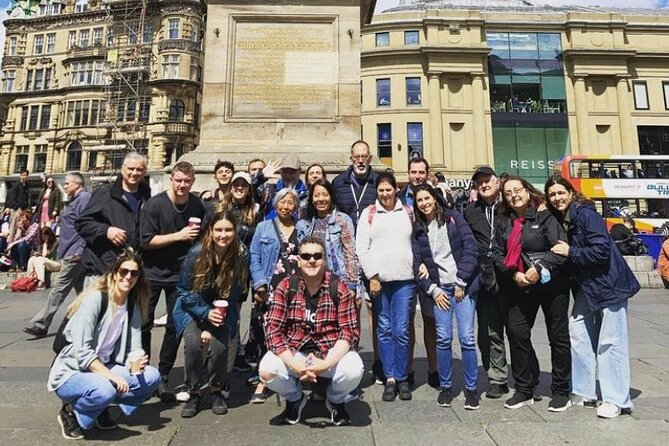
I also like the small-group limit of 15 and the chance for a guide such as Wes or Adam to answer questions rather than deliver a fixed speech. The finish at Grey’s Monument is useful, too, putting you near central shops and restaurants. The main catch is the pace: with four sections packed into roughly an hour to an hour and a half, this is an introduction, not a slow, museum-style study.
Why this Newcastle walk earns a place in your morning
- Blackfriars opens with medieval Newcastle, religious life, and the city walls.
- Central Station connects Roman origins with railway growth, St Mary’s Cathedral, and social change.
- Grainger Town reveals Newcastle’s grand civic face, from St John’s to the Bigg Market and High Bridge.
- Grey Street brings the tour to a lively finish, with theatre history, inventions, underground rivers, and Vikings.
- The route passes Newcastle Castle, Quayside, and the Tyne Bridge, adding major city sights between the formal stops.
- Wes and Adam are named guides associated with the tour, with a style built around stories, questions, and local detail.
Newcastle in 90 minutes: what this tour is really for
I would use Lightfoot Tours as a first look at Newcastle, especially if you have only a morning or want the city to make more sense before exploring alone. The walk does not try to cover every museum or explain every building. Instead, it gives you a working outline of how Newcastle grew from a Roman settlement into a medieval walled town, then into a major industrial and railway city.
That outline matters. Newcastle can seem like a collection of grand streets, old churches, steep routes, bridges, and surviving walls. A good guide connects those pieces. Here, the themes move from religion and defense to transport, trade, civic building, invention, and local identity.
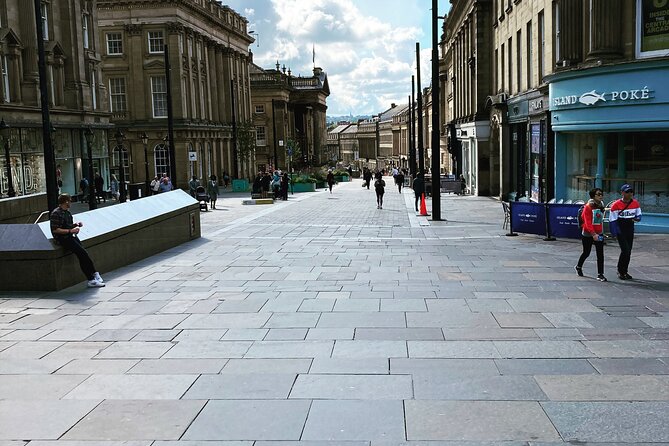
The tour begins at 10:00 am on Newgate Street, Newcastle upon Tyne, NE1 5TG. It ends at Grey’s Monument, close to the city centre’s shops and restaurants. Since the finish is different from the start, you can continue sightseeing or stop for lunch without returning across town.
The published duration is approximately one hour to one hour and 30 minutes. The four itinerary sections are each listed at about 20 minutes, so the actual timing can depend on walking speed, questions, and how much time the guide spends on a particular story.
More History Tours in Newcastle:
- Newcastle: History and Highlights Private Guided Walking Tour
★ 5.0 · 29 reviews - London Small Group Tour of Historical Pubs
★ 5.0 · 10,422 reviews - Soho Music & Historic Pubs Tour
★ 5.0 · 1,993 reviews
Blackfriars Court and Newcastle’s medieval walls
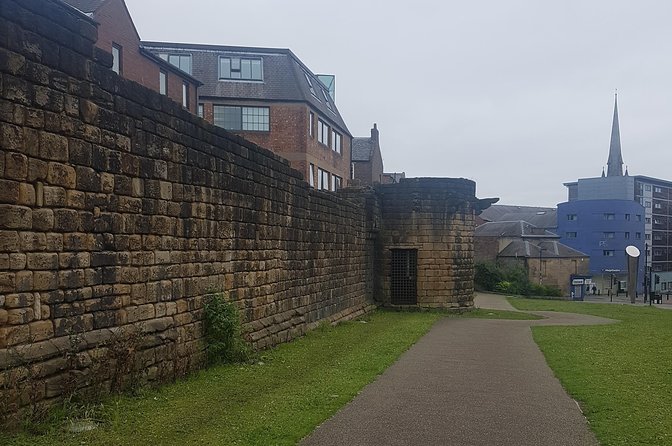
The first stop, Blackfriars Court, sets up the medieval part of the story. You hear about Newcastle’s religious past and the medieval friary, then turn to the city’s defenses and wartime history while looking at the walls.
This is a smart starting point because it shows that Newcastle was not simply a modern northern city built around industry. It had religious houses, fortified edges, and a strategic role long before the railway age. The Blackfriars setting gives the opening section a quieter feel than the commercial streets that follow.
The wall details sound especially useful for anyone who has walked past Newcastle’s remains without understanding them. One local-focused account highlights the wall at Westgate and the reason for a gap in it. That kind of detail is exactly what a short guided walk can add: you see the object, then learn why its present form is not always what you would expect.
Admission is free at this stop, as it is throughout the walking route. You are seeing the city in public spaces, not paying extra to enter a separate attraction. That helps keep the $40 price focused on the guide’s time and interpretation.
Newcastle Central Station and the railway city
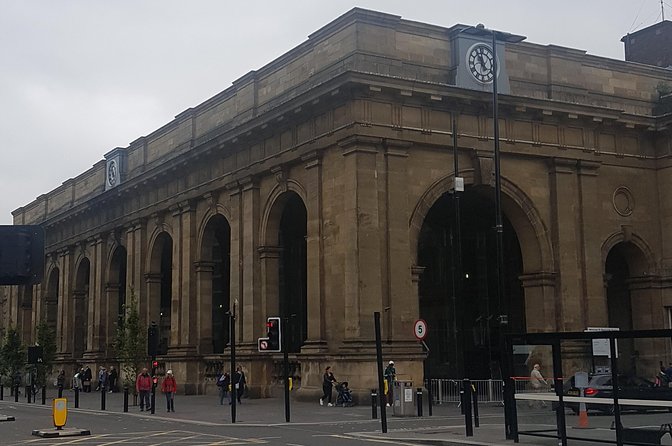
The walk then reaches Newcastle Central Station, where the subject shifts from medieval defense to transport and expansion. The guide explains the station’s construction and the growth of the railway, along with St Mary’s Cathedral, Roman origins, and the city’s social story.
This section gives you one of the clearest reasons to take the tour early in a Newcastle visit. A station can look like a place you simply pass through, yet it often explains how a city changed its fortunes. Here, railway development becomes part of a wider story about work, movement, population, and Newcastle’s place in the industrial era.
The Roman material adds another useful layer. You are not getting an isolated lecture about one period. The guide moves between Roman beginnings, later railway building, religious landmarks, and social change. That broader frame helps you see Newcastle as a city shaped by several waves of development.
St Mary’s Cathedral also adds a visible landmark to the discussion. The stop is less about entering a building and more about understanding how religious and civic structures fit into the city around the station.
I would pay attention here if you enjoy architecture or transport history. The tour is not presented as a technical railway inspection, so you should not expect detailed engineering coverage. Its strength is the connection between the station and Newcastle’s wider growth.
St John the Baptist, Grainger Town, and the old commercial centre
At the Church of St John the Baptist, the route moves toward Grainger Town, then continues toward the Bigg Market and High Bridge. This is where the city’s civic and commercial character takes over from the defensive and railway themes.
Grainger Town is one of Newcastle’s most important urban areas, and the walk gives it a place in the main story rather than treating it as a backdrop for photographs. From St John’s, you get a sense of how grand planning and everyday commerce meet. The route also brings in the Bigg Market and High Bridge, giving the section a more social and street-level feel.
The balance between major architecture and ordinary city life is one of the tour’s best features. You are not only looking up at formal buildings. You are also learning how routes, markets, bridges, and meeting places shaped the way people used Newcastle.
The walk’s local stories can make familiar streets feel new even if you already know the centre. One account from a local participant recalls learning fresh details about old haunts, the former Stoll Theatre, Pink Lane, and the steps leading down toward the Quayside via the Castle. Those references suggest that the tour includes more than a standard list of famous buildings.
At this point, keep your ears open for links between the city’s physical layout and its past. The guide may be able to answer questions about places you have just passed or places you plan to visit later. The small group helps here. With no more than 15 people, it is easier to hear and easier to ask.
A few more Newcastle half days worth a look
- Guided City Walking Tour of Newcastle
★ 5.0 · 548 reviews - Annual Admission Newcastle Castle Ticket
★ 4.5 · 114 reviews - Pilgrims’ Path walk across the sands to Holy Island
★ 5.0 · 89 reviews - 1-Hour and a Half Walking Guided Tour in Medieval Newcastle
★ 5.0 · 87 reviews
Grey’s Monument and the stories beneath Grey Street
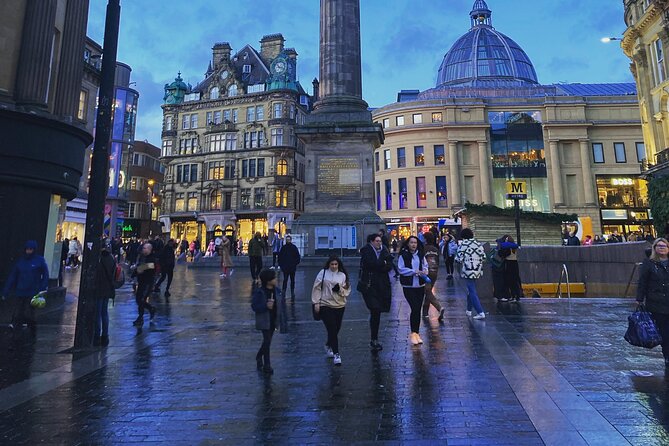
The final section reaches Grey’s Monument and takes in Grey Street. The topics become a lively mix: Newcastle’s grand theatre, important inventions, underground rivers, and Vikings.
Grey Street is a strong ending because it gives the walk a broad final view of Newcastle’s public face. The grand buildings and long urban vista provide a fitting setting for stories about civic ambition, while the underground rivers and Viking material add the sort of unexpected detail that can stay with you after the tour.
The theatre reference is useful for visitors interested in culture, not just old stones. The supplied material points to Newcastle’s grandest theatre as part of this final section, while local memories also connect the Grey’s Hotel with the Beatles and the writing of A Hard Day’s Night. That gives you several threads to follow after the walk.
The final section also brings invention into the story. Guides such as Wes have been praised for their enthusiasm about Newcastle people who made an impact beyond the city. This focus on local achievement gives the tour a personal tone and helps explain local pride without turning the walk into a collection of disconnected facts.
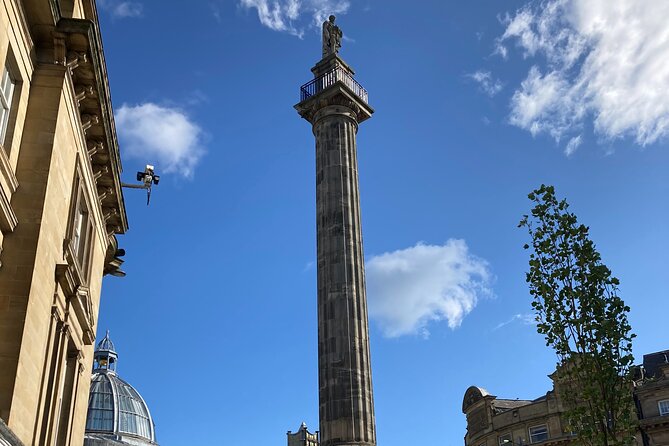
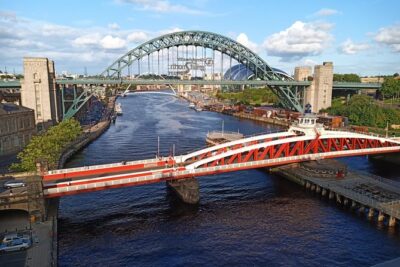
Grey’s Monument is a practical end point. You are close to shops and restaurants, and the central location makes it simple to continue exploring. The route also passes or connects with Newcastle Castle, the Quayside, and the Tyne Bridge, so you get a useful first orientation to several major sights even if the tour does not stop for a long visit at each one.
The guide makes the difference
A short city walk rises or falls on the person leading it. The feedback attached to this experience repeatedly highlights Wes and Adam by name, with praise for clear explanations, humor, enthusiasm, and personal stories.
Wes appears to bring a strong local connection to the walk. His style includes historical facts, personal anecdotes, and pride in Newcastle people whose work influenced the wider world. He has also recommended places to eat and offered ideas for further exploration, which is handy if this is your first morning in the city.
Adam is described as helpful, fun, and clever with stories and explanations. That combination matters on a fast tour. Dates and names alone can blur together, while a well-told story gives you a reason to remember the place.
The small group can change the feel of the experience. A particularly small booking may allow the guide to tailor the information to your interests. With the maximum set at 15, you are not signing up for a large crowd, though the exact group size will vary by departure.
You should still keep expectations sensible. The guide’s name cannot be guaranteed from the information provided, and a short walk cannot cover every period in equal depth. If you want detailed access to interiors, archive material, or a long stop at each landmark, you will need more time elsewhere.
Is $40 good value for this Newcastle experience?
At $40, this tour makes the most sense when you value context and efficient use of time. You are paying for roughly 60 to 90 minutes of guided walking, a small group, and a route that covers several key parts of central Newcastle without requiring you to prepare in advance.
I see the value in the range of topics. In one morning, you can hear about medieval religion, the city walls, war, Roman origins, railway construction, industrial change, Grainger Town, theatre, inventions, Vikings, and local social history. A self-guided walk could cover the same streets, but you would need to research the connections first.
The price is less compelling if you only want photographs of the main sights or prefer to wander at your own pace. The experience is built around walking and listening, not entrance tickets or a long visit inside one landmark. It also has no listed admission fees included because the route uses public places.
For me, the best value comes when you take the tour near the start of a Newcastle stay. You can use the guide’s suggestions for food and further stops, then return to the places that caught your interest. The finish near Grey’s Monument makes that especially easy.
Who will enjoy the walk, and who may want more?
I would recommend this tour to first-time visitors who want a quick framework for Newcastle. It also suits people with a free Monday morning, families with older children who can manage a city walk, and local residents who suspect they have walked past familiar landmarks without knowing their stories.
The tour works well for history fans who like connections between periods rather than a narrow focus on one century. It also suits visitors interested in urban design, railways, religion, local inventions, and the people behind Newcastle’s public identity.
The advertised physical requirement is moderate fitness. You should be ready to walk through central streets for the full duration. The experience is near public transport, and service animals are allowed, but no more detailed accessibility information is supplied.
You may want a different option if you need a very slow pace, frequent seated breaks, or a fully indoor activity. The route is a compact walking tour, and the amount of ground covered means the pace may feel brisk to some people.
Booking, timing, and cancellation details
You receive confirmation when booking, and the meeting time is 10:00 am on Newgate Street. The tour ends at Grey’s Monument, 150 Grainger Street, Newcastle upon Tyne, NE1 5AF.
A mobile ticket makes the booking simple to carry on your phone. The group is capped at 15 people, and the activity is located near public transport.
Free cancellation applies if you cancel at least 24 hours before the local start time. Cancellations made within 24 hours are not refunded, and changes within that same period are not accepted.
Should you book Lightfoot Tours Historical Tour?
Book it if you want Newcastle to make sense quickly. The route gives you medieval walls, Blackfriars, Central Station, Grainger Town, Grey Street, and glimpses of the Castle, Quayside, and Tyne Bridge, while Wes or Adam can add the local voice and odd detail that a guidebook often misses.
I would be less certain if your priority is entering attractions, taking a leisurely photographic walk, or studying one subject in depth. For most visitors, though, the small group, central finish, useful morning timing, and strong focus on stories make this a practical first step into Newcastle.
FAQ
Where does the historical tour start?
It starts at Newcastle Newgate Street, Newcastle upon Tyne, NE1 5TG, UK.
Where does the tour end?
The walk ends at Grey’s Monument, 150 Grainger Street, Newcastle upon Tyne, NE1 5AF. The finish is close to shops and restaurants in central Newcastle.
What time does the tour start?
The scheduled start time is 10:00 am.
How long does the tour last?
The approximate duration is one hour to one hour and 30 minutes.
How many people can join the tour?
The group has a maximum of 15 travelers.
What places are included on the route?
The route includes Blackfriars Court, Newcastle Central Station, the Church of St John the Baptist, Grainger Town, the Bigg Market, High Bridge, Grey Street, and Grey’s Monument. It also passes Newcastle Castle, the Quayside, and the Tyne Bridge.
Can I cancel for a full refund?
Yes. You can cancel at least 24 hours before the experience starts for a full refund. Cancellations within 24 hours are not refunded, and changes within 24 hours are not accepted.
Recently added around Newcastle
- Hadrian’s Wall Day Tour – A guided walk of the Roman Frontier★ 5.0 · 9 reviews
- Beamish the Living Museum of the North Private Tour★ 5.0 · 9 reviews
- A Silent Disco Adventure in Newcastle★ 4.5 · 16 reviews
- Newcastle : Private Walking Tour With A Guide (Private Tour)★ 4.5 · 22 reviews
- Newcastle: History and Highlights Private Guided Walking Tour★ 5.0 · 29 reviews
- Private Half Day Vera Tour of Newcastle TV Locations★ 4.5 · 50 reviews
- Newcastle beer or prosecco bike tour★ 4.5 · 50 reviews
- 1.5 Hour Explore Newcastle Walking Tour★ 5.0 · 52 reviews
Newcastle Tours, compared.

Pilgrims’ Path walk across the sands to Holy Island
Read our review →
1-Hour and a Half Walking Guided Tour in Medieval Newcastle
Read our review →
Fun, Flexible Treasure Hunt Around Newcastle with Cryptic Clues & Hidden Gems
Read our review →

Browse the lists this tour appears in