Reviewed · FULL-DAY
Full-Day Tour of Glastonbury
Glastonbury is the sort of place where Christian tradition, Arthurian legend, and modern spiritual belief share the same narrow streets. This seven-hour tour takes you from the ruins of Glastonbury Abbey to the hilltop tower of Glastonbury Tor, with stops at two unusual wells and a small medieval chapel along the way.
I like the small group size, limited to eight people, because it gives you room to ask questions and makes the day feel more personal. I also like the range of places included: you get major sights, quiet corners, local stories, and a good look at why Glastonbury attracts both history lovers and spiritual seekers.
The main caution is the amount of walking, especially the climb up Glastonbury Tor. On a hot day, or if hills are difficult for you, the final ascent may be tiring. The tour also reflects the guide’s own view of Glastonbury, so you should expect legends, energy readings, and stories about UFOs alongside more traditional history.
Key points to know before booking
- A local guide shapes the day: Tor, the guide behind Tor’s Tour, or Michael may lead the experience, bringing local stories, old photographs, and personal connections to Glastonbury.
- The Tor is the physical test: The climb takes about an hour and offers wide views toward Wales, but it can be strenuous in warm weather.
- Admission fees are extra: Glastonbury Abbey and Chalice Well do not include admission in the tour price.
- Lunch is not included: You get time to eat during the day, but you pay for your own meal.
- The spiritual side is central: Chalice Well and White Spring include ideas about healing waters, male and female energies, and the Holy Grail.
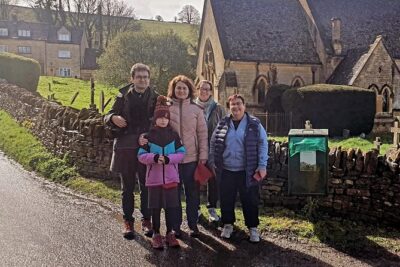
- Check the meeting details carefully: The tour begins at St John the Baptist’s Church in Glastonbury at 10:00 a.m., and it ends there too.
A small-group day through Glastonbury’s many stories
This is not a standard sightseeing loop with a guide pointing at buildings and moving on. It is a walking tour built around the stories that give Glastonbury its unusual character.
The day links early Christian tradition with the legend of King Arthur, the Holy Grail, Joseph of Arimathea, Mary Magdalene, and the spiritual meaning attached to the wells and Tor. Some parts are grounded in visible ruins and documented places. Other parts belong to local belief and folklore.
That mix will suit you if you enjoy hearing several interpretations of a place. It may not suit you if you want a strictly academic account of English history. One guide may spend more time on traditional facts, while another may give greater weight to energy fields, sleeping dragons, UFOs, or personal spiritual ideas.
The group limit of eight matters here. Glastonbury is full of small entrances, tight streets, and places where a large group would feel awkward. A compact group also lets you ask why a particular site matters rather than simply listening to a prepared speech.
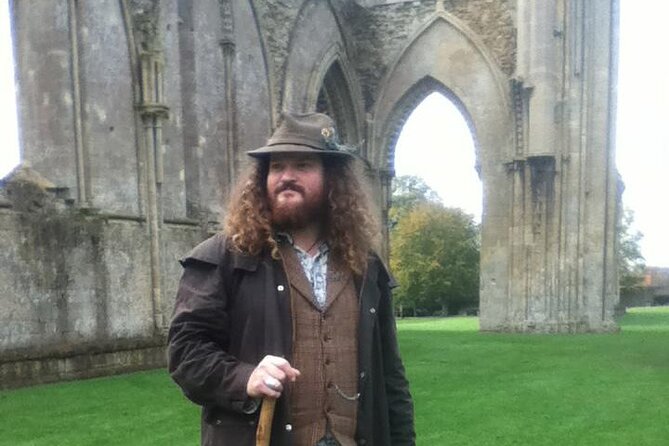
Guides named in the tour information include Tor and Michael. Tor is from Glastonbury and brings local family connections, old photographs, and personal stories into the day. Michael is also praised for adding personal touches and explaining the area in an engaging way. Since the guide can shape the tone of the experience, it is sensible to confirm who is leading when you book.
More full day trips in England:
- Stonehenge, Windsor Castle and Bath Full Day Guided Tour
★ 4.5 · 5,346 reviews - Mountain Goat Full Day Tour: Ten Lakes Tour of the Lake District
★ 5.0 · 1,717 reviews - London Full Day Sightseeing Tour with London Eye
★ 4.0 · 716 reviews
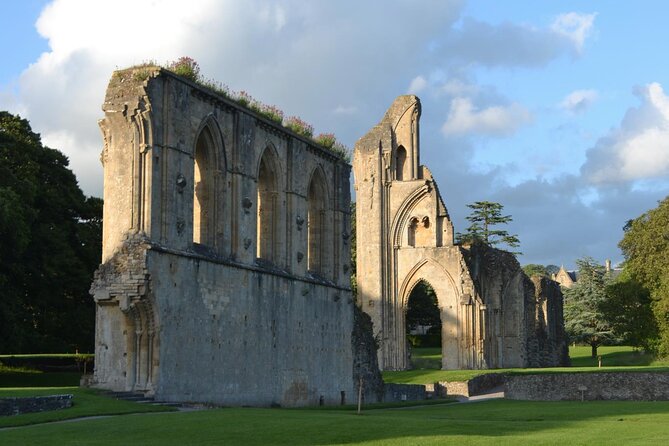
Beginning at Glastonbury Abbey
The tour starts at St John the Baptist’s Church on the High Street at 10:00 a.m. From there, the first major stop is Glastonbury Abbey, one of the town’s essential sights.
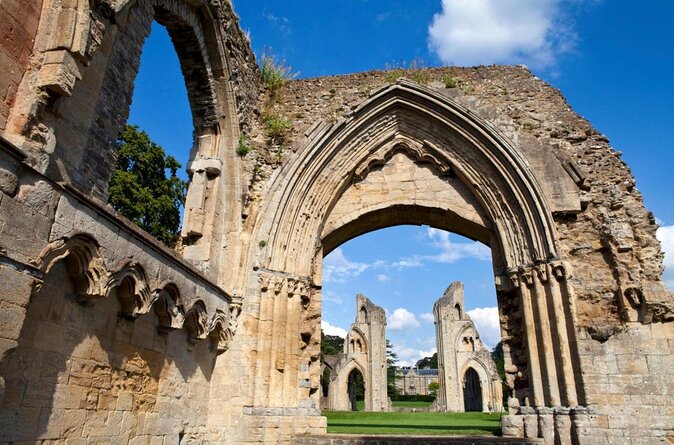
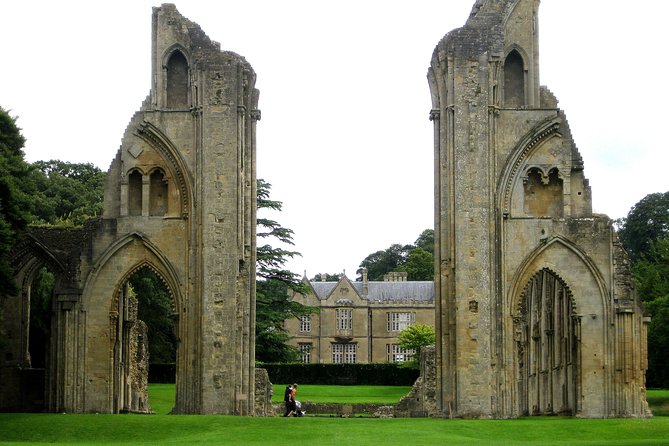
You spend about an hour here. Admission is not included, so allow extra money for the entry ticket. The tour focuses on the site of the Wattle Church, presented as an early Christian building associated with Mary Magdalene and Joseph of Arimathea in 62 AD.
You will also hear the story of King Arthur and Guinevere, whose supposed burial place is linked to the abbey. The guide explains why Arthur’s grave is said to be here and how the story connects to the family of Christ.
Treat these claims as tradition and legend rather than settled fact. That does not make them unimportant. Glastonbury’s appeal comes partly from the way old stories have shaped the town for centuries, and the abbey is the place where those stories become easiest to understand.
The ruins give you something solid to look at while the guide explains the less certain parts. You can see the remains of a major religious foundation, then hear how later generations connected it with Arthurian tales and early Christianity.
I would not rush this stop. The abbey is the historical anchor of the day, and it gives useful context before the tour moves into the more personal and spiritual side of Glastonbury.
St. Margaret’s Chapel and the Magdalene Almshouses
The next short stop is St. Margaret’s Chapel and the Magdalene Almshouses. The chapel is described as a hidden place, and the visit lasts about 30 minutes.
This is one of the quieter parts of the tour. You do not come here for a major monument or a sweeping view. You come to see a smaller religious site that might be missed if you were exploring Glastonbury on your own.
The stop adds scale to the day. The abbey is large and dramatic, while St. Margaret’s Chapel feels more tucked away and intimate. The contrast helps you see that Glastonbury’s character is not limited to its two famous landmarks.
Because this is a walking tour, your guide can connect the chapel to the nearby streets and explain how religious life once fitted into the town. The information provided does not give a detailed list of the chapel’s interior features, so expect the value to come mainly from the guide’s explanation and the atmosphere of the place.
Chalice Well and the search for the Holy Grail
After lunch, the tour turns toward Chalice Well. Lunch is not included, and the exact restaurant or length of the meal is not specified, so plan your budget and expectations accordingly.
Chalice Well is presented as a possible resting place of the Holy Grail. The well’s waters are also said to have healing qualities, and you can drink the water yourself.
The setting is intended to be calm and reflective. This is less a conventional historic attraction than a place where Christian symbolism, Arthurian legend, and modern spiritual practice meet.
The well is often associated with red water, described on the tour as representing female energy. The guide uses this idea to explain the relationship between Chalice Well and the nearby White Spring, which is linked with male energy.
You do not need to accept those ideas to find the visit worthwhile. You can approach the well as a cultural site, a religious place, or a local curiosity. I like that the tour lets you experience the ritual directly rather than only hearing a story from outside the entrance.
Admission to Chalice Well is not included. Check the current entry arrangement when booking, since this extra cost is easy to overlook when comparing the headline tour price.
A completely different sort of day out in England:
- Stonehenge, Windsor Castle, and Bath from London
★ 4.5 · 18,662 reviews - London Big Bus Hop-On Hop-Off Tour with Optional River Cruise
★ 3.5 · 10,803 reviews - London Small Group Tour of Historical Pubs
★ 5.0 · 10,422 reviews - Beatles Magical Mystery Tour
★ 5.0 · 9,266 reviews
White Spring and its candle-lit water temple
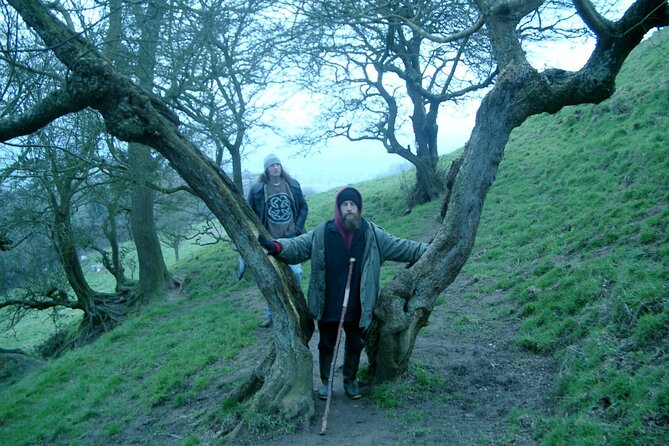
White Spring is only a short distance from Chalice Well, and the tour allows about 30 minutes here. Admission is listed as free.
The stop takes place in a candle-lit water temple. You may encounter people bathing in the water, including nude bathers. The tour provider asks you to mention in advance if you would rather not witness this.
That warning is important. This is not simply another well beside a public footpath. It is an active spiritual and bathing space, and the atmosphere can be more intimate than some visitors expect.
The guide presents White Spring as the balancing counterpart to Chalice Well. The red waters and female energies of one are paired with the white waters and male energies of the other.
Again, you can treat this as belief and symbolism rather than fact. The value lies in seeing how different traditions have given meaning to the same local water sources. If you are open to unusual religious customs, this may be one of the most memorable stops of the day. If you prefer conventional sightseeing, it may feel outside your comfort zone.
The half-hour visit is short, which helps keep the stop from taking over the tour. Still, ask yourself before booking if this type of setting interests you. The provider is unusually clear about the possibility of nude bathing, so take that information seriously.
The climb to Glastonbury Tor
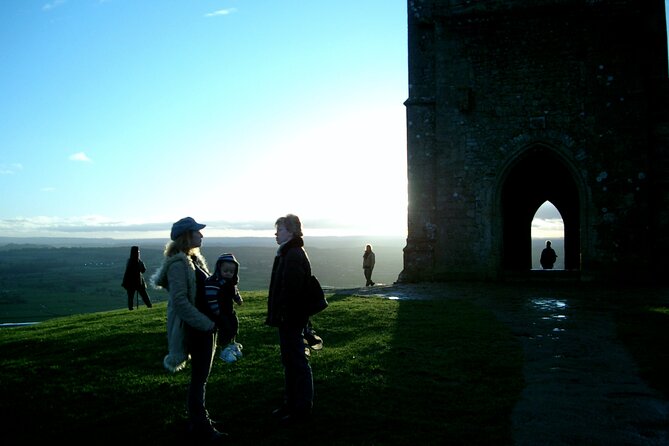
The Tor is saved for last, and the timing makes sense. It is the best-known sight in Glastonbury and the place where the day ends with a view.
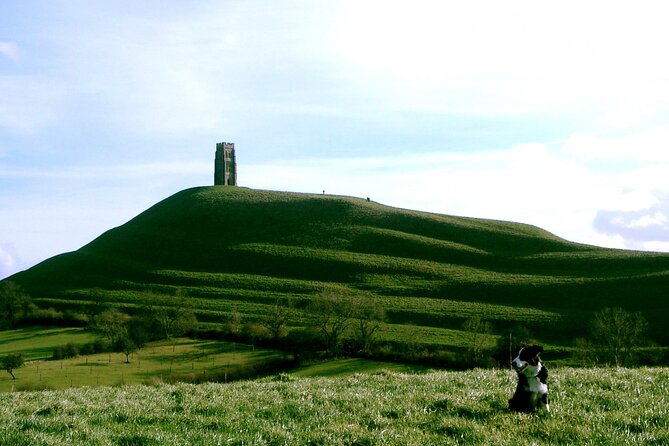
The climb takes about an hour. The tour information says the Tor is free to visit, but the walking itself is the issue. The hill is steep, and one person described the walk in hot weather as a killer. That is blunt, but useful.
You should bring sensible shoes, water, and clothing suited to the weather. The tour operates in all weather conditions, so do not assume that a cloudy morning means the day will stay cool or dry.
At the summit, you see the remains of the Tor’s tower and look across the surrounding countryside toward Wales. The guide explains why the hills are called sleeping dragons and talks about the special energies associated with the Tor.
The view is the strongest straightforward sightseeing moment of the tour. Even if you are not interested in energy lines or dragon legends, the climb gives you a clear sense of Glastonbury’s setting.
The Tor can be difficult for anyone with modest fitness, knee trouble, or poor balance. The tour information asks for a moderate level of physical fitness, and that is fair. The route is not described as accessible by vehicle, and a request in the feedback suggested that driving people up the first hill would help. Do not book this day expecting the guide to remove the climb.
The reward is not just the view. The Tor brings together the main themes of the tour: old religious traditions, Arthurian stories, unusual local beliefs, and a strong sense of place. You finish above the town, looking back at the sites you have visited.
What the guide adds to the experience
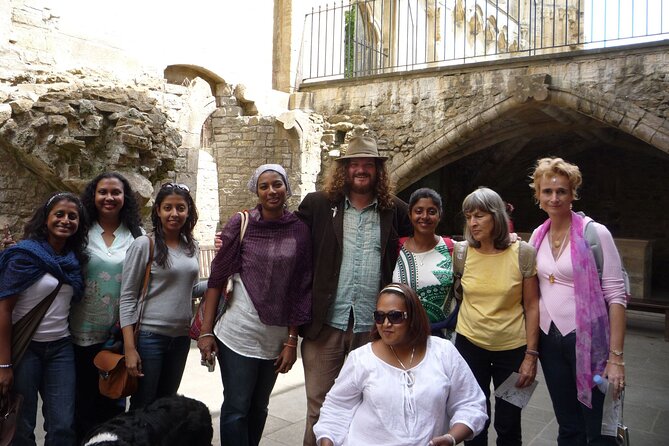
The guide is the main reason to choose this tour instead of visiting the same places independently.
Tor is described as a local who knows Glastonbury well and brings old photographs and family stories into his explanations. Michael is also noted for personal touches, including stories connected with his great-great-great-grandfather.
Those details can make the day feel more like a conversation with someone from the town than a formal lecture. A local guide can also explain how the abbey, wells, chapel, and Tor fit together in the town’s identity.
The style may vary. The strongest praise focuses on enthusiasm, warmth, local knowledge, good timing, and a willingness to answer questions. One very critical account objected to the amount of UFO discussion, the guide’s approach, and what it considered weak historical explanation.
That contrast gives you a useful booking clue. If you enjoy folklore, spiritual ideas, and the stranger side of Glastonbury, the guide’s style may be exactly what you want. If you want dates, architectural detail, and cautious historical wording above all else, ask about the tour’s tone before committing.
The real value of the $102.83 price
At $102.83 per person, this is not the cheapest way to walk around Glastonbury. The price needs to be judged against what you receive, and several costs remain outside it.
Lunch is extra. Admission to Glastonbury Abbey is extra. Admission to Chalice Well is also extra. The Tor, White Spring, and St. Margaret’s Chapel are listed with free admission.
What you are paying for is a full seven-hour day with a professional and local guide, a planned route, and a small group capped at eight people. That is good value if you want context at each stop and prefer not to work out the connections between the sites yourself.
The price is less attractive if you plan to see only the Tor and abbey at your own pace. You may also feel it is high if the guide’s spiritual interpretation does not match your interests.
Group discounts are available, although one booking experience raised a concern about how prices for more than one person were displayed. Check the final total carefully before paying rather than assuming the first price shown is the complete group cost.
The tour is often booked well in advance, with an average booking point of about 52 days ahead. That suggests you should reserve early if your schedule is fixed, especially if you want a particular date or guide.
Who should book this Glastonbury walking tour
I would recommend this experience to you if you enjoy places with several layers of meaning. It is a strong fit for people interested in Arthurian legend, early Christian tradition, wells, local folklore, and modern spiritual practice.
It also suits families who can manage the walking. A particularly positive account noted that the guide was supportive of young children, which suggests the small group format can work well for parents. Still, the Tor climb may be too much for some children, so judge that part separately from the rest of the day.
You will probably enjoy it if you like asking questions. The group size leaves more room for personal attention than a large coach tour, and the guides are described as friendly, enthusiastic, and willing to add personal stories.
I would hesitate to recommend it if you dislike speculative history or want a firmly secular tour. The spiritual language is not a minor extra. It is built into the visits to Chalice Well, White Spring, and the Tor.
You should also think carefully about the physical side. The day includes repeated walking and a steep final hill. Hot weather can make the Tor much harder, and the tour runs in all weather, so dress for conditions rather than relying on a forecast from the night before.
Practical details that affect your day
The tour starts at St John the Baptist’s Church, High Street, Glastonbury BA6 9DR, at 10:00 a.m. It ends back at the same meeting point.
Some booking information has reportedly shown a pickup point elsewhere or described a driver, while the actual arrangement begins in Glastonbury with a guide. Confirm the meeting point and whether your departure includes transport before you travel to the town.
The tour is offered in English and uses a mobile ticket. Confirmation is provided when you book. Vegetarian food can be arranged, and you should give dietary requirements in advance.
Service animals are allowed. The tour operates in all weather conditions, so waterproof clothing, sun protection, and shoes with a good grip are sensible choices.
Free cancellation is available if you cancel at least 24 hours before the start time. Cancellations or changes made inside that window are not accepted for a refund.
Should you book it?
Book this tour if you want Glastonbury explained through both its visible history and its living legends. The combination of Abbey, chapel, wells, and Tor gives you a fuller picture than a quick stop for a photograph.
The strongest reasons to book are the small group, the local guides, the personal stories, and the chance to ask questions throughout the day. The strongest reasons to pause are the extra admission costs, the steep Tor climb, and the guide’s possible focus on UFOs and spiritual ideas.
If those subjects interest you, the $102.83 price can be fair for a carefully planned day. If you want only conventional historical facts, visit the abbey and Tor independently and choose your own pace.
FAQ
How long is the Full-Day Tour of Glastonbury?
The tour lasts about seven hours.
Where does the tour begin and end?
It begins at St John the Baptist’s Church on High Street in Glastonbury at 10:00 a.m. The activity ends back at the same meeting point.
What sights are included?
The route includes Glastonbury Abbey, Chalice Well, Glastonbury Tor, White Spring Well and Temple, and St. Margaret’s Chapel and the Magdalene Almshouses.
Is lunch included?
No. Lunch is not included in the tour price.
Are admission tickets included?
Admission to Glastonbury Abbey and Chalice Well is not included. Glastonbury Tor, White Spring Well and Temple, and St. Margaret’s Chapel are listed as free.
How many people can join the tour?
The maximum group size is eight people.
Is the tour suitable for people with limited fitness?
The tour requires a moderate level of physical fitness. The climb to Glastonbury Tor takes about an hour and can be difficult, especially in hot weather.
Recently added around England
- Brighton to Heathrow Airport private taxi transfers★ 5.0 · 8 reviews
- London’s Crown Secret: Self-Guided Royal Puzzle Quest★ 4.5 · 8 reviews
- The Condensed Canterbury Tour★ 5.0 · 8 reviews
- Postcard London★ 5.0 · 8 reviews
- Private Tour: Downton Abbey London Locations by Taxi★ 5.0 · 8 reviews
- Windsor Castle, Stonehenge & Roman Baths Private Tour★ 4.5 · 8 reviews
- CS Lewis & Tolkien Tour with Magdalen Entry Public tour 13.45★ 5.0 · 8 reviews
- Cotswolds Private Driving Tour from London★ 5.0 · 8 reviews
Full-Day, compared.
Stonehenge, Windsor Castle and Bath Full Day Guided Tour
Read our review →
Mountain Goat Full Day Tour: Ten Lakes Tour of the Lake District
Read our review →
London Full Day Sightseeing Tour with London Eye
Read our review →
Cotswolds Villages and Oxford Full Day Tour from London
Read our review →
Cotswolds Villages Full-Day Small-Group Tour from Oxford
Read our review →
Steam Trains, Whitby, and the North York Moors Full-Day Tour from York
Read our review →
Hampton Court Guided Tour. Full day Access & High Tea
Read our review →