
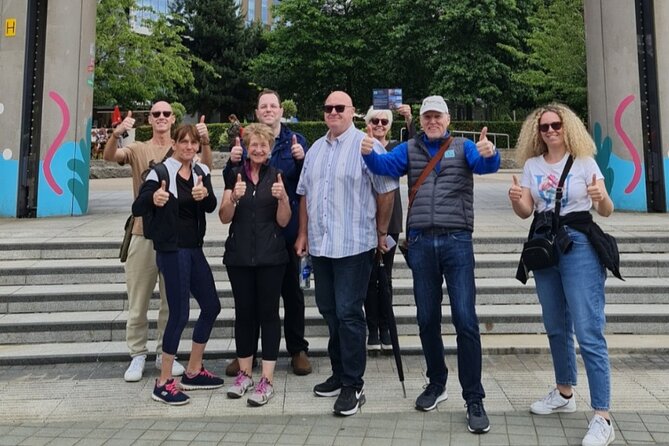
Reviewed · MANCHESTER TOURS
Inspirational guided walking tour of Media City & The Quays
Salford Quays tells one of Manchester’s biggest urban stories: former docklands turned into a major center for media, technology, art, and sport. This two-hour walk links that modern transformation with the engineering history of the Manchester Ship Canal, giving you a far better sense of the area than a quick stroll around MediaCityUK alone.
I like the audio headsets, which help you catch every word while walking beside water and open public spaces. I also like the mix of subjects: media studios, industrial engineering, IWM North, Old Trafford, rowing, and the arts all appear in one compact route. The main thing to consider is the weather. Salford Quays is exposed, and one recent outing included sun, rain, wind, cloud, and then sunshine again, so bring a coat.
Key points to know before booking
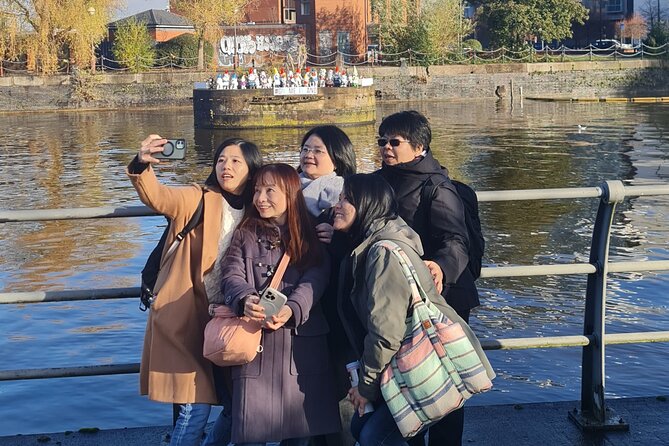
- MediaCityUK is more than a photo stop: You’ll learn how Salford became a major UK center for media and technology in roughly a decade.
- The Manchester Ship Canal anchors the walk: The canal provides the setting for the area’s industrial story and its later change of use.
- Frank is a standout guide: He is known for clear, personal commentary and for taking photos when needed.
- The audio receivers matter: You can hear the guide while walking, even in an open waterfront setting.
- You get a strong Old Trafford viewpoint: The route explains the club’s rise while showing the famous stadium, in place since 1910.
- The tour remains small: A maximum of 20 people makes questions easier than on a large coach outing.
Why this walk gives Salford Quays some meaning
MediaCityUK can look polished and new, but its appeal becomes clearer once you understand what came before it. This walk explains how Salford’s dock area changed into a home for media and technology over the past decade.
That contrast is the heart of the experience. You are not simply looking at modern buildings and taking pictures. You are also following the story of an industrial waterfront and the way an old working area found a new purpose.
I find that useful because Salford Quays can otherwise feel disconnected from central Manchester. It has its own attractions, wide spaces, water, and big landmarks. A guide helps you connect those pieces rather than treating them as separate photo opportunities.
The route is also a good choice if you want a local orientation without giving up much of your day. At about two hours, it leaves time for a museum visit, a football-related stop, or more independent exploring afterward.
More Walking Tours in Manchester
- Manchester Afternoon Walking Tour
★ 5.0 · 1,033 reviews - Rock and Goal Manchester Walking Tour
★ 5.0 · 587 reviews - Four hour walking wine tasting tour of Manchester’s best bars
★ 5.0 · 136 reviews
Meeting at MediaCityUK
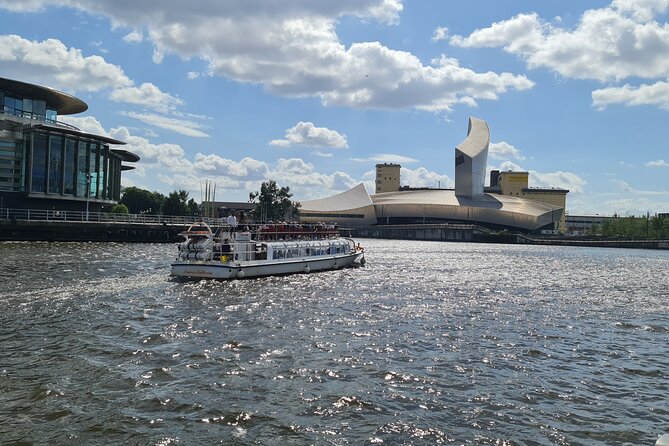
The walk begins at MediaCityUK, Salford, with the meeting point listed at M50 2EQ. It ends back at the same meeting point, which makes planning easier if you are using MediaCityUK as your base for the afternoon.
You receive confirmation when booking, and the tour is offered in English only. Public transportation is nearby, and the activity allows service animals. Most people can take part, though you should be ready for about two hours on foot in an exposed waterfront setting.
The group can include up to 20 people. That is small enough for a guide to keep the group together and answer questions, while still giving the tour a shared social feel. If numbers are very low, the experience may feel especially relaxed. One booking resulted in a private walk with Frank, who even offered to take photographs along the way.
That sort of personal attention is not guaranteed, but it tells you something useful about the operator’s approach. The tour still went ahead professionally despite only one person booking that day.
MediaCityUK and Salford’s new identity
The first major part of the walk looks at how Salford’s MediaCity became a UK center for media and technology. This is the modern face of the Quays, and it gives you the best chance to take photographs of the city’s production center.
Your guide explains the change rather than simply pointing out buildings. You’ll hear how the area developed over the past decade and why it became important to broadcasting, technology, and creative work.
This section suits first-time visitors who want a quick sense of the district. It also works for people who already know Manchester but have not spent much time on the Salford side of the water. The commentary adds the missing context.
The audio receiver is helpful here. You can look around, take pictures, and keep walking without constantly moving close to the guide. That is a small feature, but it makes the tour easier to follow.
Walking beside the Manchester Ship Canal
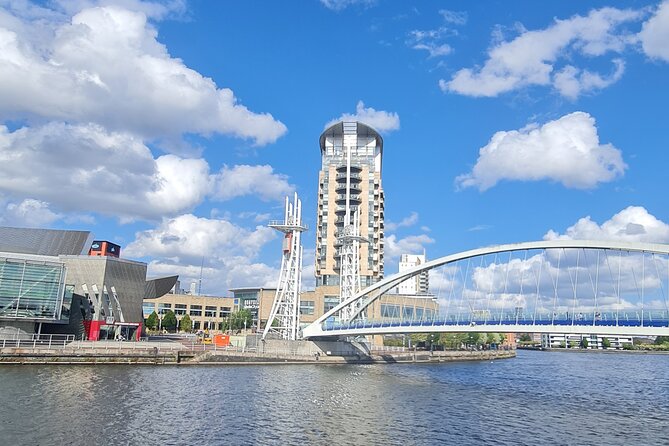
The canal is the historical anchor of the route. As you walk along its banks, the guide covers what is described as one of the 19th century’s most impressive engineering achievements.
You’ll see why the waterway matters to the story of Salford Quays. The canal is not just a pleasant walking route. It explains the original industrial purpose of the area and helps you understand why this location became important in the first place.
I like this part because it turns an ordinary waterfront walk into a lesson in engineering and trade. The route connects the scale of the canal with the later changes around it. You can look at the present-day Quays while hearing about the forces that shaped the old docks.
The setting can be windy or wet, and there may be little shelter along some stretches. Wear shoes suited to walking and a jacket that can handle Manchester weather. The tour is short enough to remain manageable, but you should not treat it as an indoor activity.
A completely different sort of day out in Manchester:
- The Manchester City Stadium Tour
★ 5.0 · 4,176 reviews - Alcotraz Prison Cocktail Experience in Manchester
★ 5.0 · 1,216 reviews - LEGOLAND Discovery Centre Manchester
★ 4.0 · 1,049 reviews - SEA LIFE Manchester Admission Ticket
★ 4.0 · 1,007 reviews
IWM North and the Quays’ cultural side
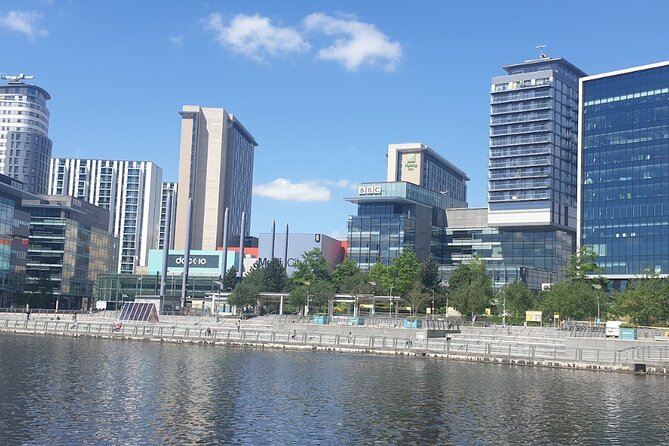
IWM North is one of the tour’s major landmarks. Your guide explains the museum’s place as the only Imperial War Museum in the north of the United Kingdom and discusses why it has become such an important art and culture attraction at the Quays.
The building is a striking local sight, and this stop adds another layer to the walk. You are no longer looking only at industrial change or media development. The area also has a strong cultural role, with IWM North helping draw people to the waterfront.
The tour does not list an interior museum visit as part of the activity, so you should think of this as an outside introduction rather than a full museum tour. That is still valuable if you plan to return later with more time.
If you have only one day in the area, the guide’s explanation can help you decide if IWM North deserves a separate visit. If you already plan to go inside, the walking tour gives you useful background before you enter.
Old Trafford from the best available angle
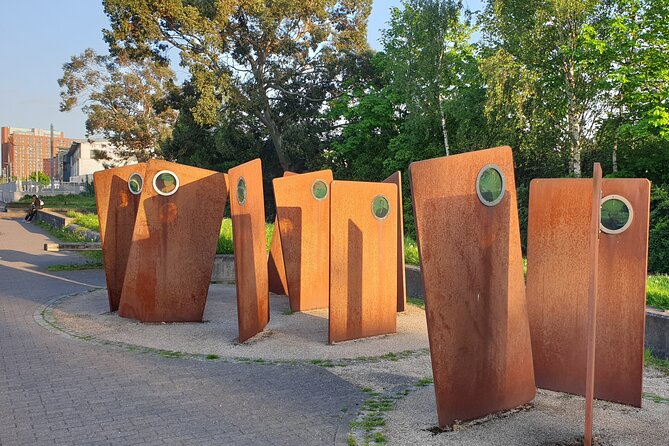
The walk also gives you a view of the famous Old Trafford stadium. The guide traces how the football club connected with the stadium was rescued from obscurity at the end of the 19th century, then explains the importance of the ground that has been in place since 1910.
This part will please football fans, but you do not need to be an expert to get something from it. The story adds social and local context to a club that is known across the world.
The route focuses on the best possible view of the stadium rather than promising entry. That distinction matters. You are not buying a stadium tour, and access inside the ground is not included in the information provided.
Still, the viewpoint makes a strong change of pace from the canal and media buildings. You get a recognizable Manchester image, along with the story behind the club’s rise.
Rowing, fishing, and the working waterway
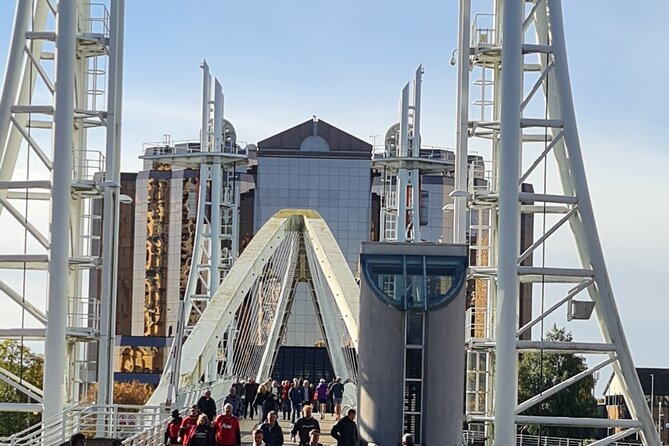
One of the more unusual subjects is the use of the Manchester Ship Canal for rowing, watersports, and fishing. This shows how the waterfront has taken on new roles beyond its original industrial work.
I appreciate this detail because it keeps the tour from presenting the Quays as a finished redevelopment project. The water remains part of local life, and the guide points out how people use it now.
The subject also reinforces the main theme of the walk: Salford Quays has changed, but it has not lost its connection to the water. You see the old engineering purpose, the new media economy, cultural attractions, sport, and recreation in one compact area.
You should not expect to take part in rowing or fishing during the tour. These activities are discussed as part of the local story.
Manchester’s most visited arts attraction
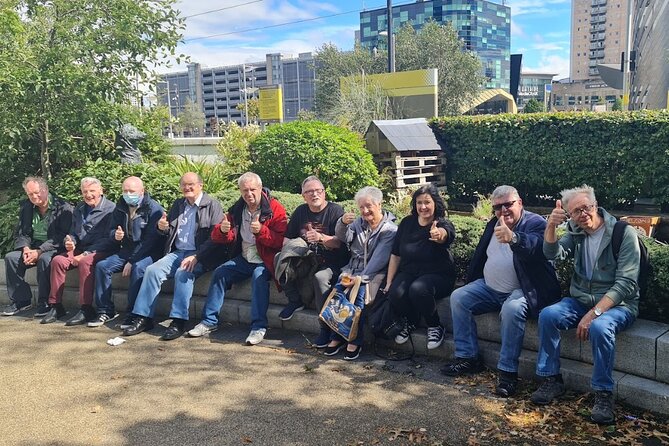
The final major subject is Manchester’s most visited arts attraction, including the story of the person whose name it carries and the reasons the building draws so much attention.
The supplied details do not identify the attraction by name, so you should treat this part as a guided introduction rather than plan around a specific indoor admission. The important point is that the tour adds an arts and architecture thread to the Quays route.
This is useful if you want more than industrial facts and football history. The walk gives you several ways into the area: technology, engineering, war, sport, recreation, and art.
For me, that range is one of the tour’s best qualities. You do not spend two hours hearing one repeated version of Manchester’s past. The subjects keep changing, but they remain tied to the same waterfront.
Frank’s guiding style and the audio equipment
Frank is the named guide in the supplied information, and his approach sounds particularly personal. He called one late-arriving participant just after 10:30 to check if they were coming, then responded with patience when a missed bus caused the delay.
That kind of contact is useful in practical terms. It suggests the guide pays attention to the group rather than simply starting a fixed speech and ignoring anyone who falls behind.
His style also includes answering questions and, when appropriate, taking photographs. The commentary is described as clear, interesting, and full of facts that can surprise people who already think they know Manchester.
The audio receivers are supplied as part of the tour. You do not need to crowd around the guide to hear. That matters at the Quays, where open spaces, water, wind, and movement can make ordinary walking commentary hard to catch.
The equipment does not change the fact that you are outdoors. Bring weather protection and be prepared to walk at a steady pace.
What the $19.24 price buys you
At $19.24 per person, this is a reasonably priced way to get organized background in an area that can be confusing on your own. You pay for about two hours with a qualified guide, plus an audio receiver, rather than for museum entry or stadium access.
The value comes from the connections. You could walk around MediaCityUK, the canal, IWM North, and the Old Trafford area independently, but you might miss why those places belong in the same story. The guide supplies that link.
It is especially good value if you are new to Salford Quays or have limited time in Manchester. You get a compact introduction, then you can decide where to spend more time afterward.
The price is less compelling if you want a long museum visit, interior access to Old Trafford, or commentary in another language. None of those is included. It is also not designed as a full-day historical tour.
Free cancellation is available if you cancel at least 24 hours before the start time. Changes or cancellations made less than 24 hours ahead are not accepted for a refund.
Who should book this experience
I would choose this walk if you want to understand Salford Quays rather than simply photograph it. It suits first-time visitors, people interested in Manchester’s industrial past, football fans, and anyone curious about how an old dock area became a media and technology center.
It also suits solo participants. The small maximum group and the possibility of a very personal guiding style make it less awkward than joining a large sightseeing group alone.
Families and mixed-interest groups may also find the range useful. One person can focus on football, another on engineering, another on art, and everyone gets the same short route.
I would be more cautious if you dislike outdoor walking, need guaranteed shelter, or want a tour in a language other than English. The route is not presented as fully indoors, and the commentary is English only.
Practical tips for a better walk
Wear comfortable shoes and pack a waterproof layer. The waterfront weather can change quickly, and the experience may include wind, rain, cloud, and sun in one outing.
Arrive at MediaCityUK with enough time to find the meeting point at M50 2EQ. Since the tour ends where it starts, you can leave other plans nearby rather than arranging a separate return journey.
Use the audio receiver from the start. It is there so you do not miss the guide’s comments, and the area’s open spaces can make a headset more useful than you might expect.
Keep your camera ready, especially around the media center, canal, cultural buildings, and Old Trafford viewpoint. If you are traveling alone, you can ask Frank about photographs, as he has offered to take them for participants before.
Should you book the Media City and The Quays walk?
Book it if you want a concise, well-connected introduction to Salford Quays at a low price. The strongest reasons are the canal story, the wide range of landmarks, the clear audio system, and Frank’s personal approach to guiding.
Skip it if you want entry to IWM North or Old Trafford, a multilingual tour, or a sheltered indoor experience. For everyone else, this is a smart way to make sense of one of Manchester’s most changed districts before exploring it on your own.
FAQ
Where does the tour start?
The tour starts at MediaCityUK in Salford, Manchester, at M50 2EQ.
Where does the tour end?
The activity ends back at the meeting point at MediaCityUK.
How long does the walking tour last?
The tour lasts approximately two hours.
How much does the tour cost?
The listed price is $19.24 per person.
What language is the tour offered in?
The tour is offered in English. Commentary in other languages is not included.
Is a guide included?
Yes. A qualified tour guide is included.
Are audio headsets provided?
Yes. Audio receivers are included so you can hear the guide during the walk.
How large can the group be?
The tour has a maximum group size of 20 participants.
Is the tour suitable for most people?
Yes. Most people can participate, and service animals are allowed. The activity is a walking tour in an outdoor waterfront area.
Can I cancel for a full refund?
Yes, if you cancel at least 24 hours before the experience starts. Cancellations or changes made less than 24 hours before the start time are not accepted for a refund.
Recently added around Manchester
- Private Cocktail Making Class in Manchester★ 5.0 · 8 reviews
- MANCHESTER: Yorkshire Adventure – Sightseeing Day Trip Tour★ 5.0 · 9 reviews
- Manchester: Luggage Storage Central★ 5.0 · 10 reviews
- Musical MADchester Quest Experience in Manchester★ 4.0 · 14 reviews
- Murder Detective Self-Guided Tour in Manchester★ 3.5 · 16 reviews
- Manchester’s Music Scene with a Local Host, Private + Custom★ 4.0 · 17 reviews
- Italian Afternoon Tea Experience in Manchester★ 4.0 · 25 reviews
- moviESCAPE Stockport Haunted House II Demon’s Curse Escape Room★ 5.0 · 27 reviews
Manchester Tours, compared.


Alcotraz Prison Cocktail Experience in Manchester
Read our review →





Manchester iFLY Indoor Skydiving Experience – 2 Flights & Certificate
Read our review →Browse the lists this tour appears in