
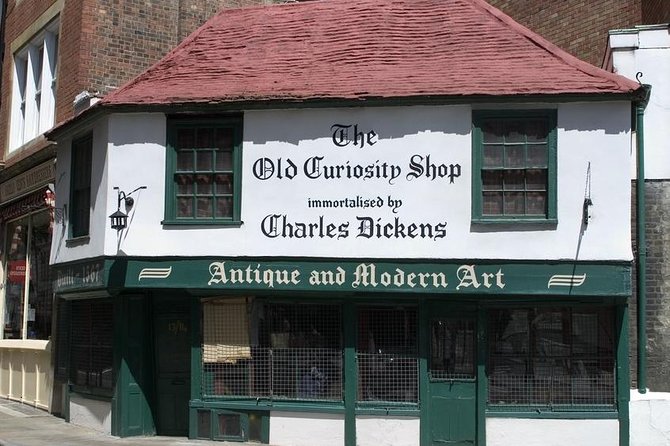
Reviewed · HISTORICAL TOURS
London’s Hidden Gems and Secret History Private Guided Tour
London’s past is hiding in plain sight here: behind office doors, down narrow alleys, beneath a church, and inside old taverns that most sightseeing walks pass by. This private tour links Roman pavements, medieval courts, Dickens locations, execution sites, and the financial heart of the City in one long walk.
I like the way Richard’s route gets away from the standard London circuit, and I like the private format, which lets you spend more time on Dickens, architecture, crime, or old London law. The strongest praise centers on Richard’s storytelling and his ability to adjust the material to your interests.
The main consideration is physical: this is a 3 to 4 hour walking tour with many stops, and comfort breaks may be needed. The advertised price is $267.48 per group up to one person, so confirm the final group pricing before booking if you are traveling with more than one participant.
Key points to know before you book
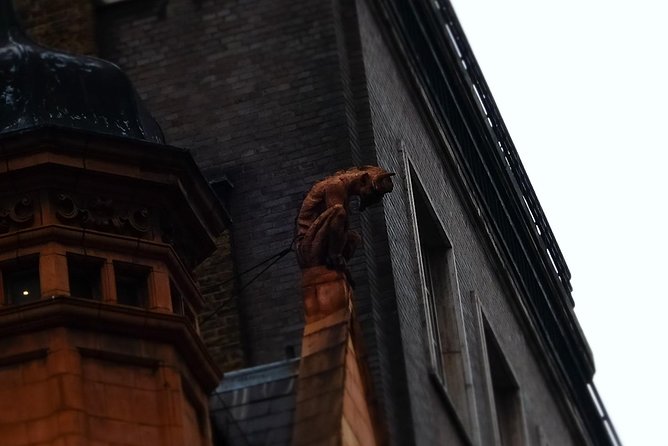
- Roman London beneath modern streets: See Roman pavements and the remains of a Roman amphitheater among later churches, markets, and office buildings.
- Richard’s personal storytelling: Richard brings together Dickens, Sherlock Holmes, the Knights Templar, Bloody Mary, William Wallace, and the Great Fire of 1666.
- A private route through old legal London: Explore the Inns of Court, ancient lanes, and places linked with Shakespeare and Charles Dickens.
- Unusual indoor stops: St Bride’s crypt and Ye Olde Cheshire Cheese provide shelter, atmosphere, and a change from street walking.
- A route with a clear ending: The tour finishes at the Monument to the Great Fire, with the option to climb its 311 steps at your own expense.
- Hotel pickup is available: The published meeting point is Embankment Station at 10 a.m., so confirm pickup arrangements when you book.
Why this London walk feels different

Most first-time London sightseeing follows a familiar path: Westminster Abbey, Buckingham Palace, the Tower, and perhaps St. Paul’s. Those places deserve their fame, but this tour takes you into the City of London, where the clues to the past are smaller and easier to miss.
You will walk through a district where Roman street patterns still influence the roads. A church crypt reveals layers beneath the city. An old pub preserves a smoky, candlelit feel. A market connects Roman trade, Victorian literature, and modern film locations.
That variety is the tour’s main strength. You are not simply looking at grand buildings from the outside. You are hearing why a side alley has an alarming name, why a church became linked with the newspaper trade, and why the Bank of England is called the Old Lady of Threadneedle Street.
Richard’s role matters here. The route contains many short stops, and a less confident guide could turn them into a string of dates and names. Richard’s appeal, based on the experience details and the praise for his work, is his ability to connect places to people and stories. If you want more Dickens and less financial history, he can adjust the emphasis.
More History Tours in London
- London Small Group Tour of Historical Pubs
★ 5.0 · 10,422 reviews - Soho Music & Historic Pubs Tour
★ 5.0 · 1,993 reviews - Royal Historic Pubs Walking Guided Tour in London
★ 5.0 · 803 reviews
Temple and the Inns of Court: London’s legal back passages
The walk begins at Embankment Station at 10 a.m., with the itinerary opening around Temple Station and the Honourable Society of the Middle Temple. Confirm the exact pickup plan in advance, since hotel pickup is included while the stated meeting point is the station.
The Inns of Court are one of London’s best areas for getting away from the usual tourist flow. They form a working world for the legal profession, with courtyards, passages, gardens, and historic buildings that can feel surprisingly quiet beside the traffic of central London.
This first section sets the tone. You may see the place associated with Shakespeare’s first performance of Twelfth Night, a fountain linked with Charles Dickens, and the English headquarters of the Knights Templar. The tour also includes a tea shop with more than 300 years of history.
The stop lasts about 45 minutes, and there is no separate admission charge. That length gives Richard room to explain how the legal quarter developed rather than simply pointing out façades. It is also a good opening for anyone interested in English law, literature, or the way old street plans survive inside a modern capital.
St Bride’s Church and the crypt below Fleet Street
From the Inns of Court, the route avoids the main road and uses old passageways, including Hanging Sword Alley. That choice is important. You get a sense of how people once moved through this part of London, before wide roads and modern traffic reshaped the city.
St Bride’s Church is often called the Cathedral of the Press because of its long association with Fleet Street newspapers. Sir Christopher Wren remodeled the church after the Great Fire of London in 1666, and a bomb destroyed its roof during the Second World War.
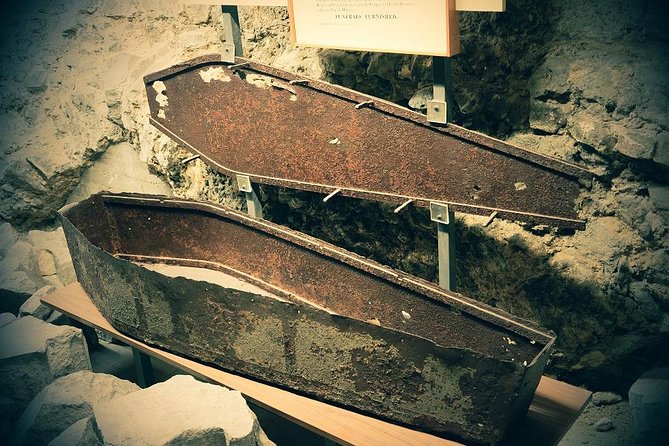
The wartime damage led archaeologists to examine the ground below more closely. In the crypt museum, you can see a medieval chapel, charred remains connected with the Great Fire, and Roman pavements. This is one of the most valuable stops for visitors who like physical evidence. Instead of hearing only that London has Roman roots, you can look at surviving Roman surfaces below the later church.
The visit takes about 20 minutes, with admission included. It is short, but it breaks up the walk and adds an indoor stop. Ask about the church’s other claim to fame, which Richard explains during the tour.
Ye Olde Cheshire Cheese and the old tavern atmosphere
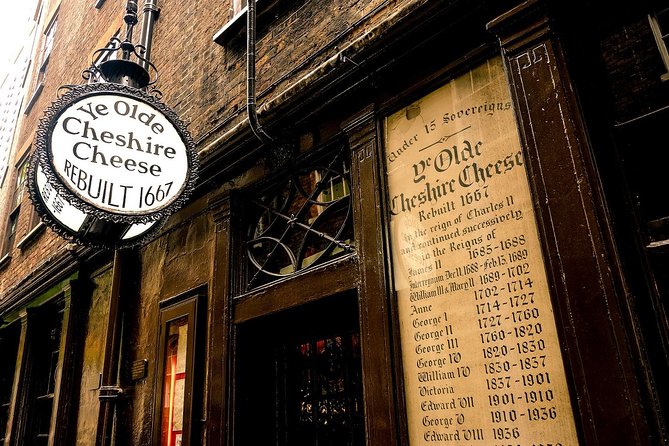
Ye Olde Cheshire Cheese makes its case as one of London’s oldest pubs through cellars dating to the 13th century. The upper rooms were rebuilt in 1667, after the Great Fire, and retain a dark, wood-paneled character.
This is not a restaurant reservation or a scheduled meal stop. Food and drinks are not included, so treat it as a place to see and hear about rather than a guaranteed pub break. The tour allows about 20 minutes.
The Dickens connection gives the pub extra appeal. You will hear about the fireplace where Charles Dickens warmed his feet, Polly the parrot, the Hellfire Club, and some rather cheeky tiles found in the 1960s. These details are exactly the sort of small stories that make an old building memorable.
If you enjoy historic pubs, this may be one of your favorite moments. If you need a proper coffee or lunch, plan to eat before or after the walk rather than relying on this stop.
A completely different sort of day out in London:
- Stonehenge, Windsor Castle, and Bath from London
★ 4.5 · 18,662 reviews - London Big Bus Hop-On Hop-Off Tour with Optional River Cruise
★ 3.5 · 10,803 reviews - Stonehenge, Windsor Castle and Bath with Pub Lunch in Lacock
★ 4.5 · 7,402 reviews - Tower of London and Crown Jewels Exhibition Ticket
★ 4.5 · 6,677 reviews
Smithfield Market, executions, and the darker side of London
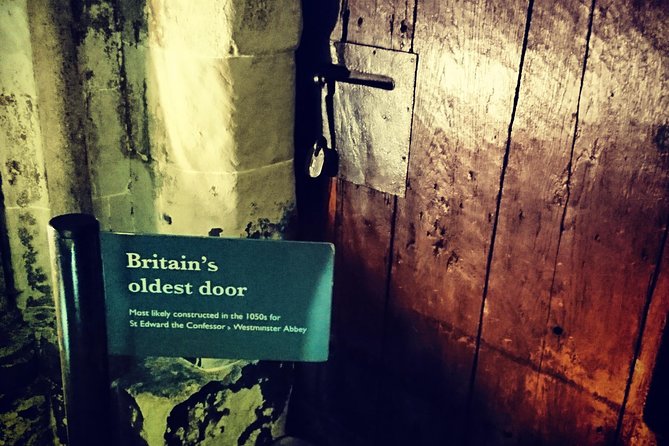
Smithfield Market is still used for its original purpose, selling meat, and it is described as London’s oldest market that continues in that role. The setting brings a grittier tone to the route.
The nearby area is tied to several unsettling chapters. The Great Fire finally went out in this part of London. Bloody Mary burned people at the stake here, and William Wallace, known as Braveheart, was executed nearby. The area also connects with Fagin’s gang and the first meeting of Sherlock Holmes and Dr. Watson at nearby St Bartholomew’s Hospital.
Richard also points out two surviving buildings that escaped the Great Fire. That contrast is useful: you are not simply hearing about destruction, but seeing how fragments of older London remained.
This section lasts about 20 minutes. It may not suit children or anyone who dislikes grim historical subjects, though the material is part of understanding how punishment and public spectacle once worked in the city.
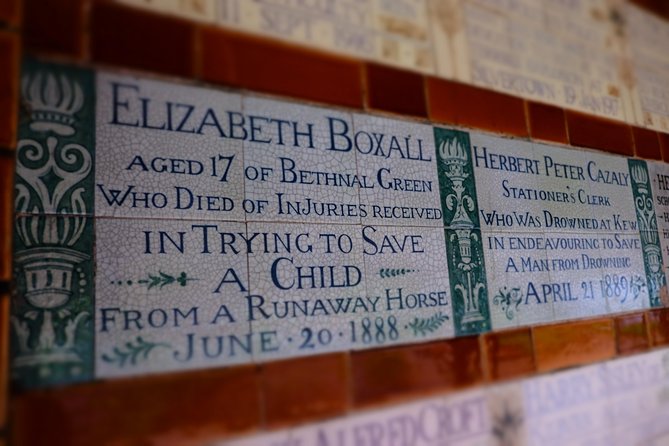
Postman’s Park and a quiet memorial to ordinary courage

Postman’s Park sits beside the former General Post Office. Postal workers used it for lunch, which gave the park its name, but the site originally served as the burial ground for St Botolph’s Church.
The purpose of the stop is a memorial to London’s unsung heroes. Rather than rushing past, you sit on a park bench while Richard explains the story behind it. That pause matters after the darker material at Smithfield Market and before the larger civic buildings ahead.
The visit lasts about 10 minutes and costs nothing. It is a small stop, but it gives the tour a human scale. The walk is filled with monarchs, authors, lawyers, bankers, and famous criminals. Postman’s Park shifts attention to people whose bravery might otherwise have disappeared from public memory.
Guildhall and the city beneath the City
Guildhall brings several periods together in one place. A Roman amphitheater once occupied this site. Saxons later built a hall where people paid taxes, and the medieval Guildhall was first recorded during the later development of the City of London.
The present building dates from around 1411, while the crypts are thought to reach back to the 13th century. Guildhall remains the historic town hall of the City of London, although daily administration now takes place in modern buildings just to the north.
The stop is brief, about 10 minutes, and admission is not included. Richard focuses on the building and on famous people who were put on trial there. You should not expect a full interior tour or a long museum visit from the published schedule. The value lies in seeing the site in context and understanding why this small district has been a center of civic power for centuries.
Bank of England and the financial heart of the Square Mile
The route then reaches the ancient heart of the City and its financial district. The Bank of England, the Royal Exchange, and the Cornhill Devils provide the main talking points.
The Bank is known as the Old Lady of Threadneedle Street, and Richard explains the nickname. The Royal Exchange also connects with Dickens, specifically the scene in A Christmas Carol where the Ghost of Christmas Yet to Come shows Scrooge’s colleagues discussing his funeral.
This stop is useful if you like the overlap between literature and real places. The financial district can look formal and modern at first glance, but the stories reveal older fears about money, death, debt, and social status.
The scheduled time is about 10 minutes. That is enough for an introduction, not a detailed tour of the Bank or Royal Exchange interiors.
George and Vulture, Dickens’s favorite chop house
The George and Vulture is presented as one of Dickens’s favorite chop houses and is mentioned more than 20 times in The Pickwick Papers. Its interior is described as little changed from Dickens’s time, and the menu still includes the food he favored.
Again, food and drinks are excluded, and the schedule allows about 10 minutes. You are there for the atmosphere and literary connection, not a full dining experience.
The surrounding courts and alleys are among the most atmospheric parts of the route. They help explain why this area supplied Dickens with so many settings and details. If you have read The Pickwick Papers or A Christmas Carol, you will get more from the stop, but Richard’s storytelling can also make the literary references accessible if you have not.
Leadenhall Market and film-ready Victorian decoration
Leadenhall Market occupies the site of a Roman crossroads and is one of London’s oldest markets. Its ornate setting has made it useful to filmmakers, including the Harry Potter films.
The market also links back to A Christmas Carol. It is associated with the scene in which Scrooge sends a boy to buy the biggest turkey on Christmas morning. That detail gives the grand market a practical, everyday role in the story.
The visit takes about 15 minutes and has no separate admission charge. You can enjoy the architecture, consider the Roman street network beneath it, and hear how the market moved from trade center to familiar literary and film setting.
Monument to the Great Fire: the walk’s fitting finish
The route ends near Monument Station, at the Monument to the Great Fire of London. The fire began nearby in 1666 and destroyed about 80 percent of the old City of London.
By the end of the walk, that event will not feel like an isolated date. You will have already seen the church damaged and rebuilt after the fire, the pub reconstructed in 1667, surviving buildings near Smithfield, and streets shaped by earlier destruction.
The Monument visit lasts about 15 minutes, and climbing the 311 steps is not included. If your legs still have energy, the climb offers views over London, but you should treat it as an optional add-on rather than part of the guided experience.
Ending here works well. The tour begins with quiet legal courtyards and ends with a monument to a city that was destroyed, rebuilt, and repeatedly altered without losing every trace of its earlier form.
Price, pace, and who gets the best value
At $267.48 per group up to one person, the cost is high for a walking tour if you are alone. It becomes more reasonable when shared by a private party, especially because the guide can tailor the route and hotel pickup and drop-off are included.
The price does not cover food, drinks, or the climb inside the Monument. There are also no major admission fees listed for most stops, with St Bride’s crypt specifically included. You are paying mainly for Richard’s time, route planning, access to unusual corners, and the ability to ask questions as you go.
The tour is best for repeat visitors, London history fans, Dickens readers, and people who have already seen the headline sights. It also suits anyone who wants a private pace instead of joining a large group.
You should be prepared for moderate walking over several hours. The route includes alleys, markets, churches, pubs, parks, and busy city streets. Tell the provider about mobility concerns in advance. Service animals are allowed, the route is near public transportation, and most people can participate, but the amount of walking remains the main practical issue.
The tour is offered in English. Confirmation arrives when you book, and free cancellation is available if you cancel at least 24 hours before the start time. If you need hotel pickup, confirm that detail because the listed meeting point is Embankment Station while the tour ends at Monument Station.
Should you book this private London history tour?
Book it if you want the London behind the grand landmarks. Richard’s route is especially strong for Dickens connections, old legal London, Roman remains, historic pubs, and the Great Fire. His ability to spend more time on your interests is a real advantage in a private setting.
Skip it if you want a light, short walk, a meal-based pub crawl, or a tour centered on royal London. The subject matter can turn grim, the walk is long, and several stops are brief. But if you are curious about the city’s overlooked corners and want stories that connect Roman Londinium with Dickens, Sherlock Holmes, medieval justice, and modern finance, this is a well-focused way to spend a morning.
FAQ
How long does the tour last?
The tour lasts approximately 3 to 4 hours.
What time does the tour start?
The stated start time is 10:00 a.m.
Where does the tour begin?
The published meeting point is Embankment Station on Embankment Place, London WC2N 6NS. The itinerary also begins around Temple Station, so confirm the exact meeting or pickup arrangement when booking.
Where does the tour end?
The tour ends at Monument Station on King William Street, London EC4R 9AA.
Is hotel pickup included?
Yes. Hotel pickup and drop-off from your London hotel are included, though you should confirm the arrangements because a station meeting point is also provided.
Is this a private tour?
Yes. Only your group participates in the activity.
What language is the tour offered in?
The tour is offered in English.
Are food and drinks included?
No. Food and drinks are not included in the price.
Can I climb the Monument to the Great Fire?
You can climb the Monument’s 311 steps after the guided tour if you still have energy, but the climb is not included in the tour.
Recently added around London
- London’s Crown Secret: Self-Guided Royal Puzzle Quest★ 4.5 · 8 reviews
- Postcard London★ 5.0 · 8 reviews
- Private Tour: Downton Abbey London Locations by Taxi★ 5.0 · 8 reviews
- Windsor Castle, Stonehenge & Roman Baths Private Tour★ 4.5 · 8 reviews
- Cotswolds Private Driving Tour from London★ 5.0 · 8 reviews
- Skip-the-line London Westminster Abbey and City of Westminster Kid-Friendly Tour★ 5.0 · 8 reviews
- A Silent Disco Adventure in London★ 5.0 · 8 reviews
- Gangster Tour of Soho★ 4.5 · 8 reviews
Historical Tours, compared.

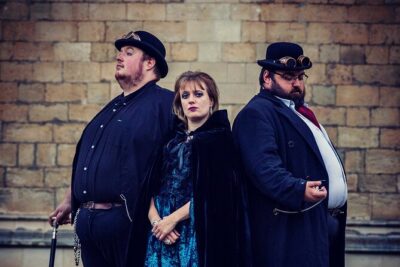
Shadows of York: Ghost Walk and Horrible History.
Read our review →
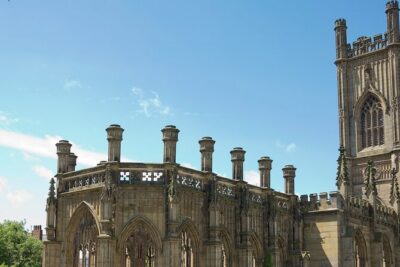
A Walk Through Time: History of Liverpool Walking Tour
Read our review →
Royal Historic Pubs Walking Guided Tour in London
Read our review →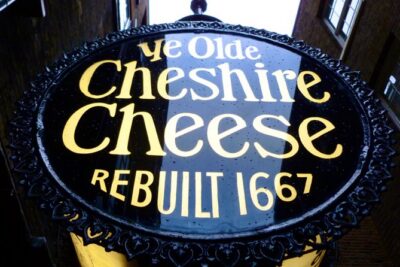
Private Group: Historical Pub Walking Tour of London
Read our review →
Best Of Liverpool Heritage, History & Culture Guided Walking Tour
Read our review →Browse the lists this tour appears in