
Reviewed · YORK TOURS
Private York Self-Guided Tour
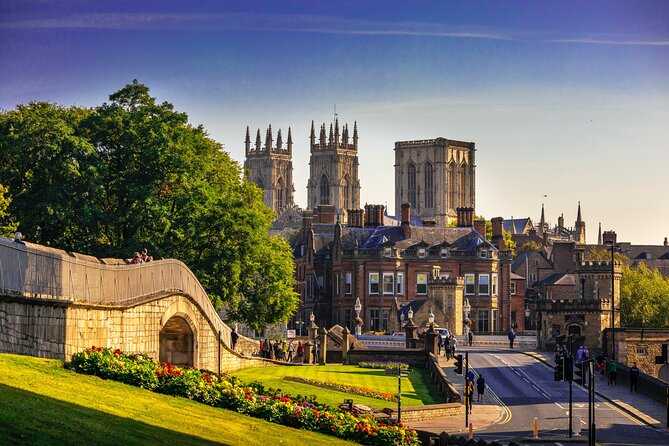
York’s story is packed into a walk of manageable length, from the great stonework of York Minster to the crooked timber buildings of the Shambles. Jenny’s recorded narration gives you the background as you move, with no guide, group, or fixed departure time to manage.
I like the three-week access period, which lets you split the route over several visits, and I like the low price of $12.33 per person. The main caution is the app itself: some people have found navigation or audio playback difficult, so download and test everything before setting out.
Key points at a glance
- Roman York in plain sight: See the Roman Column, the Multangular Tower, and the remains linked to Eboracum.
- A flexible route: Walk it in two to three hours, pause often, or break it into smaller sections during your three weeks of access.
- Jenny’s human narration: The audio guide is recorded by a real voice, not computer-generated speech.
- York’s best-known streets and sights: The route includes York Minster, High Petergate, the city walls, Museum Gardens, the Shambles, and Clifford’s Tower.
- Mostly free outdoor stops: You do not need entrance tickets for most points, though York Minster and the Shrine of Saint Margaret Clitherow are not included.
- A useful but imperfect app: GPS directions, maps, pictures, videos, and extra recommendations are included, but phone battery and app reliability deserve attention.
A self-guided walk through York’s long story
This experience follows a sensible northbound route through central York. You begin at 6 Minster Yard, beside York Minster, and finish at Clifford’s Tower. The route is private in the simplest sense: only your group uses the app, and there is no guide waiting for other people to arrive.
The advertised walking time is about two to three hours. That estimate covers the main stops, but you control the pace. You can pause the narration, linger in the gardens, walk farther along the walls, or split the route into shorter outings. That flexibility is the main reason to choose this format over a scheduled walking tour.
At $12.33 per person, the price is modest for a city introduction. You are paying for the route, narration, map, and background rather than for admission to York’s major sights. It is good value if you want orientation and stories, but less useful if you prefer a person who can answer questions as you walk.
More self guided walks in York:
- Golden Tours York Hop-on Hop-off Open Top Bus Tour with Audio Guide
★ 4.5 · 468 reviews - Romans, Vikings and Medieval York: An Audio Tour
★ 4.5 · 118 reviews - History and Hauntings Self Guided Walking Tour in York with App
★ 4.0 · 19 reviews
Beginning beneath the towers of York Minster
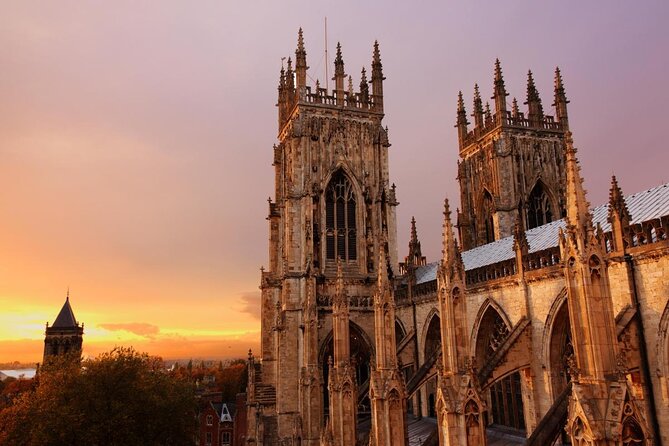
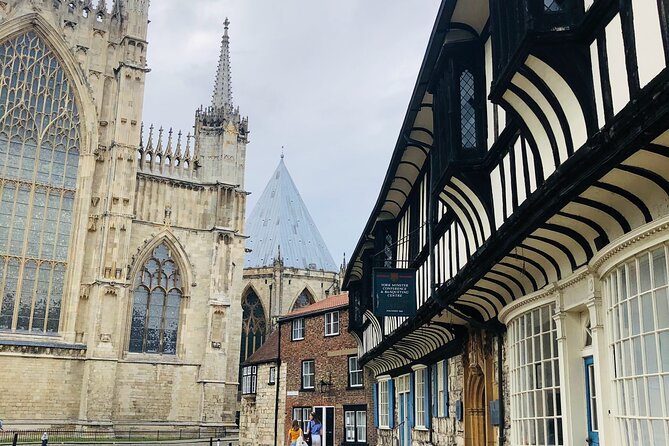
The tour opens at York Minster, the Cathedral and Metropolitical Church of Saint Peter. This is the right place to start. Its scale immediately explains why York mattered as a religious and political centre in northern England.
The narration covers the cathedral, its surroundings, and the role of the Archbishop of York. You get about ten minutes of commentary here, enough to set the scene without turning the opening into a long lecture.
The admission fee is not included. You can enjoy the outside and continue with the route, or pay separately if you want to enter. That distinction matters when comparing this with a paid walking tour that might include more indoor explanation. If you want to visit the Minster, check its own admission arrangements before arriving.
The start point is easy to reach in central York and sits near public transport. You should activate the app before you begin, then check that the map, audio, and directions work while you still have a reliable connection.
Roman York around the Roman Column
York began as Eboracum, a Roman fort founded in AD 71 by Quintus Petillius Cerialis of the Ninth Legion. The fort occupied level ground near the meeting point of the River Ouse and River Foss, a location that helped make York useful for military control and trade.
The Roman Column is a small surviving clue to that much larger settlement. Do not expect a full Roman site here. The value comes from learning how to read the scattered remains around the modern city.
The ten-minute stop is free and works well as a quick history lesson. The narration helps connect an isolated stone column with the former fortress around it. That context is useful because York’s Roman past can otherwise be easy to miss among the medieval streets and later buildings.
The Liberty of St Peter and York’s medieval power
One part of the route concerns the old boundaries of St Peter’s Church and the area once called the Liberty of St Peter. This was effectively a small city within the city, controlled by the church rather than by York’s mayor.
The stop gives you a look at medieval power from a social angle. It is not only a story about buildings. It is about who made rules, who answered to whom, and how religious institutions shaped daily life across York.
This section is especially helpful if you like local detail rather than a simple parade of famous sights. The route information does not assign a separate number or exact time to this stop, so allow a few extra minutes if the subject catches your interest.
A few more York half days worth a look
- Mad Alice’s The Bloody Tour of York -Best Tour Award Europe
★ 5.0 · 2,749 reviews - Ghost Bus Tour of York
★ 4.5 · 2,404 reviews - Shadows of York: Ghost Walk and Horrible History.
★ 5.0 · 1,403 reviews - Private Historical Walking Tour of York
★ 5.0 · 1,324 reviews
Guy Fawkes at St Michael le Belfrey
At St Michael le Belfrey, you hear about the only remaining sixteenth-century church in York and the largest pre-Reformation parish church in the city. The church is also linked to Guy Fawkes, who was baptised here on 16 April 1570.
That connection gives the stop a memorable human hook. The familiar 5 November story becomes tied to a real York address and a specific church, rather than remaining a distant national tale.
The stop lasts around ten minutes and is free. You should treat the recorded information as the main experience here, since this is a self-guided outdoor route rather than a church tour with guaranteed interior access.
High Petergate, medieval traffic, and a haunted house
High Petergate follows the line of the Roman Via Principalis, the main east-west road through the Roman fortress. Later, it became the medieval route into York from the north, running between Bootham Bar and Stonegate.
Look up as you walk. Medieval timber-framed buildings share the street with Georgian structures and buildings from later periods. The mix gives you a quick lesson in how York changed without losing every trace of its earlier form.
The formal stop lasts about fifteen minutes, but the street rewards a slower pace. The narration also points out Petergate House, a Grade II listed building associated with Sir Thomas Herbert, a historian and groom of the bedchamber to Charles I. You also get a local ghost story, which adds a lighter note to the political and architectural material.
This is one of the places where the app’s map matters. High Petergate has plenty to look at, and it is easy to walk past a detail while trying to follow directions on a small screen. Listen first, then put the phone away when you can.
Bootham Bar and York’s defensive walls
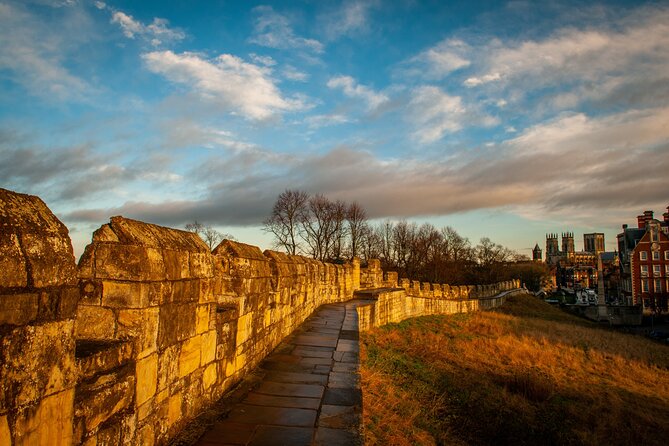
At the end of Petergate, Bootham Bar marks one of York’s historic entrances. The route connects the gate with the Roman fortress and explains why it survived as a major point of entry.
From here, the tour turns to York City Walls. York has more miles of intact city wall than any other city in England, and the walls are known by several names, including the Bar Walls and Roman walls.
The audio gives recommendations on where to join the wall walk, then leaves the choice to you. This is a smart design decision. A fixed fifteen-minute stop would not do justice to the wall, while an open-ended section lets you decide how far you want to go.
You should allow extra time here if the weather is good and you want to walk farther. The route’s two to three hour estimate includes an introduction, not every possible section of wall. The walls are free, but surfaces and steps may require care. The provided information says most people can take part, but it does not give detailed surface or step guidance, so plan according to your own needs.
The Multangular Tower and the edge of Roman York
The Multangular Tower occupies the western corner of the Roman fortress. It rises about nine metres and includes both Roman and medieval stonework.
The stop itself is short, about five minutes. That is enough for the main facts and a look at the remains. Its appeal lies in the layers: Roman military construction was altered and reused during the medieval period.
You may find this stop more satisfying after hearing about Eboracum earlier in the route. The audio builds a chain between the Roman Column, the fortress walls, and this corner tower. York’s ancient past is not confined to one museum display. It appears in fragments across the centre.
Museum Gardens and the ruins of St Mary’s Abbey
The ten-acre Museum Gardens offer a change of pace after the streets and walls. The gardens surround the Yorkshire Museum and contain trees, shrubs, perennial plants, and bulbs. The route allows about twenty minutes here, making it one of the longer stops.
The gardens occupy the former grounds of St Mary’s Abbey, a Benedictine foundation with origins reaching back to 1086. Alan Rufus, a relative of William the Conqueror and Count of Brittany, granted the site to Stephen of Whitby.
You hear about the abbey remains and the Roman fort’s west corner. You also learn about the Roman Anglian Tower at the next stop, St Mary’s Abbey. Together, these sections make the gardens more than a pleasant green pause. They show Roman, Anglo-Saxon, medieval, and later York in one setting.
The gardens are free to enter, according to the tour information. You can take your time here without worrying about a guide moving the group along. That is one of the strongest benefits of self-guided touring. If you want to stop for photos or simply sit for a few minutes, the route can wait.
The Shambles, butchery, and Saint Margaret Clitherow
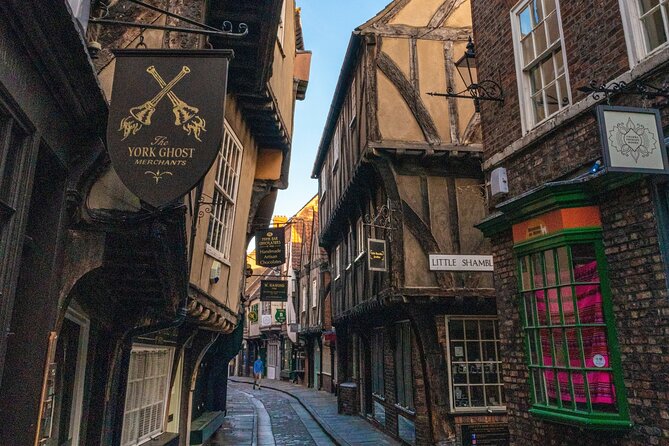
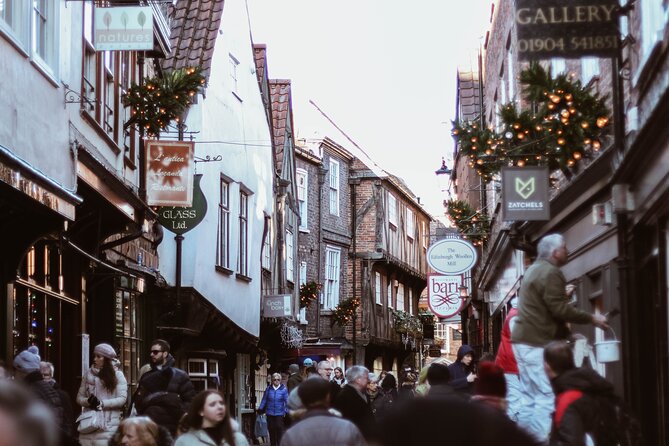
The Shambles is York’s most instantly recognisable street, with overhanging timber-framed buildings, some dating from the fourteenth century. Its older name, the Great Flesh Shambles, recalls the butcher shops that once displayed meat along the street.
The fifteen-minute stop uses the street to sort fact from modern fantasy, including its connection with Harry Potter. The crooked buildings certainly look suited to a storybook setting, but the real past is more grounded in trade, food, and crowded medieval town life.
Expect the Shambles to be one of the hardest sections for phone navigation. The street is visually busy, and you will get more from it if you listen to the audio in a safe spot, then look around instead of staring down at the screen.
The route also visits the Shrine of Saint Margaret Clitherow. She was an English saint and Roman Catholic martyr, married to a butcher who owned and lived in a shop on the street. Her former home is thought to have been No. 10 Shambles.
This stop takes about ten minutes. Admission is not included, so check separately if you wish to enter. Even without going inside, the story gives the street a serious historical layer beyond its picturesque appearance.
Viking York and the meaning of Jórvík
The tour then turns to Viking York, known to historians as Jórvík during the period when York was dominated by Scandinavian rulers in the late ninth and first half of the tenth century.
This part helps prevent a common mistake: treating York as only Roman or medieval English. The city’s identity was shaped by several ruling cultures, and the Viking period was central to its development.
The audio includes stories of three famous Vikings linked with the city, including Ragnar. The material is presented as a bonus section rather than a timed numbered stop, so you can take a little longer if Viking history is a main reason for visiting York.
For a short city walk, this range is a real strength. You move from Roman military planning to church authority, medieval commerce, Catholic persecution, and Scandinavian rule without needing several separate tours.
Ending at Clifford’s Tower
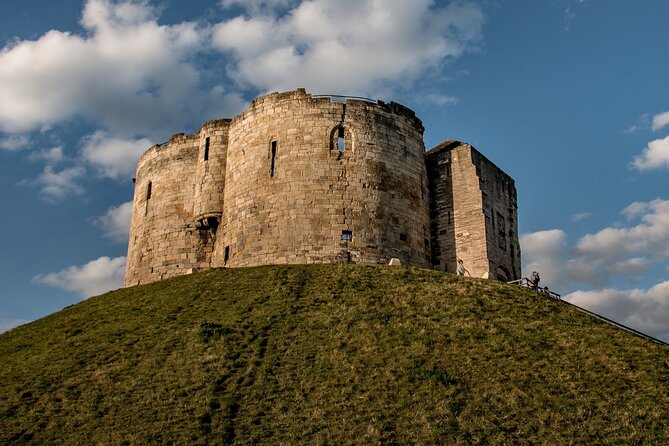
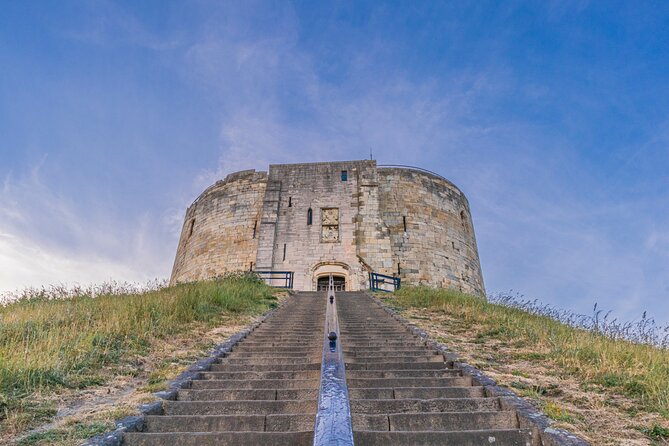
The walk finishes at Clifford’s Tower, the largest remaining part of York Castle. The tower once formed part of the centre of government for northern England and remains one of York’s best-known landmarks.
The planned commentary lasts about fifteen minutes. It explains the castle’s past and its relationship with the people of York, then adds practical suggestions about places to go, eat, and spend time in the city.
The tour information marks admission here as free, but it also says entrance fees for attractions are not included. In practice, you should treat the audio stop and exterior visit as included, and check separately if you want to enter any attraction along the route.
Ending here works well because Clifford’s Tower sits in a different part of York from the Minster Quarter. You finish with a major symbol of royal government and the city’s contested past, rather than simply returning to the starting point.
How the app works in real use
The app includes a map, GPS route, directions, stop markers, pictures, videos, recommendations, and recorded audio by Jenny. The narration is not computer-generated, which gives the tour a more natural feel.
You receive an email with activation instructions. The booking reference is not the activation code, so read the instructions carefully. Once activated, the tour remains available for three weeks with unlimited access.
That access window is valuable. You can do the Minster, Roman Column, and High Petergate one day, then return for the walls, Museum Gardens, Shambles, and Clifford’s Tower. You can also pause whenever a shop, meal, or museum catches your eye.
The weak point is technical reliability. Some users had trouble with navigation, while others had audio that cut off after a few seconds. Technical problems were also addressed quickly in individual cases, including a refund when the app could not be used, but a refund does not repair a spoiled afternoon.
Bring a charged phone and keep the app updated. If you want to reduce screen time, start the audio at each stop, then lock the phone or keep it in your pocket while you look around. The recordings are short enough to support this approach.
Who gets the best value from this York walk
I would choose this tour if you want a low-cost introduction to central York and prefer to set your own pace. It suits couples, families, and small groups who do not want to join a scheduled walk.
It is also useful for a short stay. The route covers many of the city’s major outdoor sights in one compact outing, and you can return to any section during the three-week access period.
You may prefer a live guide if you want questions answered on the spot, detailed local conversation, or help adjusting the route. You should also think twice if you dislike using your phone while sightseeing or if unreliable apps make you anxious.
The tour is offered in English only. Service animals are allowed, the route is near public transport, and the information says most people can participate. No separate accessibility details are supplied, so contact the provider before booking if steps, uneven surfaces, or wall access are important to you.
Should you book the Private York Self-Guided Tour?
Book it if you want flexibility, low cost, and a broad sweep of York’s past. The strongest parts are the route design, Jenny’s recorded narration, the free outdoor sights, and the chance to return within three weeks.
Skip it if you need a dependable in-person guide or dislike troubleshooting an app. The technical record is mixed, and the non-refundable booking policy means you should be comfortable with that risk before paying.
For $12.33, this is a useful orientation walk rather than a full replacement for paid attraction visits or a live historical tour. Test the app early, charge your phone, and treat the route as a framework rather than a race. Done that way, you get a smart introduction to York’s Roman ruins, church power, Viking past, medieval streets, and castle remains.
FAQ
How long does the York self-guided tour take?
The route takes approximately two to three hours, depending on how long you spend at each stop and whether you walk extra sections of the city walls.
Where does the tour start and finish?
It starts at 6 Minster Yard, York YO1 7JD, near York Minster, and finishes at Clifford’s Tower on Tower Street.
How long can I use the app?
After activation, you receive unlimited access to the self-guided tour for three weeks.
Is there an in-person guide?
No. This is a self-guided experience using Jenny’s recorded audio narration, maps, GPS directions, pictures, videos, and recommendations.
Are attraction admission fees included?
No. Entrance fees are not included. York Minster and the Shrine of Saint Margaret Clitherow are specifically marked as having admission not included, while most outdoor stops are free.
What language is the tour offered in?
The tour is offered in English.
Recently added around York
- York 3-Hour Photography Walking Tour★ 5.0 · 9 reviews
- Guided Historic Pub Tour (York)★ 4.5 · 11 reviews
- Full-Day Heartbeat Locations Tour from York★ 3.5 · 11 reviews
- Private Roman Tour of York★ 5.0 · 14 reviews
- Whitby, Robin Hood’s Bay and the Moors from York★ 5.0 · 18 reviews
- Lake District from York★ 5.0 · 19 reviews
- History and Hauntings Self Guided Walking Tour in York with App★ 4.0 · 19 reviews
- The Treasures of Bloodaxe – A Fun Viking Treasure Hunt in York★ 4.5 · 21 reviews
York Tours, compared.

Mad Alice’s The Bloody Tour of York -Best Tour Award Europe
Read our review →
Shadows of York: Ghost Walk and Horrible History.
Read our review →


Wizard Walk of York – WINNER Best Tour & Best of York Award
Read our review →
Browse the lists this tour appears in