
Reviewed · CITY TOURS
Secret Gardens of the City of London Private Tour
The best thing about this tour is its fresh view of the City of London. Instead of simply ticking off St. Paul’s Cathedral and the Tower, you follow a chain of small gardens, churchyards, ruins, and lanes that most sightseeing routes skip. The stories range from Roman London and the Great Fire to Samuel Pepys, Shakespeare, the Blitz, and the campaign to end the slave trade.
I especially like the private format, which lets your guide adjust the pace and follow your interests. I also like the mix of quiet green spaces and big historical landmarks, including St. Dunstan in the East, Postman’s Park, and the Roman amphitheatre beneath Guildhall. The main caution is the title: these are public City gardens, not private gardens behind locked gates. If you want plants and history in equal measure, this works well. If you expect elaborate botanical displays, it may not.
Key points to know before you book
- Twenty-five stops in about three hours: The route moves quickly, with many gardens receiving only five minutes.
- A private guide shapes the experience: Stephen and Kevin are praised for strong storytelling, warmth, and a deep grasp of London’s past.
- The gardens are public spaces: Their secret quality comes from their location and history, not private access.
- The route links major stories: You will connect Roman ruins, medieval churches, the Great Fire, World War II, and modern London.
- Hotel pickup is available: Your guide can meet you at a Central London hotel, then accompany you by Tube to St. Paul’s.
- Expect a city walk: Smart casual clothing and moderate fitness are sensible, with transport costs not included.
Why this City of London walk feels different
The City of London is London’s oldest core and its modern financial center. That mix creates a strange and rewarding setting. Glass towers rise over medieval lanes. A garden may occupy an old churchyard, while Roman walls sit beside office buildings. You can hear traffic one moment, then step into a quiet square with only trees, stone, and a church tower in view.
This tour makes those contrasts the point. You are not walking through one large park. You are moving from one small green space to another, learning why each exists and what stood there before. Several gardens occupy former burial grounds or bomb-damaged church sites, so the plants are only part of the story.
The route begins at Caffè Nero on Newgate Street, near Paternoster Square and St. Paul’s Cathedral, at 9:30 a.m. If you arrange hotel pickup, the guide can meet you at any Central London hotel, not only a fixed list of properties, and go with you by Tube to the starting point. The operator also suggests a later start around 10:30 or 11 a.m. to avoid the rush hour. Confirm the practical details when booking, since the stated meeting point remains the clearest fixed location.
A few more London half days worth a look
- Stonehenge, Windsor Castle, and Bath from London
★ 4.5 · 18,662 reviews - London Big Bus Hop-On Hop-Off Tour with Optional River Cruise
★ 3.5 · 10,803 reviews - London Small Group Tour of Historical Pubs
★ 5.0 · 10,422 reviews
From St. Paul’s to the first quiet gardens
You begin beneath St. Paul’s Cathedral, one of London’s great landmarks. The cathedral itself is not included as an admission visit, so this is an exterior starting point rather than a cathedral tour. It gives you a useful sense of scale before the route turns toward smaller spaces.
St. Paul’s Churchyard is the first garden stop. Its planted paths and open views provide a calm frame for the cathedral. From there, Festival Gardens adds a short burst of color, with St. Paul’s still providing the backdrop. These first stops are brief, but they establish the pattern: the guide helps you notice small spaces that are easy to pass without understanding.
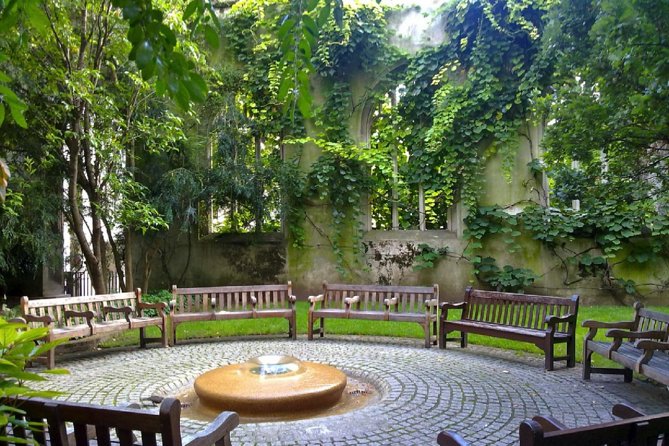
The Reflection Garden was redeveloped during the Covid period. Its water feature and view make it one of the route’s more recent additions. Distaff Lane Garden is shadier, with silver birch and another water feature. These are not grand formal gardens, so allow yourself to enjoy them as pauses in the walk rather than major attractions requiring long visits.
Cleary Garden has Italian inspiration, linked to Roman remains beneath the area. That connection between planting and archaeology is typical of the tour. Whittington Garden honors Dick Whittington, one of London’s famous lord mayors, and links the garden to the nearby church he helped build.
St. Swithin London Stone Church Garden is almost concealed from the main flow of the City. It has a Welsh theme and a sad story behind it. This is the sort of stop where the guide’s explanation matters more than the size of the garden. Without context, you might simply see a small planted enclosure. With context, it becomes part of London’s long record of faith, migration, loss, and rebuilding.
Great Fire monuments and the ruin at St. Dunstan
The Monument to the Great Fire of London gives the route one of its most recognizable landmarks. The visit is brief and does not include admission, but the column connects the surrounding streets to the 1666 fire that reshaped much of the City.
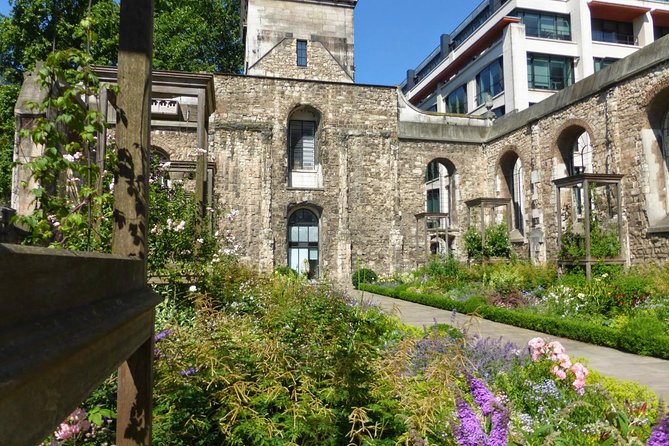
St. Dunstan in the East is one of the major stops. The old church survives as a roofless ruin, with greenery growing through the stonework. It is a striking place, and admission is included. The setting offers a sharp reminder that London’s past is not always preserved as a polished museum display. Sometimes the most moving places are broken, open to the sky, and still in use as a public garden.
The route then reaches Seething Lane Garden, once associated with Samuel Pepys. Decorative stones illustrate episodes from the life of the famous diarist. If you have read Pepys, this stop adds a physical setting to his world. If you have not, the guide’s stories help explain why his record of London remains so important.
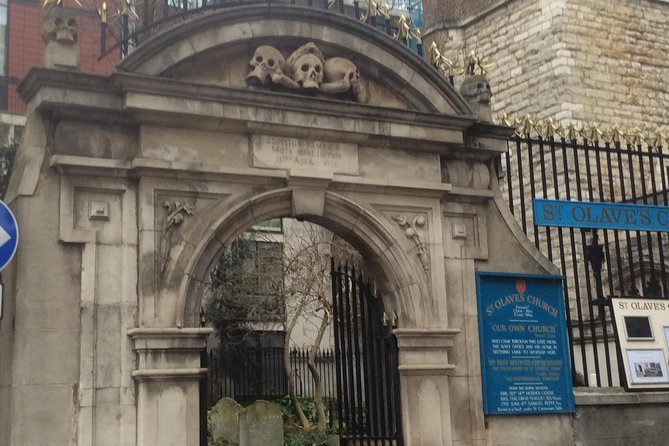
St. Olave’s Church and garden bring in the Great Fire, plague, and two world wars. The church has survived repeated shocks, making it a useful place to consider how much of the City has been destroyed and rebuilt. The tour does not treat London as a single preserved old town. It shows you a place repeatedly altered by disaster.
At All Hallows Staining Church Tower, the garden is being redeveloped, so the visit may feel less finished than other stops. Its deeper interest is the reason the garden exists, tied to a dark episode from centuries ago. This is a good example of the tour’s approach: not every stop is a picture-perfect garden, but each has a story that changes how you see the site.
Views from Garden at 120
Garden at 120 is one of the route’s most useful orientation points. This modern sky garden offers a view over the places you have already visited and the parts of the City still ahead. Admission is free, but access is not guaranteed on every visit because the garden has a capacity of 207 people. The operator says entry has generally been possible, though rare capacity issues can occur.
The fifteen-minute visit is longer than most garden stops, and that makes sense. After moving through lanes and churchyards at street level, you get a chance to understand the City as a whole. The view also helps you connect old church towers with the new high-rise skyline.
Hogarth Court adds a more modern and serious note. Its garden includes a poignant artwork about the slave trade, located where two men campaigned for its abolition. This is a valuable stop because it places London’s commercial power beside the moral arguments that challenged it.
Leadenhall Market follows with a very different mood. Its Victorian structure was built above a Roman market, and its ornate appearance has made it recognizable in films and television. The visit is short, so think of it as an architectural glimpse rather than time for a full market exploration.
A completely different sort of day out in London:
- Stonehenge, Windsor Castle and Bath with Pub Lunch in Lacock
★ 4.5 · 7,402 reviews - Tower of London and Crown Jewels Exhibition Ticket
★ 4.5 · 6,677 reviews - Thorpe Park Admission Ticket
★ 4.0 · 5,915 reviews - Stonehenge, Windsor Castle and Bath Full Day Guided Tour
★ 4.5 · 5,346 reviews
Cornhill, old churches, and a Roman arena
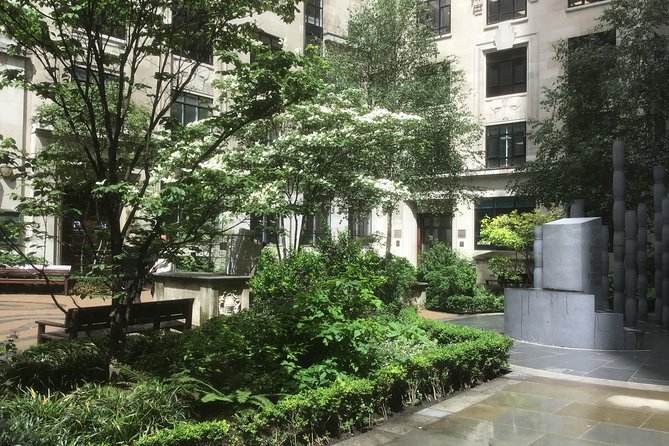
The gardens at St. Peter-upon-Cornhill are relatively plain, but the churchyard contains a grave possibly linked to one of the most famous names in English literature. The exact interest here lies in the setting: ancient lanes, old religious sites, and modern buildings occupy the same small area.
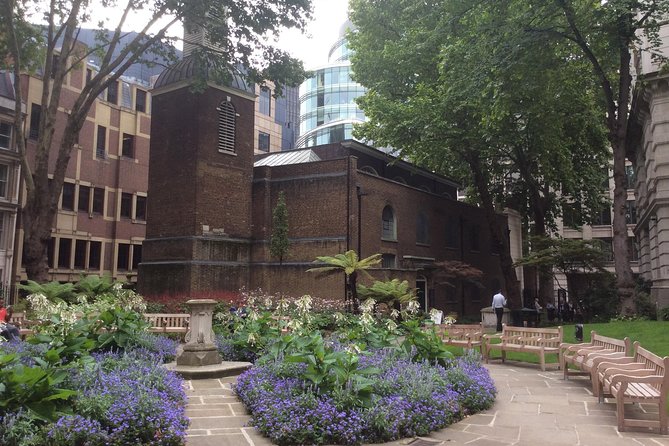
St. Michael’s Cornhill is tucked into medieval passageways where cars and other vehicles cannot reach the garden. It is a sheltered sun trap surrounded by old churches, pubs, and the oldest coffee shop. This is one of the places where the tour’s route planning pays off. You are not merely being shown a garden, you are being led through the lanes that make the City feel unlike the rest of central London.
Guildhall brings the Roman story into clear focus. You stand above the old Roman amphitheatre, with admission included. The stop helps explain why the City’s street plan and archaeological remains matter, even when modern offices dominate the view.
St. Lawrence Jewry is a small space in the heart of London’s old Jewish district. Much of the church was rebuilt after World War II, so it continues the theme of survival and reconstruction. The Churchyard of St John Zachary is sunken and has both ancient and more recent history. These two stops are not grand attractions on their own, but together they show how much of London’s past survives in fragments.
Noble Street is especially unusual because its gardens contain remains of the Roman city wall, uncovered during World War II. This is the kind of discovery that gives the walk its value. You are seeing archaeology not in an isolated exhibit, but woven into an ordinary urban route.
Shakespeare, Churchill, and the everyday heroes of Postman’s Park
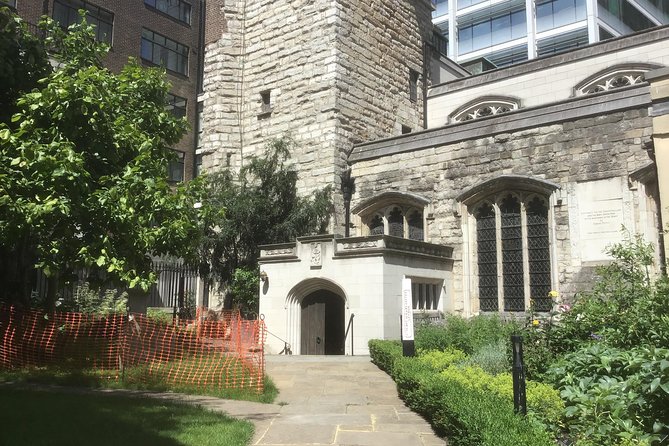
St Mary Aldermanbury Garden carries associations with William Shakespeare and Sir Winston Churchill. Admission is included, and the ten-minute stop gives the guide room to explain how the church and garden connect with major figures from English culture and politics.
At St Mary Staining, an old tree takes the main role. Modern architecture surrounds it, creating another of those small City contrasts that the tour handles well. The stop is short, but it offers a visual pause before the final visit.
Postman’s Park is one of the most affecting places on the route. Its memorial honors ordinary people who died while saving others. The park is not famous for grand buildings or sweeping views. Its power comes from the names and brief accounts on the memorial tiles.
Guide Stephen has written a book about Postman’s Park and has a particular connection to the memorial. That makes this portion worth extra attention if you care about social history and personal stories. It is also a good reason to ask questions rather than simply take a quick photograph and move on.
The tour ends back at the meeting point after roughly three hours. The supplied route includes 25 stops, but the timing tells you what to expect: most visits last five minutes, with a few receiving ten or fifteen. You will see a lot, but you will not have long, unstructured time in every garden.
The guides make the route work
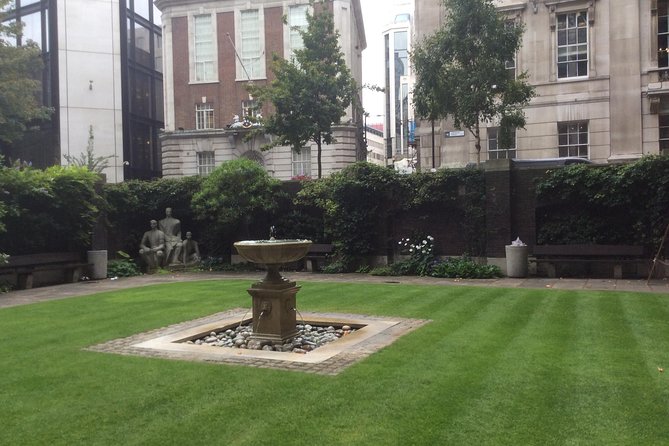
The strongest part of this experience is the guiding. Stephen and Kevin are repeatedly praised for making the City’s stories clear and lively. They are described as personable, attentive, and eager to share London’s past, with Stephen also holding the honor of Freeman of the City of London.
That matters here because many stops are small. A garden may not justify a long visit on its appearance alone. The guide supplies the reason to care, explaining the people, events, ruins, and religious communities connected with it.
A private tour also allows some adjustment. If you are more interested in architecture, churches, Roman London, or social history, tell your guide early. One particularly useful detail from the feedback is the request for a card or written list naming each garden. That would help you remember the sequence later, so ask for a list if you want to retrace the route or identify photographs.
Is $260.51 per person good value?
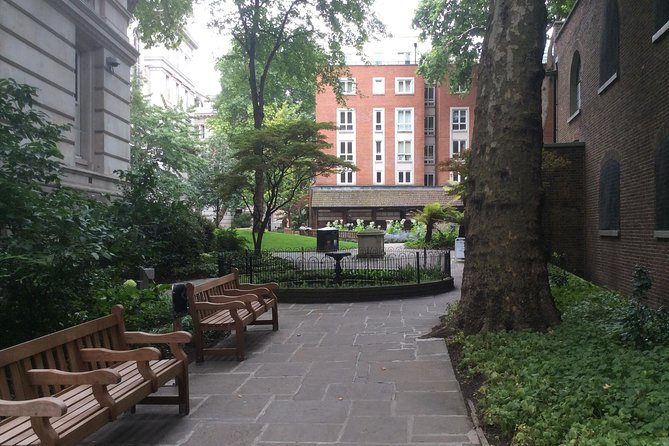
At $260.51 per person, this is not a budget walking tour. Its value depends heavily on group size. For a couple or family who wants a private guide and a tailored pace, the cost buys personal attention across three hours. Group discounts may improve the calculation for a larger party.
You are also paying for route design and interpretation. The gardens themselves are free in most cases, and several church or landmark visits require no admission. The price is therefore not about entry tickets. It is about getting someone to connect 25 scattered places into one understandable story.
Transportation to and from attractions is not included. Hotel pickup is included as a guiding service, but the Tube journey to St. Paul’s and any other transport costs are yours. This is worth factoring in when comparing prices.
The tour is booked an average of 44 days ahead, so it is sensible to reserve early if your dates are fixed. Free cancellation is available up to 24 hours before the start time. Poor weather can also lead to a new date or a full refund, according to the stated policy.
Who will enjoy this walk most?
I would choose this tour if you have already seen London’s headline sights and want a different side of the City. It also suits a first-time visitor who prefers stories, lanes, and small historic places to a packed list of major museums.
It is a good match for:
- Repeat London visitors who want places beyond the usual route
- History fans interested in Roman London, the Great Fire, churches, war damage, and social reform
- Families or couples who value a private guide
- Photographers looking for quiet corners and unusual views
- People who enjoy walking at a steady pace and asking questions
I would hesitate if your main goal is formal horticulture. The gardens are generally small, city-maintained spaces, and some plantings may feel similar. You also need moderate physical fitness, since the experience involves a substantial urban walk with repeated stops.
Smart casual clothing is requested. Service animals are allowed, and the route is near public transportation. The tour is offered in English.
Should you book Secret Gardens of the City of London?
Book it if the phrase secret gardens means small public spaces with overlooked stories. You will see St. Dunstan in the East, Roman walls, a sky garden, old churchyards, Postman’s Park, and places tied to Pepys, Shakespeare, Churchill, and the Great Fire. The guide is the real key, with Stephen and Kevin bringing the route to life through personal attention and detailed storytelling.
Skip it if you expect access to private residential gardens or a long botanical tour. The title can create that misunderstanding, but the experience is a private tour of public City gardens, not a tour of private gardens.
For the best value, bring an interested mind, wear comfortable shoes, and ask for a written list of the gardens you visit. If the idea of finding London’s past in small, easy-to-miss spaces appeals to you, this is an unusual and worthwhile way to spend a morning.
FAQ
How long does the Secret Gardens of the City of London tour last?
The tour lasts approximately three hours.
Where does the tour start?
The stated meeting point is Caffè Nero at 30 Newgate Street, Paternoster Square, near St. Paul’s Cathedral, London EC4M 8AD.
What time does the tour start?
The listed start time is 9:30 a.m. A later start around 10:30 or 11 a.m. may be suggested to avoid rush hour.
Is hotel pickup available?
Yes. The guide can meet you at any Central London hotel, then go with you by Tube to the starting point near St. Paul’s.
Is transportation included?
Transportation to and from the attractions is not included. If you use the Tube or another service, those costs are separate.
Is this a private tour?
Yes. Only your group and the guide participate.
Are admission tickets included?
Admission is included at some locations, including St. Dunstan in the East, Guildhall, St. Lawrence Jewry, Churchyard of St John Zachary, St Mary Aldermanbury Garden, and Postman’s Park. Several other stops are free or viewed from outside, while St. Paul’s Cathedral and the Monument do not include admission.
What happens if the weather is poor?
The experience requires good weather. If it is canceled because of poor weather, you will be offered another date or a full refund. You can also cancel for a full refund up to 24 hours before the start time.
Recently added around London
- London’s Crown Secret: Self-Guided Royal Puzzle Quest★ 4.5 · 8 reviews
- Postcard London★ 5.0 · 8 reviews
- Windsor Castle, Stonehenge & Roman Baths Private Tour★ 4.5 · 8 reviews
- Private Tour: Downton Abbey London Locations by Taxi★ 5.0 · 8 reviews
- Cotswolds Private Driving Tour from London★ 5.0 · 8 reviews
- Skip-the-line London Westminster Abbey and City of Westminster Kid-Friendly Tour★ 5.0 · 8 reviews
- A Silent Disco Adventure in London★ 5.0 · 8 reviews
- Gangster Tour of Soho★ 4.5 · 8 reviews
City Tours, compared.


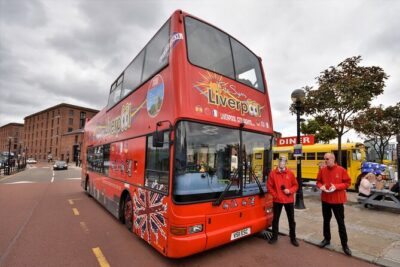
Liverpool City Sights Hop On Hop Off City Tour – 24hr Ticket
Read our review →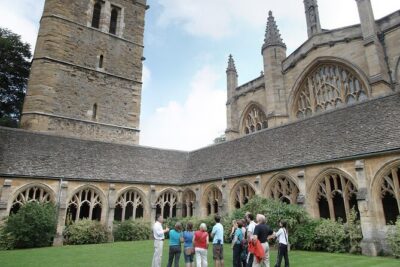
1.5-hour Oxford City and University Walking Tour
Read our review →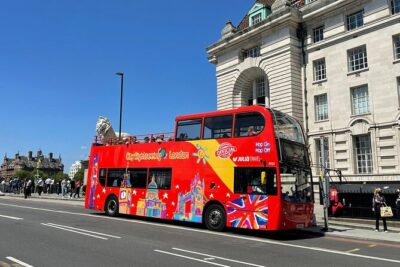
City Sightseeing London Hop-On Hop-Off Bus Tour & Bookable Extras
Read our review →

City Sightseeing Oxford Hop-On Hop-Off Bus Tour
Read our review →
Browse the lists this tour appears in