
Reviewed · CANTERBURY TOURS
The Canterbury Classic Tour
Canterbury’s best stories hide in plain sight: a former city gate that became a prison, a clock tower in a shopping street, and a dove flying into Pope Gregory the Great’s ear. This 90-minute walking tour connects those odd details with the bigger story of Roman, medieval, Tudor, and modern Canterbury.
I like the small cap of 10 people, which gives you room to ask questions and hear Sam clearly. I also like the mix of famous sights and less obvious details, from Chaucer and Thomas Becket to the city’s coat of arms and the surprising history beneath ordinary shopfronts.
The main consideration is that this is an outdoor walking tour with short stops rather than a full visit inside Canterbury Cathedral or the museums. Most points are viewed from outside, and admission to Westgate Towers and other paid attractions is not included.
Key points about the Canterbury Classic Tour
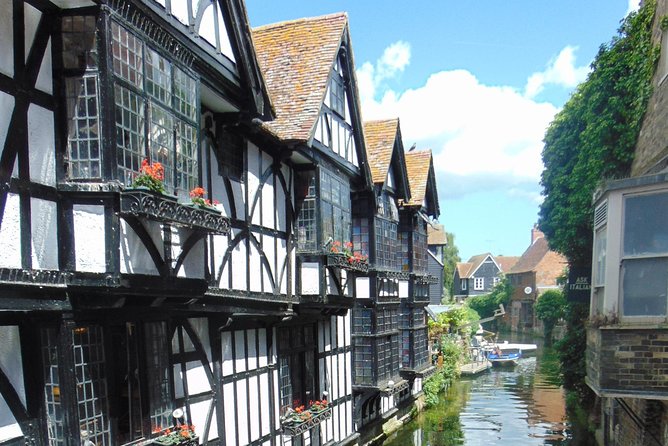
- Small groups of up to 10: You get a better chance to ask Sam questions and follow the stories without being lost in a crowd.
- A compact city-center route: The walk starts at the Beaney House and ends beneath St George’s Tower, covering central Canterbury on foot.
- Stories beyond the standard sights: Expect Chaucer, Christopher Marlowe, Thomas Becket, Roman Canterbury, odd architectural details, and local legends.
- A good first-day introduction: The tour helps you decide which museums, gardens, cathedral areas, and city walls deserve more of your time.
- Family-friendly storytelling: Sam has kept children aged 6 and 11 involved, and teenagers have also enjoyed the pace and humor.
- Good value at $19.44: For roughly an hour and a half with an accredited guide, the price is modest, especially if you use the tour to plan the rest of your visit.
Why this short Canterbury walk works
I like this tour because it treats Canterbury as more than a cathedral stop. The city’s major religious story matters, of course, but the walk also brings in writers, Roman streets, wartime discoveries, old defenses, art, architecture, and small details you could easily pass without noticing.
Sam is the guide named for this experience, and the strongest praise centers on his delivery. You can expect a relaxed, friendly style with plenty of facts, anecdotes, and humor rather than a dry list of dates.
That matters in Canterbury. The city can feel visually compact, yet its past reaches from the Roman period to the Second World War and beyond. A good guide gives you a thread to follow, so the buildings around you feel connected rather than scattered.
The walk is also a sensible length. At about 1 hour 30 minutes, it gives you a clear introduction without taking over the day. You can fit it before a museum visit, after arriving in town, or at the start of a longer Canterbury stay.
The route is mostly about looking, listening, and walking. Since several stops are outside, you should think of this as an orientation tour with stories, not a substitute for paid entry to the cathedral, Westgate Towers, or the Roman Museum.
A few more England half days worth a look
- Official Canterbury Guided Walking Tour – 11.00 Tour
★ 5.0 · 422 reviews - Official Canterbury Guided Walking Tour – 14.00 Tour
★ 5.0 · 214 reviews - Silver Ring Workshop in Kent, England
★ 5.0 · 102 reviews
Starting at the Beaney House of Art and Knowledge
The meeting point is outside the Beaney House of Art and Knowledge at 18 High Street. It is right in the city center, and the building has facilities you can use before the walk begins.
That central starting point is useful if you are arriving by public transport or already exploring Canterbury’s main shopping streets. It also makes the tour easy to pair with a separate visit to the Beaney later, especially if Sam’s comments spark your interest in its art and local collections.
The group then heads toward the statue of Geoffrey Chaucer. This opening stop sets up one of Canterbury’s most famous literary connections.
Chaucer and the people who came to Canterbury
At Geoffrey Chaucer’s statue, you learn about the writer behind The Canterbury Tales. Chaucer did more than place Canterbury in a famous book. He helped shape the way generations of readers imagine the city and the pilgrims who traveled there.
This is a useful first story because it links the physical place with the stories people have carried away from it. You get context before reaching the cathedral area, rather than seeing each old building as an isolated monument.
The stop lasts about five minutes, but that does not mean the subject feels thin. Short pauses keep the group moving and leave you with more time for the route’s wider collection of anecdotes.
Westgate Towers and Canterbury’s defenses
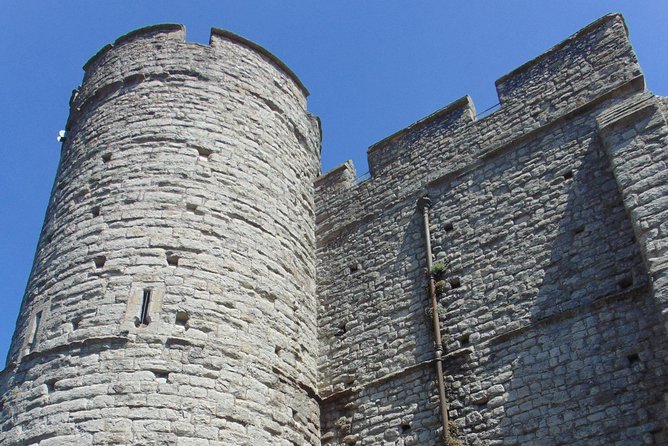
Westgate Towers is one of the route’s most striking sights. It is described as the largest surviving medieval city gate in the United Kingdom, and the guide explains how its design helped with attack and defense during a turbulent period.
You hear about the methods used to protect the city and why this tower was considered highly advanced for its time. There is also a dramatic story connected with Westgate, described as worthy of its own short film.
The tour stops outside for about five minutes. Entry to the Westgate Towers Museum and viewpoint is not included, so you will need a separate ticket if you want to go inside or see the view from above.
That is not necessarily a weakness. The outside explanation gives you the defensive context, and you can decide afterward if the museum fits your schedule. If elevated city views are high on your list, plan extra time and budget for admission.
A completely different sort of day out in England:
- Stonehenge, Windsor Castle, and Bath from London
★ 4.5 · 18,662 reviews - London Big Bus Hop-On Hop-Off Tour with Optional River Cruise
★ 3.5 · 10,803 reviews - London Small Group Tour of Historical Pubs
★ 5.0 · 10,422 reviews - Beatles Magical Mystery Tour
★ 5.0 · 9,266 reviews
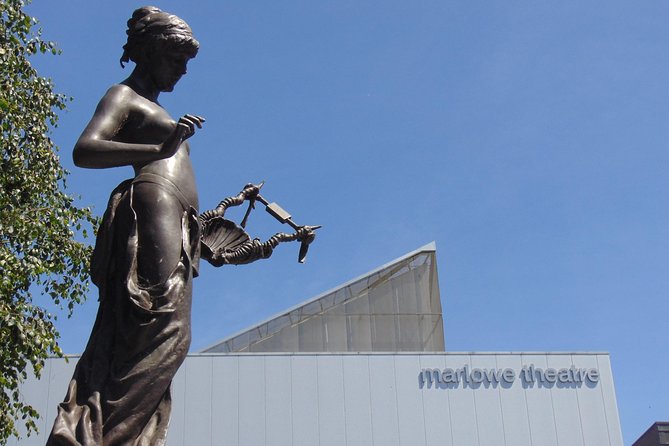
Christopher Marlowe beside the modern Marlowe Theatre
The next stop passes the Marlowe Theatre, a modern structure with a very old connection to Canterbury’s literary life. Here, the focus shifts to Christopher Marlowe, the playwright associated with a hard-partying life and work as a spy.
Marlowe makes a good counterpoint to Chaucer. Instead of only presenting Canterbury as a place of pilgrims and saints, the story brings in a restless, controversial writer whose life was as dramatic as his plays.
Sam also uses this stop to show how the written word has shaped Canterbury. You will not tour the theatre, and the stop is brief, but the contrast between the contemporary building and Marlowe’s eventful life gives the route a welcome change of tone.
I particularly like this part for visitors who want more than church architecture. It shows that Canterbury’s cultural identity includes theater and literary troublemakers as well as religious figures.
Christ Church Gate and a Tudor surprise
Christ Church Gate brings you into the cathedral precinct area. The gate was completed to commemorate a Tudor prince and his Spanish bride, though the identity of that prince may not be the one you first expect.
The guide also explains how the gate changed over time. That detail is important because old buildings are rarely frozen exactly as they began. Alterations, repairs, and changing uses can tell you as much about a city as the original construction.
The stop lasts around five minutes and is viewed from outside. If you are planning a separate cathedral visit, this is a useful preview, but do not mistake the walking tour for cathedral admission or an interior tour.
Roman Canterbury and the stories beneath the street
Outside the Canterbury Roman Museum, Sam explains the Roman city and how it was rediscovered after the Second World War. That link between ancient remains and wartime damage gives the Roman story a modern turning point.
You also hear about the area around Butchery Lane, where several details come together: the Bell Harry Tower of Canterbury Cathedral, the city coat of arms, and a bull’s head that seems to appear in an unexpected place.
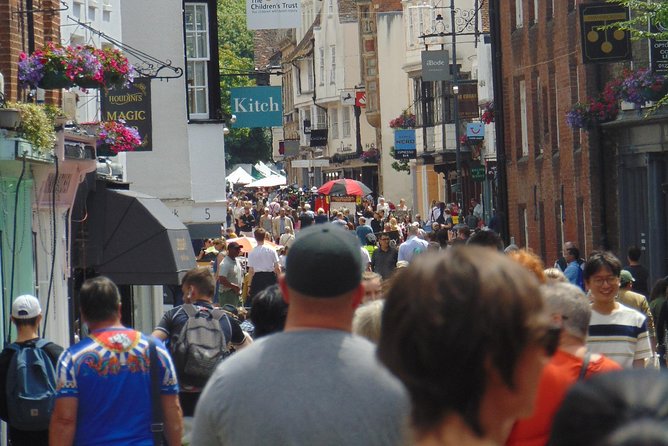
These are exactly the small observations that make a city walk worthwhile. You could pass through Butchery Lane focused on shops and cafes, then miss the visual clues above and around you. Sam’s role is to slow your eye down for a moment and explain what you are seeing.
The Roman Museum itself is not included as an admission stop. If Roman archaeology is a priority, you can return later with a clearer idea of what the museum adds to the street-level story.
Thomas Becket, Canterbury’s defining figure
At St Thomas of Canterbury Roman Catholic Church, the tour turns to Thomas Becket. His murder and later importance transformed Canterbury into one of medieval Europe’s major pilgrimage destinations.
The guide presents the full story of the man who became the city’s most famous figure, even though he was not from Canterbury. This is one of the route’s central historical episodes, and it helps explain why Canterbury Cathedral became such a powerful destination.
The stop also includes a wonderfully odd visual detail: why Pope Gregory the Great has a dove flying into his ear. It is the kind of question you would not think to ask while walking through the city, which is why these short guided pauses add real value.
You should expect legends and historical interpretation alongside factual detail. That blend is part of the appeal, especially for visitors who enjoy the way old places collect both documented events and memorable stories.
Ending under St George’s curious clock tower
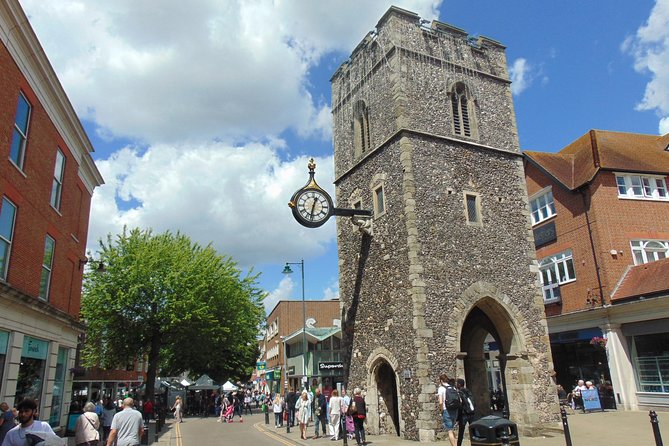
The tour ends beneath St George’s Tower at 27 St George’s Street. The tower is the former St George’s Church, and Sam explains how it became a reminder of the past within a busy shopping area.
This is a clever final stop because it brings the tour back to ordinary modern life. Canterbury is not a preserved museum set apart from the present. People shop, eat, and go about their day around remnants of much older buildings.
The clock tower also gives you a final quirky image to remember. By the end of the walk, you should have a clearer sense of how to read the city, looking up at towers, checking coats of arms, and noticing details tucked beside commercial streets.
The finish point is not the same as the starting point, but both are in the central area. That makes it easy to continue exploring on foot after the tour.
Sam’s guiding style and group size
The guide is a major part of the experience. Sam is described through the tour’s feedback as friendly, entertaining, approachable, and deeply familiar with Canterbury’s past, architecture, and art.
His strongest skill seems to be turning information into stories. He handles facts, fiction, legends, and side notes without making the walk feel like a lecture. He has also kept mixed-age groups involved, including families with children and teenagers.
The group limit of 10 is important here. A small party lets you ask about a building, stop for clarification, or hear a story without competing with dozens of people. One particularly useful detail is that Sam kept the same enthusiasm even when only one person attended a scheduled walk.
That small-group format is not a guarantee that every departure will have the same atmosphere. Still, it gives you better odds of a personal exchange than a large city walk.
Is $19.44 good value?
At $19.44 per person, this is a fairly modest way to get a guided introduction to Canterbury. You are paying for about 90 minutes of a guide’s time, a carefully arranged central route, and the local details that are hard to spot alone.
The value improves if you take the tour early in your stay. You can use Sam’s explanations to choose where to spend more time afterward, including the Beaney, Canterbury’s gardens, city walls, cathedral areas, and the museums along the route.
The price does not cover admission to Westgate Towers or the Canterbury Roman Museum. That is worth noting when you set your budget, though it also means you are not paying for attractions you may not want to enter.
The tour is especially good value for a first visit. If you already know Canterbury well and have studied its main sites, you may prefer a longer specialist experience or independent exploration. For most first-time visitors, the low cost and short duration make it an easy addition.
Who should book this walk?
I would choose this tour if you want to get your bearings quickly and understand what makes Canterbury distinctive. It suits first-time visitors, couples, families, solo visitors, and anyone who likes history delivered with humor rather than a formal lecture.
Families should take a close look at it. Sam has engaged children aged 6 and 11, and teenagers have also responded well to the mix of unusual facts, legends, and visual details.
It is also a good choice if you enjoy literary history. Chaucer and Marlowe give the route a different flavor from a tour focused only on saints, kings, and medieval battles.
Most people can participate, service animals are allowed, and the tour is near public transportation. You will be walking outdoors, so sensible shoes and clothing suited to Canterbury’s changeable weather are practical choices.
The tour is offered in English and uses a mobile ticket. Free cancellation is available up to 24 hours before the start time, but cancellations or changes made inside that period are not accepted for a refund.
Should you book the Canterbury Classic Tour?
Book it if you want a friendly, compact introduction that shows you both the headline sights and the strange details between them. Sam’s storytelling, the 10-person limit, and the mix of Roman, medieval, literary, and modern subjects make this more useful than simply following a map.
Skip it if you want substantial interior visits, long museum time, or an in-depth cathedral tour. The Canterbury Classic Tour works best as a first look, then you return to the places that caught your attention.
At $19.44, it is an easy value call for most first-time visitors. Put it near the start of your Canterbury stay, listen for the stories beneath the shopfronts, and let the walk shape the rest of your day.
FAQ
Where does the Canterbury Classic Tour start?
The tour starts outside The Beaney House of Art and Knowledge at 18 High Street, Canterbury CT1 2RA, UK.
Where does the tour finish?
The tour ends beneath St George’s Tower at 27 St George’s Street, Canterbury CT1 2LE, UK. The tower is the former St George’s Church.
How long does the tour last?
The tour lasts approximately 1 hour and 30 minutes.
How many people can join the tour?
The group is capped at a maximum of 10 travelers.
Is entry to Westgate Towers included?
No. The stop at Westgate Towers Museum and Viewpoint is outside, and admission is not included.
Is the Canterbury Roman Museum included?
No. The tour discusses the Roman city outside the Canterbury Roman Museum, but museum admission is not included.
Can I cancel for a full refund?
Yes. You can cancel at least 24 hours before the experience start time for a full refund. Changes or cancellations made less than 24 hours before the start time are not accepted for a refund.
Recently added around England
- Brighton to Heathrow Airport private taxi transfers★ 5.0 · 8 reviews
- London’s Crown Secret: Self-Guided Royal Puzzle Quest★ 4.5 · 8 reviews
- The Condensed Canterbury Tour★ 5.0 · 8 reviews
- Postcard London★ 5.0 · 8 reviews
- Private Tour: Downton Abbey London Locations by Taxi★ 5.0 · 8 reviews
- Windsor Castle, Stonehenge & Roman Baths Private Tour★ 4.5 · 8 reviews
- CS Lewis & Tolkien Tour with Magdalen Entry Public tour 13.45★ 5.0 · 8 reviews
- Cotswolds Private Driving Tour from London★ 5.0 · 8 reviews
Canterbury Tours, compared.

Official Canterbury Guided Walking Tour – 11.00 Tour
Read our review →
Official Canterbury Guided Walking Tour – 14.00 Tour
Read our review →

Cultural Homestay Exploring London, Oxford and National Parks
Read our review →


Browse the lists this tour appears in