
Reviewed · MANCHESTER TOURS
Manchester Afternoon Walking Tour
Manchester packs industrial history, music, football, protest, art, and nightlife into a compact city centre. This afternoon walk links those subjects through streets and squares, from Emmeline Pankhurst and Alan Turing to the Manchester Ship Canal, Chinatown, the Northern Quarter edge, and the old buildings near The Shambles.
I like the way the tour gives you a fast sense of direction, and I like the guide’s practical approach. Gareth is praised for witty storytelling, easy pacing, and useful suggestions for pubs and restaurants. The main drawback is simple: you cover a lot of ground in 2.5 hours, with plenty of standing, so comfortable shoes and a rain jacket matter.
I also like the mix of famous landmarks and small details, including the Vimto sculpture, Sackville Gardens, and Manchester’s old retail streets. The tour costs $24.27 per person, a fair price for a first look at the city, though most interiors are brief exterior stops rather than full visits.
Key points to know before you book
- A city-centre overview in 2.5 hours: You move from the library and civic quarter to Chinatown, the Gay Village, The Shambles, Manchester Cathedral, and the National Football Museum area.
- Guide Gareth brings the history together: His style combines facts, humor, answers to questions, and suggestions for places to eat and drink later.
- The route is made for walking: You reach streets and small corners that buses cannot show you, but the tour is non-stop walking and standing.
- Manchester’s many identities share one route: Expect stories about suffragism, industry, music, theatre, football, LGBTQ+ Manchester, wartime memory, and computing.
- A small group helps with questions: The maximum is 25 people, and groups are often smaller.
- Weather can affect the tour: The experience requires good weather, and Manchester rain can make the open-air route less pleasant.
Why this route works as a first look at Manchester
The best use of this tour is on your first day in Manchester. You get the basic map of the centre, learn which areas connect, and gather ideas for the rest of your stay.
The route begins at Manchester Central Library at 2pm. That is a useful meeting point because it sits in the civic heart of the city, close to St Peter’s Square and several tram stops. The tour then moves through central Manchester in a broad loop before finishing on Cathedral Street near Manchester Cathedral.
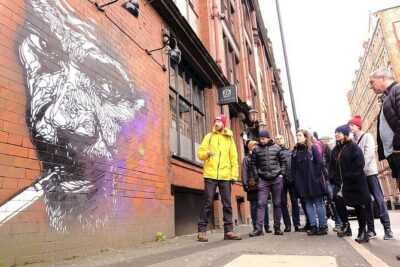
The walking is not a strenuous hike, but it is steady. One participant described the pace as easy, while another pointed out that the tour is almost all walking and standing. I would plan on roughly two and a half hours without a long café break. Wear shoes you can walk in and bring an umbrella or waterproof layer, especially in winter.
With a maximum of 25 people, the group is small enough for the guide to answer questions. That matters on a history tour, since Manchester’s story can quickly become a list of dates unless you can stop and ask how one place connects to another.
More Walking Tours in Manchester
- Rock and Goal Manchester Walking Tour
★ 5.0 · 587 reviews - Four hour walking wine tasting tour of Manchester’s best bars
★ 5.0 · 136 reviews - Daily Manchester City Centre Walking Tour with Local Guide
★ 5.0 · 107 reviews
Starting with libraries, protest, and Manchester’s civic centre
Manchester Central Library is the right place to begin. The circular building is one of the city’s best-known civic landmarks, and the opening stop gives you a sense of Manchester as a place shaped by public institutions, not just factories and football.
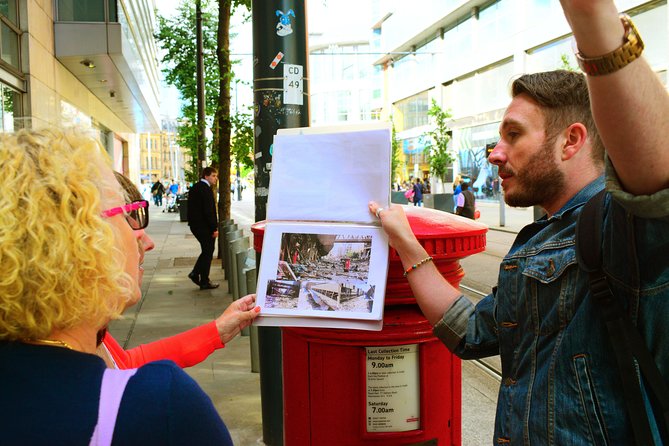
From there, the route reaches the statue of Emmeline Pankhurst. This is one of the tour’s more important historical stops because it introduces Manchester’s role in the suffrage movement. You get a short explanation of suffragism and the people who pushed for women’s voting rights.
The nearby Bridgewater Hall adds a cultural note. It is home to the Hallé Orchestra, giving the walk a quick connection to Manchester’s long musical life. The stop is brief, so think of it as an orientation point rather than a concert-hall visit. Admission to the building is not included.
Manchester Central follows. This former railway station and events venue helps explain how the city’s transport and industrial past shaped its civic centre. The tour does not spend long at each stop, but the sequence works well: library, political history, music, then transport and industry.
Canals, theatres, and a drink invented in Manchester
The Manchester Ship Canal section brings the city’s industrial past into view. You walk beside or through the canal area and hear about the early man-made waterways that helped Manchester connect with wider trade routes.
This is one of the places where walking adds value. A bus could carry you past the area, but it would not give you the same sense of how water, warehouses, railways, and streets fit together. The canal stop is included in the tour, with no separate admission needed.
The Palace Theatre provides another change of subject. Manchester has a strong theatre tradition, and this stop shows you a grand performance venue in the middle of the modern city. You do not receive a theatre performance or an interior visit as part of the tour, so keep your expectations focused on the building and its story.
At 39 Sackville Street, the route turns toward a more unusual piece of local culture. This stop is dedicated to a drink, leading to the Vimto sculpture. The sculpture celebrates a soft drink created in Manchester, and you may get the chance to try it during the visit.
That small tasting is useful because it breaks up the heavier historical material. Manchester’s past is not only about mills, canals, and political movements. It also includes everyday inventions and local brands that still shape the city’s identity.
Sackville Gardens, Alan Turing, and the Gay Village
Sackville Gardens is one of the more thoughtful parts of the route. The park sits in Manchester’s Gay Village and is connected with the city’s LGBTQ+ identity.
The Alan Turing Memorial is nearby. Turing is remembered for his work in computing and for helping break the Enigma code during the Second World War. The stop links science, wartime history, persecution, and Manchester’s later role as a city willing to recognize LGBTQ+ lives more openly.
The route also passes colorful streets and rainbow displays. This section can feel more personal than a standard list of monuments because the guide connects public spaces with the communities that use them.
The stop is short, but the subject deserves attention. If you want a long discussion of Turing or LGBTQ+ Manchester, you may need to explore the area independently afterward. On the walking tour, you get a clear introduction and a chance to place the memorial within the city centre.
A completely different sort of day out in Manchester:
- The Manchester City Stadium Tour
★ 5.0 · 4,176 reviews - Alcotraz Prison Cocktail Experience in Manchester
★ 5.0 · 1,216 reviews - LEGOLAND Discovery Centre Manchester
★ 4.0 · 1,049 reviews - SEA LIFE Manchester Admission Ticket
★ 4.0 · 1,007 reviews
Chinatown, the art gallery, and public memory
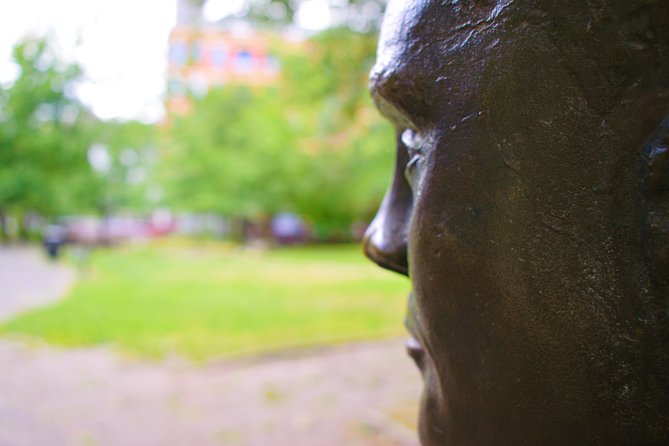
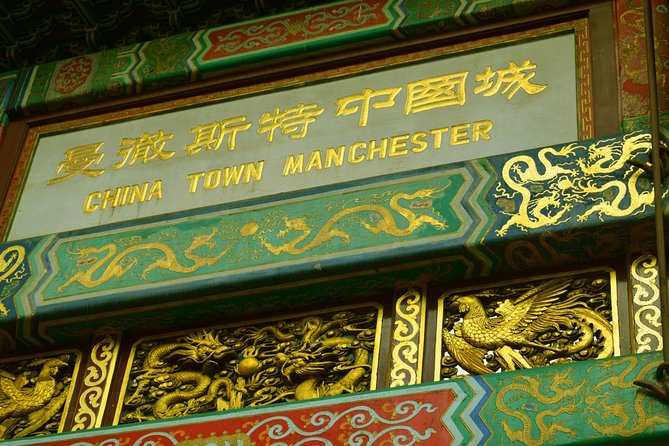
Manchester’s Chinatown is described as the second-largest Chinatown in the United Kingdom. The tour uses it as another example of how the centre has changed through migration, business, and community life.
The stop is short, but it adds welcome variety after the civic and industrial landmarks. You see a part of Manchester that is defined less by grand public buildings and more by food, shops, signs, and community institutions.
Next comes Manchester Art Gallery. The gallery is included in the route, though the tour does not function as a full art visit. You should not expect time to study a large collection. Instead, the stop places the gallery within the city’s cultural centre and gives you a useful option for later.
The Manchester Cenotaph introduces wartime memory. It honors soldiers who died in the First World War, and the guide explains its place among the city’s public monuments. This is another short stop, but it helps you read Manchester’s squares and civic buildings as more than attractive architecture.
Albert Square and Manchester’s grand civic buildings
Albert Square is one of the main event spaces in Manchester. It is also where the city’s Gothic civic architecture becomes most concentrated.
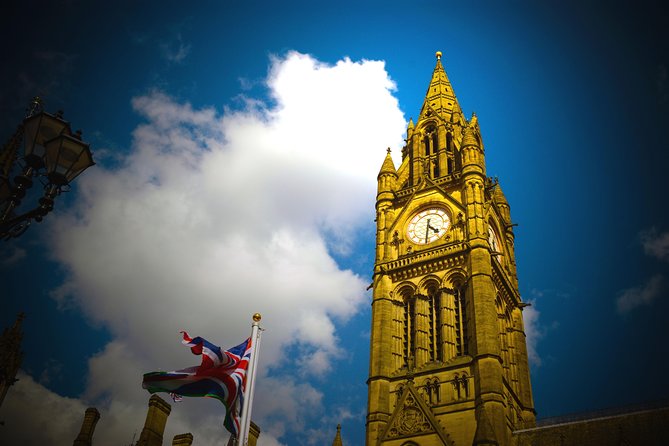
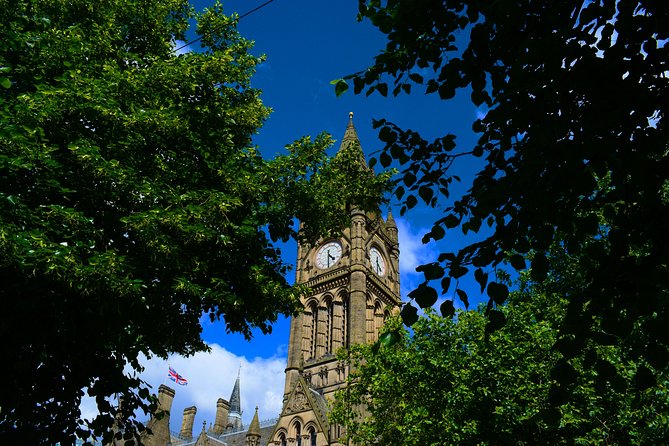
The Albert Memorial and Manchester Town Hall are the major landmarks here. The town hall is a striking building, but admission is not included, and the tour does not provide a full interior visit. Depending on opening arrangements and the day’s conditions, you should treat this part as an exterior explanation and a chance to take in the square.
The route also passes old retail boutiques and St Anne’s Roman Catholic Church. These stops show a different side of the centre, where older shops and religious buildings sit among newer commercial streets.
St Anne’s Church receives only a few minutes, but that is enough to introduce its unusual story and architecture. Saint Ann’s Square then gives you a wider view of the historic city centre. This is a good point to listen for the guide’s explanation of how Manchester has been rebuilt and altered over time.
The Royal Exchange and The Shambles
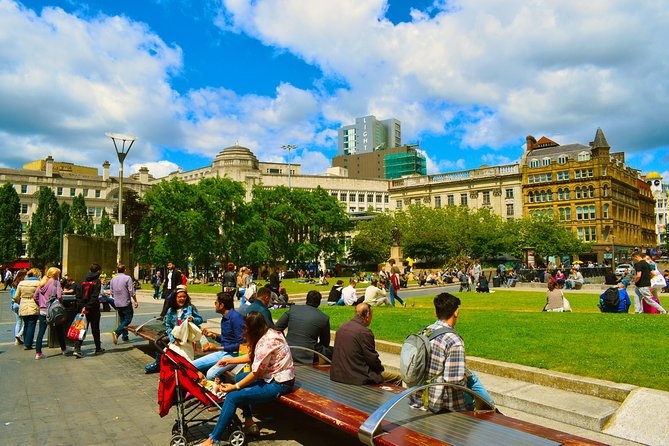
The Royal Exchange Theatre is one of the route’s most memorable buildings. Its theatre space is known for a modern design placed inside a historic setting, and the stop helps explain how Manchester continues to reuse older commercial buildings.
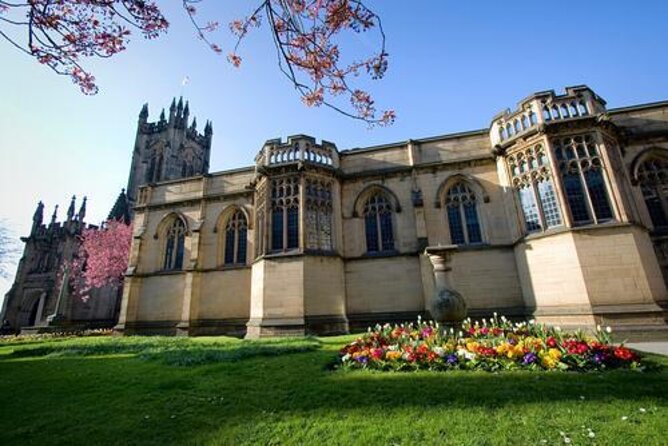
The tour then reaches The Shambles, described as some of the oldest buildings in Manchester’s city centre. This is one of the route’s strongest contrasts. After grand civic buildings, theatres, and modern streets, you get a glimpse of older urban Manchester.
The itinerary places The Shambles near the end, which works well. By this point, you have enough context to understand that the city centre is not one neat period. Modern shops, old warehouses, religious buildings, theatres, and surviving fragments of earlier streets all sit close together.
Admission to The Shambles is not included. The stop is mainly a walk-through and explanation, so allow extra time later if you want to explore the buildings more closely.
Cathedral Quarter, Chetham’s Library, and football
The final stretch heads toward the Corn Exchange and Manchester Cathedral. The Corn Exchange has been remade as a food and shopping venue, showing how old commercial space can be given a new purpose.
The cathedral is a calmer stop after the busy central streets. Admission is included, and you get an introduction to one of Manchester’s key religious buildings. The route does not give you unlimited time inside, but the stop is valuable for understanding the city before industrial expansion and modern redevelopment.
Chetham’s Library is another highlight. It is described as the oldest public library in the English-speaking world, and it gives the final part of the tour a strong connection to learning and civic life. Admission is included, though the time available is limited.
The walk finishes near the National Football Museum and AO Arena. The football museum is not included as a full museum visit, and the arena stop is also brief. Still, these landmarks make sense at the end of a city orientation. They show modern Manchester’s links with football, entertainment, and large public events.
You may want to visit the National Football Museum later if football is a main reason for your trip. The tour gives you the location and context, but five minutes is not enough for the museum itself.
What you get for $24.27
At $24.27 per person, this is good value if you want a guided introduction rather than a deep visit to individual attractions. The price covers the guide, the walking route, commentary, and a list of 101 things to do in the city.
The real value is the connections. You are not paying simply to look at Manchester Central Library, a statue, or a theatre. You are paying for someone to explain how suffrage, canals, food and drink, music, science, LGBTQ+ life, war memorials, religion, football, and urban renewal meet in a small central area.
The tour becomes less useful if you want long interior visits. Several stops have no admission included, and even included sites receive limited time. I would use this as a city introduction, then return on your own to the cathedral, Chetham’s Library, Manchester Art Gallery, or the National Football Museum.
The 101-things list adds value after the walk. It can help you decide what to do next, especially if you have only a day or two in Manchester.
The guide style and group experience
Gareth is the guide most often named for this experience. His strengths are clear: he explains Manchester’s history in an engaging way, keeps an easy walking pace, answers questions, and adds humor without losing the main story.
He also adapts useful advice to the group. If you are heading to an event, he may point out something relevant on the route. His food and drink suggestions are another practical benefit, especially because the tour passes through areas with many places to eat afterward.
The group size can reach 25 people, though some departures are smaller. A group of around 12 gives you plenty of room to hear the guide and ask questions. Larger groups may feel less personal, especially in crowded streets, but the maximum is still modest for a city walk.
Who should book this afternoon walk?
I would recommend it to first-time visitors, people with only one or two days in Manchester, and anyone who wants a strong overview before choosing museums or neighborhoods to explore alone.
It also suits local residents who know the centre by routine but want the larger story. One useful feature of a good walking tour is that it makes familiar streets readable, and this route does that through monuments, old buildings, public squares, and community landmarks.
The tour may not suit young children or anyone who finds prolonged standing difficult. One participant specifically warned that it is non-stop walking and standing. The pace is described as easy, but easy does not mean seated.
Weather is the other real concern. The experience requires good weather, and Manchester is known for damp afternoons. Bring warm clothing in January, plus an umbrella or waterproof layer. If poor weather cancels the tour, you are offered another date or a full refund.
You can cancel for a full refund up to 24 hours before the 2pm start. The same 24-hour rule applies to changes, and the tour can also be canceled if the minimum number of people is not reached.
Should you book the Manchester Afternoon Walking Tour?
Book it if you want to understand Manchester quickly, hear its stories from a lively local guide, and cover many central landmarks without spending much. The strongest parts are the clear narrative, the range of subjects, Gareth’s humor and practical advice, and the chance to get your bearings on foot.
Skip it if you want detailed museum time, a slow photography walk, or a tour with regular café breaks. For most first visits, though, $24.27 is a sensible price for a 2.5-hour introduction. Take it early in your stay, wear comfortable shoes, and keep the rest of the afternoon free for one or two places that catch your interest.
FAQ
How long does the Manchester Afternoon Walking Tour last?
The tour lasts approximately 2 hours and 30 minutes.
What time does the tour start?
It starts at 2:00pm.
Where does the tour begin?
The meeting point is Manchester Central Library, Manchester M2 5PD, United Kingdom.
Where does the tour finish?
The tour ends on Cathedral Street near Manchester Cathedral, Manchester M3 1SW.
What language is the tour offered in?
The tour is offered in English.
How much does the tour cost?
The listed price is $24.27 per person.
How large can the group be?
The maximum group size is 25 people.
Are attraction admission fees included?
Some stops are listed with admission included, including the Manchester Ship Canal area, Vimto sculpture, Sackville Gardens, Chinatown, Manchester Art Gallery, the Royal Exchange Theatre, Manchester Cathedral, and Chetham’s Library. Admission is not included for stops such as Bridgewater Hall, Palace Theatre, Manchester Town Hall, Albert Memorial, The Shambles, Corn Exchange, National Football Museum, and AO Arena.
Can I cancel the tour for a refund?
Yes. You can cancel at least 24 hours before the start time for a full refund. Cancellations or changes made less than 24 hours before the tour are not accepted for a refund, and poor weather or failure to meet the minimum group size may result in another date or a full refund.
Recently added around Manchester
- Private Cocktail Making Class in Manchester★ 5.0 · 8 reviews
- MANCHESTER: Yorkshire Adventure – Sightseeing Day Trip Tour★ 5.0 · 9 reviews
- Manchester: Luggage Storage Central★ 5.0 · 10 reviews
- Musical MADchester Quest Experience in Manchester★ 4.0 · 14 reviews
- Murder Detective Self-Guided Tour in Manchester★ 3.5 · 16 reviews
- Manchester’s Music Scene with a Local Host, Private + Custom★ 4.0 · 17 reviews
- Inspirational guided walking tour of Media City & The Quays★ 5.0 · 23 reviews
- Italian Afternoon Tea Experience in Manchester★ 4.0 · 25 reviews
Manchester Tours, compared.


Alcotraz Prison Cocktail Experience in Manchester
Read our review →



Manchester iFLY Indoor Skydiving Experience – 2 Flights & Certificate
Read our review →
Browse the lists this tour appears in