
Reviewed · BRISTOL TOURS
Bristol Harbourside Self-Guided Walking Tour
Bristol’s waterfront is a city-sized history lesson, and this self-guided walk ties it together through docks, bridges, churches, caves, and old trading streets. You begin at Millennium Square and finish beside Brunel’s SS Great Britain, following the story of Bristol’s rise from a medieval river settlement to a major port.
I like the freedom to pause at M Shed, linger by the water, or stop for food without holding up a group. I also like Helen’s real recorded voice, plus the mix of maps, GPS directions, pictures, videos, and recommendations. The main concern is navigation: one route user found unnamed streets, blocked access, and detours that made the walk much longer than planned.
Key points to know
- Helen provides the narration: You hear a real human guide in English, not a computer-generated voice.
- The route covers old Bristol and modern Harbourside: Expect medieval churches, Georgian squares, trading quays, former shipyards, and museums.
- You get three weeks of access: The app can be used beyond one afternoon, which helps if you want to split the walk.
- The route ends at SS Great Britain: This gives you a natural chance to add Bristol’s famous iron steamship afterward.
- Navigation needs attention: GPS support is useful, but check directions carefully if streets or access points have changed.
- The price is modest: At $12.33 per person, it costs less than a conventional guided walk, but you give up an in-person guide.
A waterfront walk with Bristol’s working past beneath it
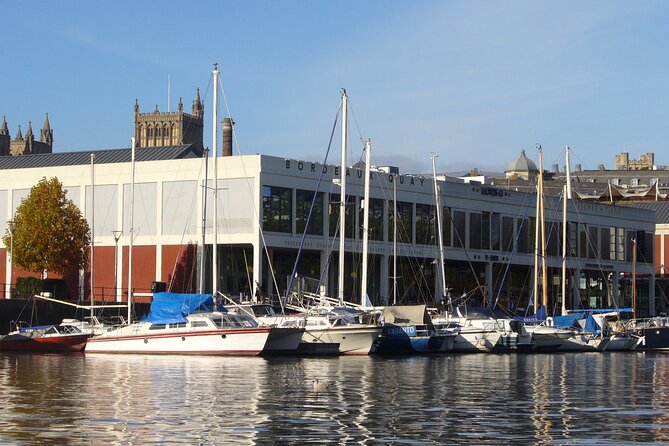
This is not simply a stroll beside attractive water. Bristol’s Harbourside was shaped by trade, shipbuilding, warehouses, marshland, docks, and the difficult relationship between a growing city and its rivers.
At Millennium Square, you learn that the area was once Canon’s Marsh, where the River Frome met the Avon. The marsh was drained and built on in the early 18th century, giving you an immediate reminder that much of modern Bristol rests on land altered for commerce and city life.
From there, the route moves through public squares, old streets, bridges, and quays. The walk is listed at about two to three hours, but that timing depends on how closely you follow the route, how long you pause, and whether access has changed.
The app gives you unlimited access for three weeks. That is a useful feature, since you can use the first outing to see the main route and return later to explore M Shed, the SS Great Britain, or places you passed too quickly.
More Walking Tours in Bristol
- Blackbeard to Banksy – The Ultimate Walking Tour of Bristol
★ 5.0 · 1,961 reviews - Air Raid Shelter + St. Nicholas Market Walking Tour
★ 5.0 · 1,950 reviews - Ghosts, Ghouls & Gallows :The Original Bristol Ghost Walk
★ 5.0 · 262 reviews
Millennium Square and the skateboard-friendly amphitheatre
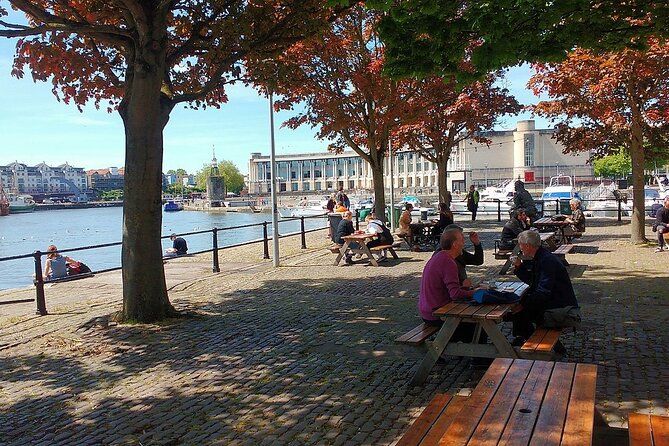
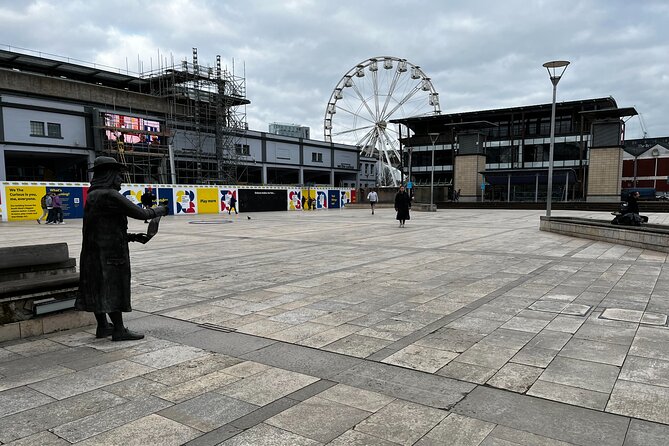
Millennium Square is the opening stop. Its story begins with geography: the Frome comes from the northeast, the Avon from the east, and their meeting point created the marshy Canon’s Marsh.
You get around ten minutes of commentary here, enough to set up the rest of the walk without turning the opening into a long lecture. I like this start because it explains why the waterfront looks the way it does today. You are not just seeing a modern public space. You are standing on ground that was drained, developed, and brought into the city.
The nearby Bristol Amphitheatre and Waterfront Square takes only about five minutes. It is a modern gathering place with a practical difference: skateboarders are allowed to ride here. In other parts of Bristol, you may notice design features intended to prevent skating.
That small detail says something useful about how cities manage public space. The stop is brief, but it connects present-day street life with the older port story. Keep your eyes open for skateboarders and the way the square is used while Helen explains its past.
Pero’s Bridge and Bristol’s medieval river meeting point
Pero’s Bridge is one of the route’s most recognizable sights. Opened in 1999, it honors Pero, an important local figure in Bristol’s story. The bridge’s horn-shaped sculptures are a visual clue to that story, and Helen explains both the name and the unusual design.
This is a short stop, around five minutes, but it is worth paying attention to the narration. The bridge links the modern Harbourside to the city’s difficult connections with overseas trade and human lives affected by it.
A nearby stop covers the medieval harbour, located around the point where the Avon and Frome met. The present-day fountains mark roughly where that old harbour developed. This is one of the places where the audio format helps: you can look at the water and surrounding buildings while the guide explains how the area functioned before today’s public spaces existed.
The route also offers recommendations for nearby places to visit. Since the information remains available in the app for three weeks, you do not have to act on every suggestion during the walk.
College Green, King Street, and Queen Square
College Green is a longer stop, about fifteen minutes, and one of the better places to slow down. The area draws people to its open grass and historic surroundings. The commentary points you toward an important abbey, artworks by a very famous artist, a chapel, and a museum.
This stop rewards listeners who like several threads at once. You are not only hearing about one building. You are getting a guide to the cultural sights around the green, which can help you decide where to return later.
King Street shifts the focus back to Bristol’s port. In earlier centuries, ship captains, traders, and dock workers moved goods between boats and stores here. The street is a useful place to imagine the harbour as a workplace rather than a leisure district.
Queen Square gives the walk another change of mood. Today it is a Georgian park ringed by trees, cobbled streets, and houses. Before that, the land was marshy and used for rubbish dumping and weapons practice. Building began in 1699, starting on the south side.
These three stops work well together because they show Bristol in layers: religious and cultural buildings at College Green, commercial traffic around King Street, and planned Georgian development at Queen Square.
A completely different sort of day out in Bristol:
- (9pm) The House Magicians Comedy & Magic Show – Smoke & Mirrors
★ 5.0 · 356 reviews - West Country Games – the most popular group activity in the South West!
★ 5.0 · 315 reviews - The House Magicians’ Comedy Magic Show at Smoke & Mirrors in Bristol (Sat 7pm)
★ 5.0 · 296 reviews - The House Magicians Comedy Magic Shows
★ 5.0 · 263 reviews
Welsh Back, Castle Park, and Bridge Quay
Welsh Back remains an active part of the city, with evening bars, restaurants, and dining spaces on boats. Its name is not random, and Helen explains what it reveals about the area’s past.
The stop takes about ten minutes. It is especially useful in daylight, when you can compare the current dining scene with the old working waterfront described in the audio. If you plan to eat here, the recommendations at the end may help you return after finishing the walk.
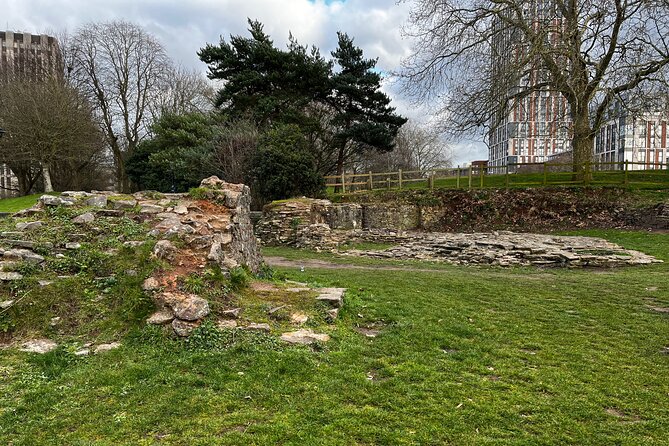
Castle Park marks the site of Bristol’s old castle and medieval settlement. The stop is short, about five minutes, but it puts the city’s early defensive and urban story into the route.
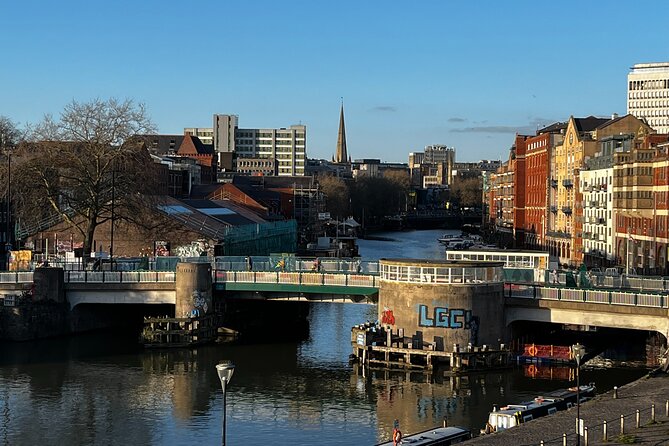
At Bridge Quay, you get a good view of Bristol Bridge. St Peter’s, St Nicholas’, and St Mary Le Port churches appear in the background. The bridge is believed to mark the place where Bristol’s settlement began, making this a strong viewpoint for connecting the river, churches, and old city together.
This part of the walk is also a reminder that the route is not just a straight waterfront promenade. You move between open squares, city streets, old commercial areas, and viewpoints. That variety keeps the tour from feeling repetitive.
Redcliffe, St Mary Redcliffe, and the cave network
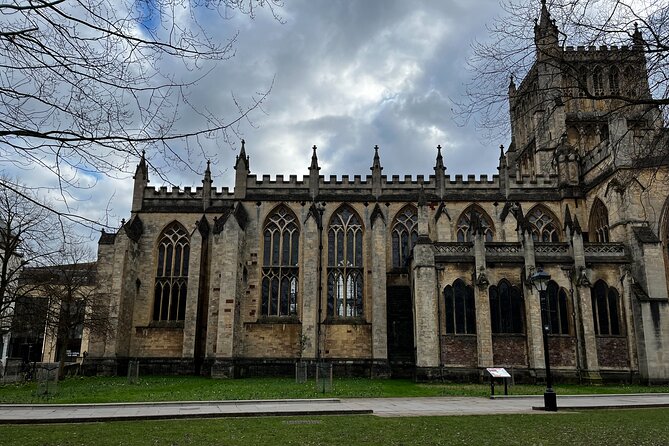
The route then reaches Redcliffe, one of Bristol’s most memorable areas. St Mary Redcliffe Church is a major landmark, though the building you see today is not the original. The church dating from Henry I’s time fell into disrepair and was rebuilt in the 14th century.
The stop itself lasts around five minutes. If the church is open and you have time, it may deserve a longer look than the audio schedule allows. The tour gives you context, but you should treat the suggested timings as a guide rather than a strict timetable.
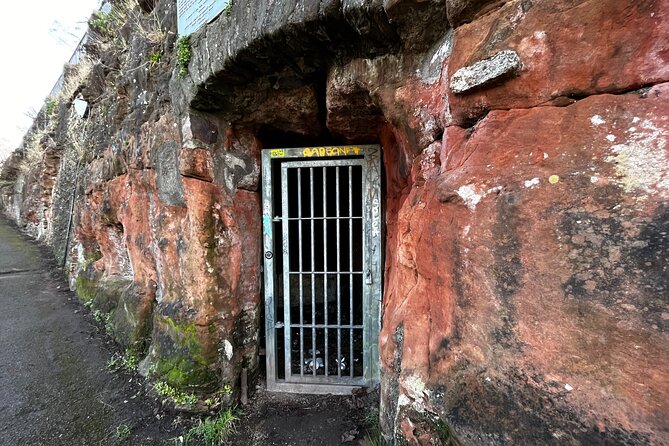
Redcliffe Caves adds a more unusual note. The area takes its name from the bright red Triassic sandstone visible nearby. Houses along Redcliffe Wharf were built above a cave system that leads toward St Mary Redcliffe Church.
The stop lasts about ten minutes and helps you look below the polished waterfront. Bristol’s port was not only made up of ships and warehouses. Its rock, cellars, caves, and buildings were tied together in ways that are easy to miss when you are walking at street level.
Bathurst Basin and the old sailor’s pub
Bathurst Basin is one of the short unscheduled points along the route. Its water supply was lost when the New Cut was dug in 1809, an important change to Bristol’s waterways.
At the entrance is the Ostrich pub, built around 1745. It once served sailors, dock workers, and merchants. The building gives you a direct link to the people who used the harbour for work rather than recreation.
This is a good place to pause and check the map. Short transition points such as this can be easy to miss if you are listening while walking. The app’s GPS route should help, but do not assume every turn will be obvious.
Princes Wharf, the Matthew, and Bristol’s dock evidence
At Princes Wharf, the tour explains how nearly all the city docks have changed since cargo ships stopped using them. Today’s waterfront is much quieter in commercial terms, but traces of the old port remain if you know what to look for.
That is the value of this section. Instead of treating the Harbourside as a new entertainment district, the commentary asks you to read the older dock features still visible around you.
You also pass the Matthew of Bristol, a replica of the ship John Cabot sailed to the Americas in 1497. The replica is surprisingly small, yet it crossed the Atlantic to Canada in 1997 for the 500th anniversary of Cabot’s voyage.
The Matthew provides a useful sense of scale. Historical ship journeys can sound grand when reduced to dates and names. Seeing the size of the replica makes the risks and limits of early ocean travel easier to picture.
M Shed and Wapping Wharf
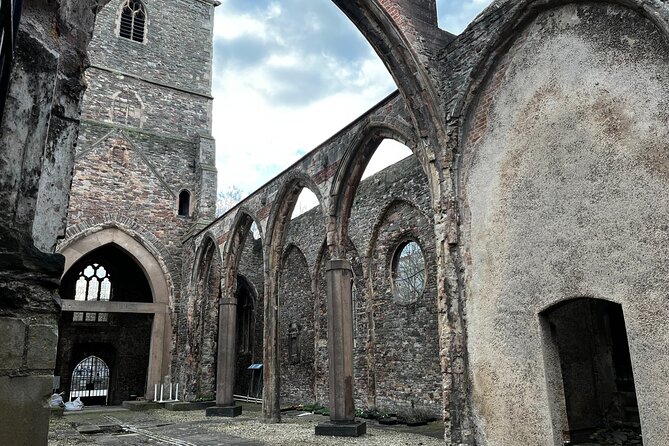
M Shed is a free museum about Bristol and one of the few Harbourside sites to retain all its original features. The tour allows about fifteen minutes here, but I would treat that as an introduction rather than enough time for a full visit.
If you enjoy museums, this is the place most likely to stretch the walk beyond three hours. You can listen to Helen’s overview, then return later during the three-week access period.
Wapping Wharf was once used for shipbuilding and repairs. In the 1800s, Bristol Docks were packed with boats loading and unloading goods. The area looks more pleasant today, but the audio helps you picture the noise, movement, and work that once filled it.
This final section is strong because it brings the story back to ordinary labour. You hear not only about famous ships and engineers, but also about repair yards, cargo handling, and the people who kept the port moving.
Finish beside Brunel’s SS Great Britain
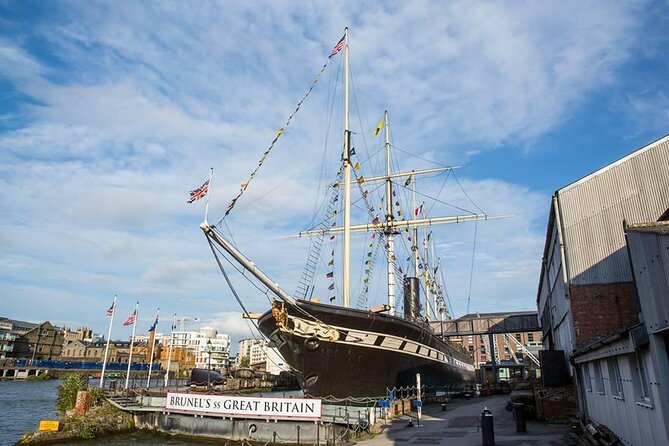
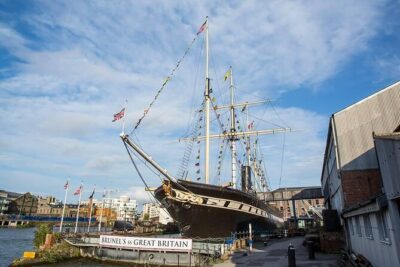
The route ends at the Great Western Dockyard beside Brunel’s SS Great Britain. Isambard Kingdom Brunel built the ship, which was the largest of its kind at launch and the first ship constructed using iron.
The ship was launched in 1843 and was described at the time as a remarkable experiment. The tour does not include entry to the ship, so plan separately if you want to go aboard. Even from outside, its location gives the walk a strong finish because you are standing where a major part of Bristol’s engineering and shipping story took shape.
Ending here also gives you a practical choice. You can continue exploring the central city with the app’s recommendations, or make the SS Great Britain your next paid attraction.
What the $12.33 price really buys you
At $12.33 per person, this is inexpensive for a two to three-hour city walk. The price is especially fair if you value flexibility and plan to use the app more than once during its three-week access period.
You receive:
- An English audio guide narrated by Helen
- GPS directions and a mapped route
- Stop information, photographs, and videos
- Recommendations for additional places
- Unlimited access for three weeks
The trade-off is simple. You pay less than you would for a private in-person guide, but you must manage your own pace, phone, route, and attention. There is no person beside you to explain a confusing turn or adjust the walk to your interests.
The activity is described as private, meaning only your group participates. In practice, it is still self-guided, so do not expect a live guide waiting at the start.
Navigation, timing, and practical concerns
Download or activate the tour before you set off and read the instructions carefully. The booking reference is not the activation code, which is an easy detail to overlook.
The route is listed as available every day from midnight to 11:30 p.m. That gives you plenty of freedom, but daylight will make it easier to spot buildings, bridges, caves, and dock remains.
Allow more than two hours if you want to enter M Shed, stop for food, study the churches, or follow recommendations. The suggested stop times add up quickly, and real walking time between them is not included in every short stop.
Navigation deserves the most caution. One route user reported streets without clear names, blocked access, detours, and a walk that became much longer than expected. Bristol’s changing streets and waterfront works can affect a GPS route, so keep the map open and use nearby landmarks such as bridges, squares, churches, and the water to check your position.
The tour is near public transportation, service animals are allowed, and most people can take part. No special physical requirements are stated, but the route includes city streets, cobbled areas, and changing access points, so sensible footwear and a flexible attitude will help.
Who should choose this Bristol walk?
I would recommend it to independent visitors who want a guided story without joining a group. It suits you if you like pausing for photographs, choosing your own food stop, or returning to a museum later.
It is also a good fit for repeat visitors who want a clear route through several parts of Bristol. The mix of harbour engineering, medieval settlement, Georgian planning, churches, caves, and modern public spaces gives you more than a single-theme walk.
You may prefer an in-person tour if you dislike using your phone while walking or if you want immediate answers. The navigation issue is important enough that I would not choose this as your only Bristol plan if you need a tightly timed schedule.
The tour carries a 4.6 rating from 12 reviews, though the available feedback also includes a three-star account of navigation problems. That balance tells you what to expect: the content and format can offer good value, but route clarity may depend on current street access and your comfort with GPS directions.
Should you book the Bristol Harbourside Self-Guided Walking Tour?
Book it if you want a low-cost, flexible introduction to Bristol and are happy to guide yourself. The strongest reasons are Helen’s human narration, the broad route, the three weeks of access, and the finish beside SS Great Britain.
Skip it if you need a perfectly simple route, a live expert, or a fixed finish time. Since the experience is non-refundable and cannot be changed after booking, check the activation instructions and your comfort with self-guided navigation first. For independent visitors with a little extra time, it is a useful way to connect Bristol’s old port, city centre, and Redcliffe waterfront in one outing.
FAQ
How long does the Bristol Harbourside Self-Guided Walking Tour take?
The tour takes approximately two to three hours. Stops at museums, churches, food venues, and other recommended places can make your visit longer.
What language is the audio guide in?
The tour is offered in English.
Who narrates the audio guide?
Helen narrates the tour. The guide uses a real human voice rather than a computer-generated voice.
How long can I access the tour?
You receive unlimited access through the app for three weeks.
What does the app include?
The app includes a map, directions, a GPS route, tour stops, audio narration, videos, pictures, recommendations, and additional information.
Is an in-person guide included?
No. This is a self-guided activity, so no live guide accompanies you.
Where does the tour start and finish?
The tour starts in Bristol and finishes at Brunel’s SS Great Britain at Great Western Dockyard on Gas Ferry Road.
Is entry to the attractions included?
The listed stops have no admission charge, but the tour does not state that paid entry to attractions such as SS Great Britain is included. M Shed is free to enter.
Can I cancel or change the booking?
No. The experience is non-refundable and cannot be changed for any reason after booking.
More self guided walks in Bristol
- Bristol Street Art: Banksy Exploration Game and Tour
★ 3.5 · 39 reviews - Self-Guided Craft Beer Tour (Explore Old Market)
★ 4.5 · 19 reviews - Brunel’s Bristol: A Self-Guided Tour from SS Great Britain to Clifton Bridge
★ 4.5 · 11 reviews - Westminster Abbey Entrance Ticket Including Audio Guide
★ 4.0 · 661 reviews
Recently added around Bristol
- Brunel’s Bristol: A Self-Guided Tour from SS Great Britain to Clifton Bridge★ 4.5 · 11 reviews
- Wine & Cheese in the Somerset Valleys – with Michelin-star lunch!★ 5.0 · 12 reviews
- 4 Day Tour in Cornwall, Devon and Stonehenge from Bristol★ 4.5 · 14 reviews
- Bristol Old City Food & drink Tour★ 5.0 · 15 reviews
- Cocktail Classes in Bristol, England★ 4.5 · 15 reviews
- Self-Guided Craft Beer Tour (Explore Old Market)★ 4.5 · 19 reviews
- Bristol Luggage Storage★ 5.0 · 20 reviews
- Avon Gorge Rock Climbing Experiences★ 5.0 · 21 reviews
Bristol Tours, compared.

Blackbeard to Banksy – The Ultimate Walking Tour of Bristol
Read our review →
Air Raid Shelter + St. Nicholas Market Walking Tour
Read our review →
(9pm) The House Magicians Comedy & Magic Show – Smoke & Mirrors
Read our review →
West Country Games – the most popular group activity in the South West!
Read our review →
The House Magicians’ Comedy Magic Show at Smoke & Mirrors in Bristol (Sat 7pm)
Read our review →
Ghosts, Ghouls & Gallows :The Original Bristol Ghost Walk
Read our review →
Browse the lists this tour appears in