

Reviewed · CHESTER TOURS
Private Chester Self-Guided Tour
Chester’s long story is packed into a walk of about 2 to 3 hours, from the cathedral and medieval walls to the Roman amphitheatre and Minerva’s Shrine. This self-guided tour gives you a clear route without tying you to a group or a fixed pace.
I like the freedom to pause, replay, or skip sections, and I like the useful app extras, including maps, GPS directions, videos, and links to Google or Apple Maps. At $12.33 per person, it is a sensible way to get your bearings before exploring more on your own.
The main caution is the app itself. One user found the directions poor and the automatic playback annoying, while another objected to a computer-generated voice. The tour says Jake provides a real audio voice, but you should test the app before setting off.
Key points at a glance
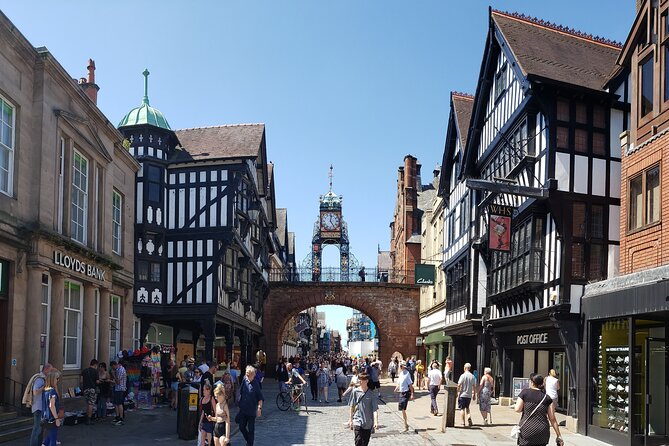
- Roman Chester is the star: See the amphitheatre, Roman Gardens, city walls, and Minerva’s Shrine.
- Start at Chester Cathedral: The route opens with one of Chester’s major landmarks and the seat of the Diocese of Chester.
- Walk at your own speed: You control the pauses, pace, and order in which you absorb the information.
- Three weeks of access: You do not have to finish the route on the day you activate it.
- Useful digital extras: The app includes audio, photos, videos, directions, GPS, and food and sightseeing suggestions.
- Expect a self-guided experience: There is no in-person guide, and attraction admission fees are not included.
Why this Chester walk works well

Chester is an easy city to explore on foot, but its history can feel scattered. A Roman gate sits below a Victorian clock. Medieval walls run beside modern streets. A Norman castle, a Roman shrine, and a grand cathedral all occupy the same compact center.
This tour gives those pieces a sensible order. You begin at Chester Cathedral, cross through the old center, follow the walls from Eastgate toward North Gate, then head to the castle, the Roman remains, and Grosvenor Park. You get a broad introduction instead of spending your first hour wondering which direction to take.
The format suits people who dislike being hurried. You can stop for a coffee, enter the cathedral if you wish, take photographs, or replay a section when the streets get noisy. You also receive three weeks of unlimited access through the app, so the route can be spread across more than one outing.
That flexibility is the strongest reason to book. It also makes this a useful first walk for a family or private group. You are not sharing a guide with strangers, and the only participants are members of your own group.
At the same time, this is not a substitute for a lively local guide. The commentary focuses on facts, dates, and background. One person found it informative but wanted more storytelling and human detail. If you prefer personal anecdotes and a guide who can answer questions on the spot, you may find the experience too formal.
More self guided walks in England:
- Westminster Abbey Entrance Ticket Including Audio Guide
★ 4.0 · 661 reviews - Western Approaches Self Guided Tour
★ 5.0 · 505 reviews - Golden Tours York Hop-on Hop-off Open Top Bus Tour with Audio Guide
★ 4.5 · 468 reviews
Starting at Chester Cathedral
The route begins at Chester Cathedral on St Werburgh Street. This is a good starting point because the cathedral immediately gives you a sense of Chester’s scale and age.
The audio introduction sets the city in context before moving into the cathedral’s story. You learn about the mother church of the Diocese of Chester and the building’s place in the city. The cathedral portion is listed at about 15 minutes.
Admission is not included, so treat the audio stop as an outside introduction unless you choose to pay for entry separately. The tour does not provide a guided interior visit. That distinction matters if the cathedral is your main reason for coming.
I like beginning here because it prevents the walk from becoming a simple checklist of ruins. Chester’s story includes religious, Roman, medieval, and Victorian chapters, and the cathedral helps establish that wider frame from the start.
Roman Chester before the clock
The route then turns to Chester’s Roman past. The commentary explains the city’s role during the Roman conquest of Britain and introduces Roman heritage before you reach some of the larger remains.
Chester was known as Deva Victrix during the Roman period. The tour uses that past to explain why the city has so many Roman traces. This early section is useful because later stops, such as the amphitheatre and Roman Gardens, make more sense when you understand the military importance of the settlement.
The Roman information is also a good reason to listen rather than simply follow a map. Ruins can look like disconnected blocks of stone. Audio context helps you picture the city as a major Roman fort rather than a few scattered archaeological sites.
Still, expect an educational presentation more than a dramatic historical performance. The experience is designed to orient you, not recreate Roman life with actors or elaborate scenes.
Eastgate and the famous clock
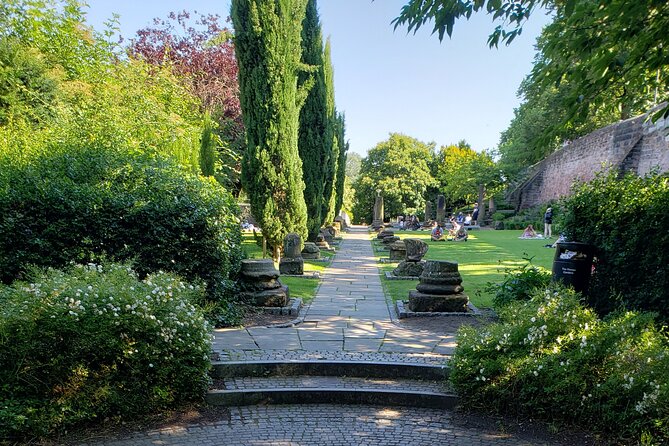
Eastgate and Eastgate Clock are among the quickest stops, with about five minutes suggested. The gate is one of Chester’s best-known symbols, and the clock sits above an ancient Roman gateway.
The audio explains why the clock was built over the old gate and how it became tied to Chester’s public image. That small detail is easy to miss if you only stop for a photograph. The route gives you a reason to look beneath the decorative clock and notice the older structure supporting it.
This is a brief stop, but it makes a useful bridge between Roman Chester and the medieval city. You are not only seeing a pretty clock. You are seeing layers of the city occupying the same point.
Admission is free. You can pause longer than the suggested five minutes if you want photographs or need to check the next direction in the app.
A few more England half days worth a look
- Fascinating Walking Tours Of Roman Chester With An Authentic Roman Soldier
★ 5.0 · 1,232 reviews - Admission Ticket to Sick To Death in Chester
★ 4.5 · 384 reviews - Fun, Flexible Treasure Hunt Around Chester with Cryptic Clues & Hidden Gems
★ 5.0 · 162 reviews - Medieval Walking Tour of Chester
★ 5.0 · 155 reviews
Walking Chester’s walls from East to North Gate
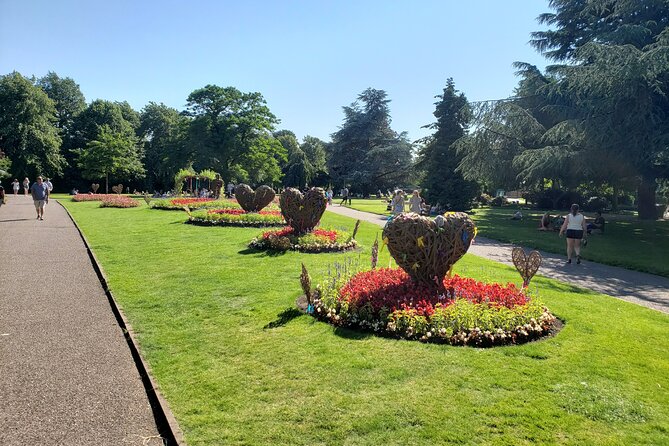
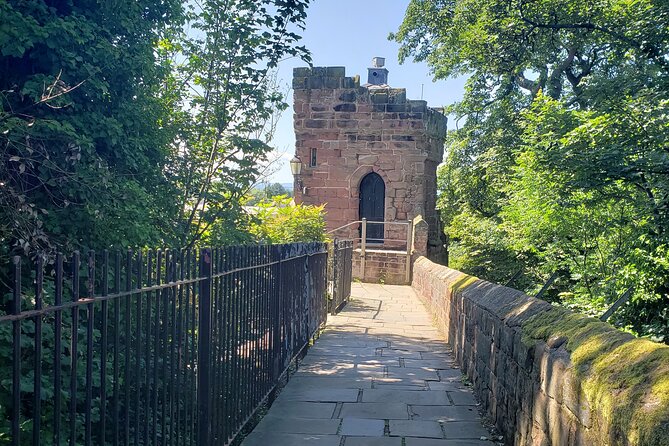
The city walls are one of the best parts of this route. The tour follows them from East Gate to North Gate and explains why they were built, how they shaped the city, and why so much of the circuit remains preserved.
The walls give you a different view of Chester than street level. You can see how the historic core is arranged and understand the practical purpose of the fortifications. The route also adds a sense of movement, since you are not merely looking at a wall from below.
The suggested time is about 15 minutes, though your actual pace may vary. The app’s GPS route should help, but this is one section where you want to keep an eye on your surroundings rather than rely only on automatic prompts.
One practical issue deserves attention. A user found that the app sometimes began playing when it thought the group was near a site, even when the group was not ready. Automatic playback can be convenient, but it may also interrupt your conversation or start the wrong section. Keep your phone controls easy to reach.
High Cross and Chester’s civil-war story
A further stop looks at Chester during the civil war and explains why the High Cross occupies its particular position. The cross was important in the city’s past, and this section adds a political chapter to the walk.
This is a welcome change from the Roman focus. Chester’s story is not only about ancient ruins. Civil-war history helps explain the city as a place of power and conflict, where public spaces carried meaning beyond their appearance.
The stop also shows the advantage of a route with audio commentary. A simple cross can be easy to pass without a second thought. A short explanation tells you why its location matters and encourages you to read the street around it as part of the story.
Chester Castle and the Agricola Tower

The walk continues to Chester Castle, founded by William the Conqueror in 1070. Today, the Agricola Tower is the only remaining part of the Norman castle mentioned in the tour.
The audio helps you imagine the site as it may have been almost 1,000 years ago. That is valuable because the castle is no longer an intact fortress with every wall in place. You need explanation to connect the remaining structure with the larger medieval stronghold.
The suggested stop lasts about 15 minutes. Admission to attractions is not included, so check the entry situation if you want to go inside any part of the castle site. The tour itself provides the historical explanation, but it does not cover entrance costs.
I especially like this stop for visitors who want more than Roman Chester. William the Conqueror’s castle marks a clear shift into Norman rule, giving the walk a useful chronological rhythm.
Minerva’s Shrine beside the River Dee

Minerva’s Shrine is one of the more unusual stops. The shrine to the Roman goddess Minerva sits in Edgar’s Field Park and is listed as a Grade I building on England’s National Heritage List.
The tour explains the early second-century sandstone quarry and what the shrine may have meant to ordinary people at the time. That focus on everyday use makes the stop more interesting than a quick statement about Roman religion.
Because the shrine is in a park, this part of the walk also feels less formal than the cathedral or castle. You get a quieter setting and a chance to consider how Roman remains survive outside the main center.
The stop is planned for about 10 minutes and admission is free. Keep your route active on the app, since this is the kind of place where a weak direction prompt could cost you time.
Roman Gardens and the question of reconstruction
The Roman Gardens display reconstructed Roman buildings and remains connected with Chester’s former fort, Deva Victrix. The tour explains what has been rebuilt and why this location was chosen for the garden.
This is an important distinction. You are not looking at a fully preserved Roman quarter. You are seeing a public display that brings together Roman material and reconstructed elements so you can better understand the ancient fort.
The tour also addresses the controversial nature of the garden. That makes the stop more useful than a simple list of dates, since it acknowledges that presenting ancient remains always involves choices about reconstruction and interpretation.
Allow about 15 minutes. Entry is free, and the gardens are an easy place to pause while you listen to the audio or study the visual material supplied in the app.
Chester Roman Amphitheatre
The Roman amphitheatre is the major ancient sight on the route. The exposed remains are the northern half of a large stone amphitheatre, and it is described as the largest Roman amphitheatre uncovered in Britain so far.
The structure dates to the first century, around the time the Roman fort of Deva Victrix was founded. The audio explains how the amphitheatre fitted into Roman Chester and helps you picture the scale of the original building.
Plan on about 15 minutes here, though you may want longer. The remains are open and free to view, so you can take in the shape of the site without paying an entrance fee. This is a place where the pictures and videos in the app may help, especially if you want to compare the ruins with a reconstruction.
For many people, this will be the point where the Roman sections come together. The earlier commentary gives you background, while the amphitheatre provides the clearest physical proof of Chester’s importance in Roman Britain.
Ending in Grosvenor Park
The tour finishes at Grosvenor Park, outside Chester’s historic walls and overlooking the River Dee. The park is Grade II registered and has a Green Flag Award.
The final section lasts about 20 minutes and focuses on the park as a Victorian public space. It is a calm way to end a walk that has moved through military ruins, religious buildings, city defenses, and political history.
The ending is practical, too. The tour provides recommendations for places to eat and things to do around Chester. You can use those suggestions to plan the rest of your day rather than treating the walk as a complete visit to the city.
The end point is on Grosvenor Park Road, in the heart of the park. Remember that the route does not return you to the cathedral. If you need to collect a bag or meet transport near the start, plan for the walk’s one-way layout.
App performance and the voice question
The tour includes a map, route, GPS, stop markers, photos, videos, recommendations, and audio commentary. Links to Google or Apple Maps are especially useful if you prefer to switch between the tour and a familiar navigation tool.
The supplied information says Jake provides the narration and specifically describes it as not computer-generated. Yet one poor experience reported a computer-generated voice, while another user had trouble getting the app working for about 20 minutes. That conflict is worth taking seriously.
Before you start walking, download the Exploro app and read the Before You Go instructions. Activate the tour in advance if possible, and note that the booking reference is not the activation code. The access instructions arrive by email.
Once the app works, the format can be very convenient. If it does not work, the first part of your visit may be spent troubleshooting rather than looking at Chester. Bring enough phone battery for the route, though the tour data does not specify whether charging points are available.
Is $12.33 good value?
At $12.33 per person, this is inexpensive for a private city introduction. The value is strongest if you want a planned route, basic historical context, and the freedom to move without a live guide.
You also get three weeks of access, which gives the fee more weight than a one-use audio file. You can use the material again during your stay, though the route itself is designed as a single walk.
The price does not include cathedral or castle admission, and there is no in-person guide. If you would need to pay for several attractions on top of the tour, your total Chester day will cost more.
I would compare it with the price of a live walking tour in your travel budget. Choose this option for independence and low cost. Choose a live guide if questions, local stories, and personal interaction matter more than controlling the pace.
Who should book this Chester tour?
This experience suits you best if you:
- Want a first look at Chester in two or three hours
- Prefer exploring privately rather than joining a group
- Enjoy audio commentary and phone-based navigation
- Want Roman, Norman, medieval, Victorian, and civil-war context in one route
- Are visiting with family and want a flexible shared activity
- Like having suggestions for food and further sightseeing
It may not suit you if you dislike using apps, expect a polished dramatic narration, or want a guide who can adjust the route and answer questions. It also requires some self-management. You need to activate the app, follow the directions, and handle playback yourself.
The rating is 3.9 from 23 reviews, which fits the experience’s strengths and weaknesses. The route and content can be genuinely useful, but the app setup and narration may affect your enjoyment.
Should you book the Private Chester Self-Guided Tour?
Book it if you want a cheap, flexible introduction to Chester and plan to visit the main sights in a sensible order. The strongest parts are the Roman amphitheatre, city walls, Eastgate Clock, and the unusual Minerva’s Shrine, with the cathedral and Grosvenor Park giving the walk a broader shape.
I would download the app and check the activation details before leaving for the start point. If the audio and GPS work properly, $12.33 buys a useful framework for your visit. If you want richer storytelling or a human guide, spend more on an in-person tour instead.
FAQ
How long does the Chester self-guided tour take?
The tour takes about 2 to 3 hours, depending on your walking speed, pauses, photographs, and time spent at the stops.
Where does the tour start?
It starts at Chester Cathedral, St Werburgh Street, Chester CH1 2DY, United Kingdom.
Where does the tour finish?
The route finishes at Grosvenor Park Road, Chester CH1 1QQ, in Grosvenor Park.
Is this a private tour with an in-person guide?
No. It is a private self-guided activity, so only your group participates, but there is no in-person guide.
What language is the audio guide offered in?
The tour is offered in English. The included information identifies Jake as the audio guide.
Are entrance fees included?
No. Any entrance fees for attractions mentioned during the walk are separate. Several outdoor stops, including Eastgate Clock, the city walls, Minerva’s Shrine, Roman Gardens, the Roman amphitheatre, and Grosvenor Park, are listed as free.
How long can I use the self-guided tour?
You receive three weeks of unlimited access to the tour through the app after activation.
Recently added around England
- Brighton to Heathrow Airport private taxi transfers★ 5.0 · 8 reviews
- London’s Crown Secret: Self-Guided Royal Puzzle Quest★ 4.5 · 8 reviews
- The Condensed Canterbury Tour★ 5.0 · 8 reviews
- Postcard London★ 5.0 · 8 reviews
- Private Tour: Downton Abbey London Locations by Taxi★ 5.0 · 8 reviews
- Windsor Castle, Stonehenge & Roman Baths Private Tour★ 4.5 · 8 reviews
- CS Lewis & Tolkien Tour with Magdalen Entry Public tour 13.45★ 5.0 · 8 reviews
- Cotswolds Private Driving Tour from London★ 5.0 · 8 reviews
Chester Tours, compared.

Fascinating Walking Tours Of Roman Chester With An Authentic Roman Soldier
Read our review →

Fun, Flexible Treasure Hunt Around Chester with Cryptic Clues & Hidden Gems
Read our review →

Chester Food Tour: Unique Food With Drinks & Sightseeing
Read our review →
City Sightseeing Chester Hop-On Hop-Off Bus Tour
Read our review →
North Wales Adventure – Sightseeing Day Trip Tour
Read our review →
Browse the lists this tour appears in