
Reviewed · BRITISH MUSEUM TOURS
British Museum & National Gallery of London Semi-Private 8ppl Max
London gives you two huge museums in one half-day tour, but the real prize is having someone decide what deserves your attention. At the British Museum, your guide moves you from Samurai armor to Assyrian lion-hunting reliefs, the Lewis Chessmen, and the Rosetta Stone without leaving you lost in 6,000 years of material.
I like the eight-person maximum, which makes it easier to hear the guide and ask questions. I also like the split between archaeology and European painting, with strong guides such as Stephanie, Becky, Matilda, Jamie, Sheldon, and Anthony Matthews praised for making difficult subjects clear. The main drawback is simple: two museums this large can only be sampled in 5.5 hours, and lunch is on your own between the visits.
Key points to know before booking
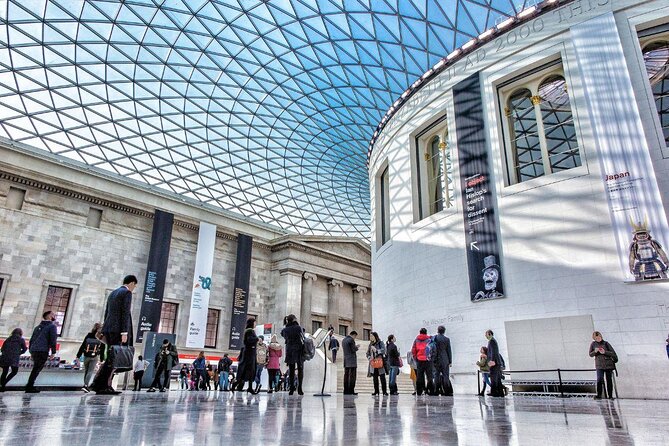
- Two major London museums in one day: Begin at the British Museum and finish at the National Gallery in Trafalgar Square.
- A true small-group format: The group never exceeds eight people, with a private-tour upgrade available.
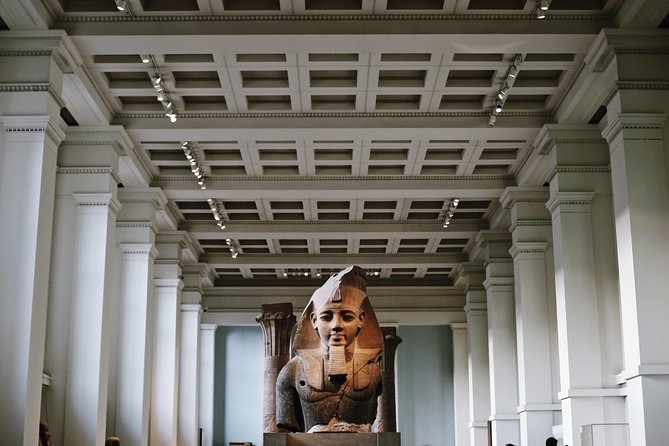
- Essential British Museum highlights: See the Rosetta Stone, Mummy of Katebet, Lewis Chessmen, Samurai armor, and Assyrian reliefs.
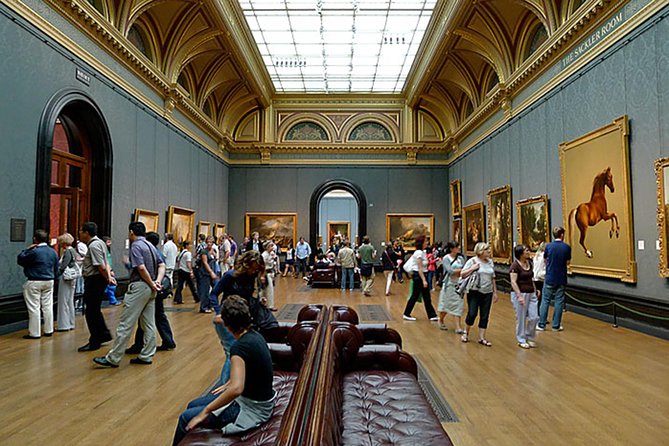
- European painting from the 1300s onward: The National Gallery portion includes Van Eyck, Van Gogh, Rembrandt, Vermeer, Seurat, Botticelli, Monet, and Leonardo da Vinci.
- Five and a half hours with a lunch break: Each museum receives about 2.5 hours, with lunch at your own expense between stops.
- Best for first visits: A guide helps you find the major works quickly and supplies the context that labels alone rarely provide.
Why these two museums work well together
The British Museum and National Gallery tell very different stories. The first follows human cultures across thousands of years through objects, monuments, and artifacts. The second traces the development of European painting from the 13th through the 19th centuries.
That contrast gives the day a useful rhythm. You begin with ancient Egypt, Assyria, medieval Europe, and Japan. After lunch, you shift to composition, portraiture, color, light, and the changing role of the artist.
I would not try to see either museum in full during one visit. The British Museum holds material from around the world across 6,000 years, while the National Gallery contains more than 2,300 paintings. The value of this tour is not total coverage. It is a focused route through major works, with a guide explaining why they matter.
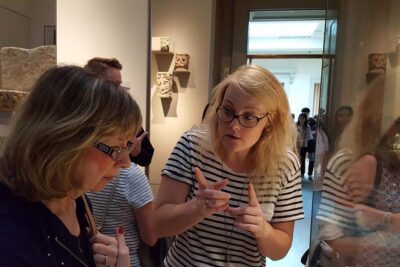
The group size also matters. With a maximum of eight people, you get a more personal setting than a large coach-style museum tour. You can ask a question without stopping an entire crowd, and the guide can react to the interests of the group.
More British Museum visits:
- British Museum London Guided Tour Semi-Private 8ppl Max
★ 5.0 · 984 reviews - The British Museum London – Exclusive Guided Museum Tour
★ 5.0 · 555 reviews - British Museum Guided Tour
★ 4.0 · 470 reviews
Starting near the British Museum at 10 a.m.
The tour begins at 10 a.m. near the British Museum, at Stop W, London WC1B 3BP. You are responsible for reaching the meeting point, since hotel pickup and drop-off are not included. The area is near public transportation, and the operator recommends using a taxi or Uber if that suits your plans.
Bring your mobile ticket and make sure the operator has your mobile phone number, including the country code. That contact detail is required, so do not skip it when booking.
Security rules affect what you can bring inside. Large bags and suitcases are not allowed. A handbag or small, thin backpack is the safer choice. Since museum rules can change, pack lightly and allow a little patience for security checks.
The tour requires at least two people to operate. If that minimum is not reached, you are offered another option or a full refund. The maximum is eight people, so the small-group promise is clear.
Seeing the British Museum through selected objects
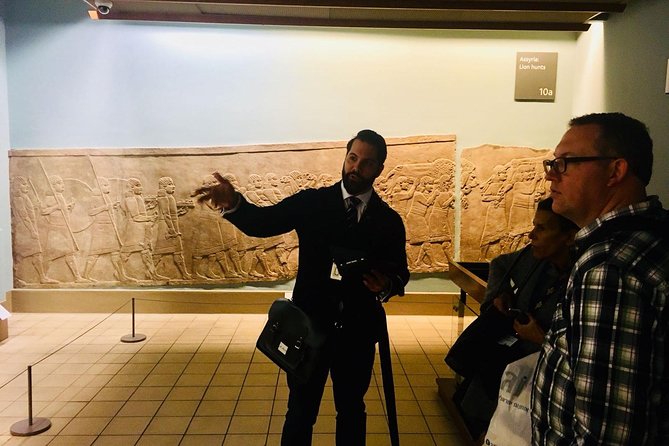
The British Museum portion lasts about 2.5 hours. That is enough time for a thoughtful introduction and a route through major galleries, but not enough for every room.
This is where a guide earns the fee. On your own, the museum can feel like a grand warehouse of famous names. You may find the Rosetta Stone, but not understand why one inscribed stone became so important to reading ancient Egyptian hieroglyphs. You may pass the Assyrian lion-hunting reliefs, but miss the way royal power, ritual, and storytelling are built into the scene.
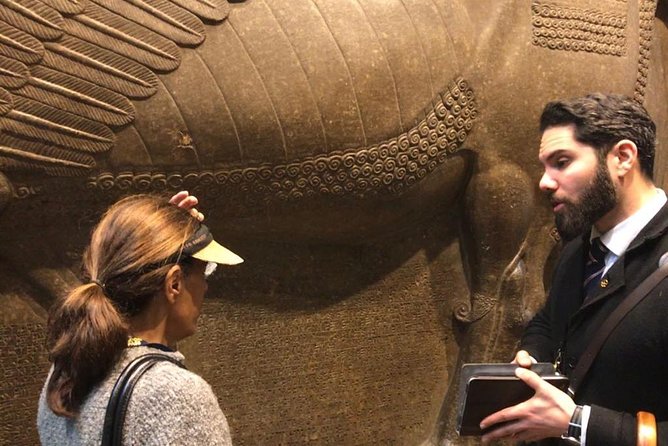
The guide’s job is to connect the object to its time and purpose. The tour description promises discussion of primitive tribes and fallen empires, but the stronger idea is the human scale of the collection. You move from early societies to sophisticated empires and see how people recorded belief, power, play, and daily life.
Rosetta Stone
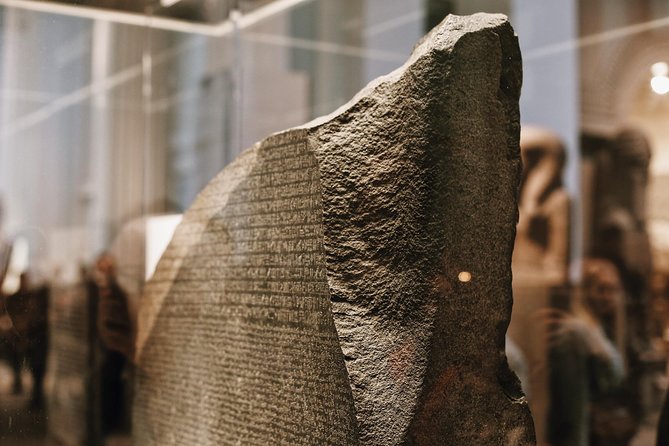
The Rosetta Stone is the obvious British Museum landmark. It is an actual ancient stone inscribed with priestly Egyptian texts, not anything connected with the language-learning program that shares its name.
Its importance comes from the way the same text appears in different scripts. Your guide places it in the story of decipherment and explains why this one object changed modern understanding of ancient Egypt. That context is more useful than simply taking a photo and moving on.
More museums and galleries in London:
- Tower of London and Crown Jewels Exhibition Ticket
★ 4.5 · 6,677 reviews - Chelsea FC Stadium Tours and Museum
★ 5.0 · 1,908 reviews - Official tickets: Moco Modern & Contemporary Art Museum
★ 4.5 · 1,157 reviews - The Postal Museum Admission Ticket
★ 4.5 · 347 reviews
Mummy of Katebet
The Mummy of Katebet gives the Egyptian collection a personal focus. Instead of looking only at rulers and monumental objects, you encounter an individual and the customs surrounding death, identity, and the afterlife.
A good guide can make this kind of stop memorable without turning it into a dry list of dates. The tour’s emphasis is on the human story behind the artifact, which helps you connect the museum’s ancient material to familiar concerns.
The Lewis Chessmen
The Lewis Chessmen are among the most approachable objects on the route. Their small size and expressive faces make them easy to enjoy, even if you know little about medieval history.
They also open a window into gaming, craftsmanship, trade, and social life. This is the sort of stop that works well in a small group because you can look closely and ask why the pieces appear as they do.
Assyrian lion-hunting reliefs and Samurai armor
The Assyrian reliefs show royal hunting as political theater. The imagery is not just decoration. It presents the ruler as powerful, controlled, and capable of defeating nature itself.
Samurai armor shifts the focus to another society and another form of status. Seeing these objects in the same museum makes the British Museum’s global scope clear, though it also highlights the day’s central limitation: every gallery you visit means another gallery you leave for a future trip.
The guide helps you avoid spending too long at the first famous object you encounter. Several guides, including Stephanie, Jamie, and Craig, have been especially praised for steering groups around crowds and reaching important pieces efficiently. Craig’s experience working at the museum also added behind-the-scenes context for one group, though guide assignments vary.
Lunch break between the museums
After the British Museum, you leave the museum for a lunch break before reconvening for the National Gallery. Lunch is not included, and the supplied details do not specify a restaurant or fixed length for the break.
Plan your budget and energy accordingly. The first museum involves a lot of standing and walking, and the afternoon art tour demands attention rather than just sightseeing. A proper break can help, but you should not assume that lunch is part of the guided service.
The National Gallery is at Trafalgar Square, London WC2N 5DN, where the tour ends. Since the day finishes there, this location works well if you plan to continue around central London afterward.
Meeting Van Eyck, Van Gogh, and the painters of the National Gallery
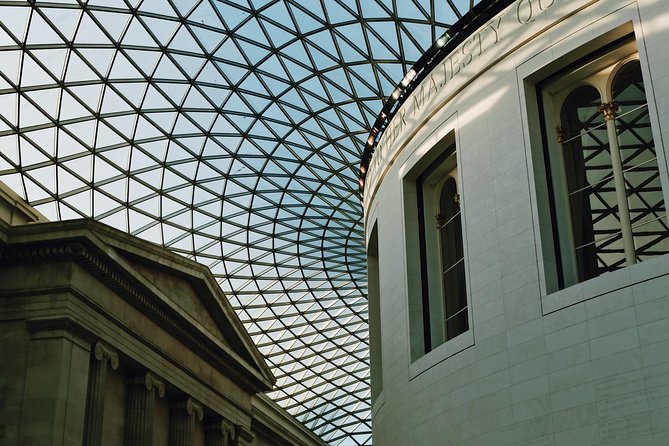
The National Gallery portion lasts about 2.5 hours. The collection covers European painting from the 13th to the 19th centuries, with more than 2,300 works in total.
The guide begins with a short introduction, then leads you to selected highlights. The goal is not to race through every room. It is to show you how painters handled subjects, technique, patronage, religion, portraiture, and changing ideas about art.
That approach is particularly useful if you are not already comfortable in art museums. Names such as Seurat, da Vinci, Botticelli, Monet, Rembrandt, and Vermeer can blur together when you see them on a map. A guide gives each artist a place in the story and asks you to look at how the painting works.
The Arnolfini Portrait
Jan van Eyck’s Arnolfini Portrait, painted in 1434, depicts a Bruges merchant and his wife. It is a small painting with a great deal packed into it, including detail, symbolism, clothing, furnishings, and the question of what the scene represents.
This is a good example of why a guide improves the visit. You can admire the precise surfaces on your own, but a discussion of the figures, setting, and visual clues gives you more ways to look. The painting becomes a puzzle about identity and meaning rather than simply an old portrait.
Van Gogh’s Sunflowers
Van Gogh’s Sunflowers provides a sharp contrast. Its color, brushwork, and emotional force feel very different from Van Eyck’s controlled detail.
The National Gallery holds one of four sunflower paintings made by Van Gogh in 1888. Your guide can use the work to explain his handling of paint and the role of repeated subjects in his art. Even if you know the image well from books and posters, seeing the original within a sequence of other painters changes how you read it.
Rembrandt, Vermeer, Seurat, Botticelli, Monet, and da Vinci
The route also includes works by Rembrandt, Vermeer, Seurat, Botticelli, Monet, and Leonardo da Vinci. The exact rooms and works can vary, since museum collections shift and some galleries may be closed.
The best part of this section is the comparison between artists. You may look at how light behaves in a Vermeer, how Rembrandt builds a face, how Seurat organizes color, or how Monet treats changing atmosphere. You gain a basic visual vocabulary that makes the rest of the National Gallery easier to enjoy.
Becky has been especially praised for explaining both individual paintings and art in general. Her style reportedly includes questions that make you look closely and form your own response before she supplies the historical background. Matilda, Mathilda, Jamie, Luis, Eli, and Anthony Matthews have also been singled out for clear explanations, strong energy, and an ability to connect art with its period.
What the small group changes
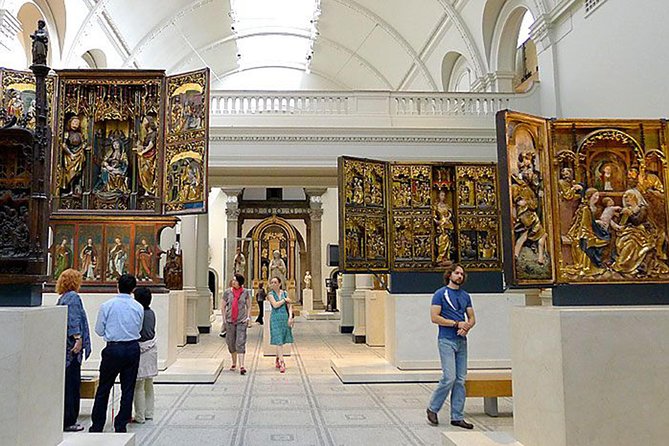
An eight-person limit is not the same as a private tour, but it is a useful middle ground. You receive more access to the guide than you would in a large group, while paying less than a fully private experience.
The group can still affect the pace. One detailed question may slow the route, especially in a museum where every gallery offers another possible discussion. That is not always a bad thing, but you should understand that the schedule has limits.
A private upgrade is available if you want maximum flexibility and personalization. That choice makes the most sense for a family with very specific interests, a group with different walking speeds, or anyone who wants to spend longer on selected objects.
The guide quality matters more than the precise route. Stephanie has been praised for taking groups directly to the major British Museum sights. Becky has received strong recognition for her art teaching. Matilda has been noted for adapting when museum conditions changed, and Elisha for making ancient objects feel approachable while welcoming questions.
Price, value, and the five-and-a-half-hour format
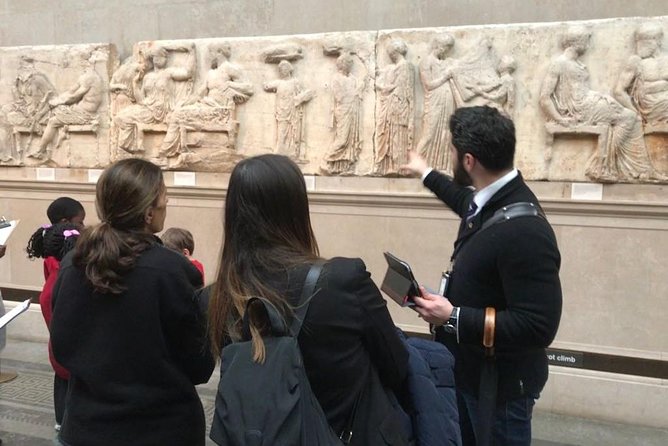
At $201.01 per person, this is not a budget museum visit. Both museums offer free general admission, and you can enter on your own without paying this tour price.
You are paying for planning, interpretation, navigation, and a small group. If you already know both collections well, the price may be hard to justify. If you are visiting London for a short time and want the major works placed in context, the calculation looks better.
The tour gives each museum about 2.5 hours, including a lunch break across the full 5.5-hour experience. That is efficient, but it is also demanding. You will not leave feeling that you have seen everything.
For a first visit, I consider the price reasonable only if guided interpretation is important to you. The strongest value comes from avoiding wasted time in enormous museums and learning how to look at objects and paintings. You can then return on your own later with a better sense of where to go.
Temporary exhibitions are not included. The collections and accessible rooms may vary during the year, and occasional closures can occur without warning. If a museum opens more than an hour late, an alternative is offered, but refunds or discounts are not provided for those changes.
Who should book this London museum tour?
I would recommend it to you if this is your first London visit, your schedule is tight, or you find major museums overwhelming. It also suits families and mixed-age groups, since the guide can explain complex subjects without requiring specialist knowledge. One guide was specifically praised for being patient with children.
It works well for adults who want art and history together. The British Museum supplies objects and civilizations. The National Gallery supplies paintings and artistic change. The combination gives you a useful overview of human culture, but it asks for sustained attention.
I would think twice if you prefer slow, unplanned museum visits. You may want to spend an hour with one painting or linger in a favorite civilization gallery, and this format does not allow much freedom.
The tour is also not suitable for people with walking disabilities or those using a wheelchair. A moderate level of physical fitness is required, and you should expect to stand and walk for much of the day.
Practical details that can make the day easier
Wear appropriate clothing for museum entry and comfortable shoes. Leave large luggage at your accommodation, since only small bags are allowed through security.
The start point is near public transportation, but hotel transfers are not included. The day ends at the National Gallery in Trafalgar Square, not back at the British Museum.
Free cancellation is available up to 24 hours before the local start time. Cancellations or changes made inside that window are not accepted for a refund. The operator also offers a satisfaction guarantee, but you must contact it within 24 hours after the tour and allow it a chance to address the problem.
Should you book it?
Book this tour if you want a fast, guided introduction to two of London’s major museums and value a small group more than a low price. The British Museum highlights are strong, and the National Gallery section can change how you look at paintings, especially with a guide such as Becky, Stephanie, Matilda, Jamie, or Anthony Matthews.
Skip it if you are happy navigating alone, want temporary exhibitions, need wheelchair access, or prefer to spend a full day in one museum. For everyone else, the tour gives you a practical first pass through an enormous amount of art and history, with enough explanation to make a return visit much more rewarding.
FAQ
How long does the British Museum and National Gallery tour last?
The experience lasts approximately 5 hours and 30 minutes, including a lunch break.
What time does the tour start?
The tour starts at 10 a.m.
Where does the tour begin?
It begins near the British Museum at Stop W, London WC1B 3BP, United Kingdom.
Where does the tour end?
The tour ends at the National Gallery in Trafalgar Square, London WC2N 5DN.
How large is the group?
The semi-private group has no more than eight people. A private-tour upgrade is also available.
Is lunch included?
No. The tour includes a lunch break, but you pay for your own lunch.
Are museum admission tickets included?
The experience includes the guided combo museum tour and guide service. General admission to the British Museum and National Gallery is listed as free. Temporary exhibitions are not included.
Is hotel pickup or drop-off provided?
No. Hotel pickup and drop-off are not included. The meeting area is near public transportation, and taxi or Uber service is recommended.
Can I cancel for a full refund?
Yes. You can cancel at least 24 hours before the experience start time for a full refund. Changes or cancellations made less than 24 hours before the start time are not accepted for a refund.
Recently added around London
- London’s Crown Secret: Self-Guided Royal Puzzle Quest★ 4.5 · 8 reviews
- Postcard London★ 5.0 · 8 reviews
- Private Tour: Downton Abbey London Locations by Taxi★ 5.0 · 8 reviews
- Windsor Castle, Stonehenge & Roman Baths Private Tour★ 4.5 · 8 reviews
- Cotswolds Private Driving Tour from London★ 5.0 · 8 reviews
- Skip-the-line London Westminster Abbey and City of Westminster Kid-Friendly Tour★ 5.0 · 8 reviews
- A Silent Disco Adventure in London★ 5.0 · 8 reviews
- Gangster Tour of Soho★ 4.5 · 8 reviews
British Museum Tours, compared.
British Museum London Guided Tour Semi-Private 8ppl Max
Read our review →
The British Museum London – Exclusive Guided Museum Tour
Read our review →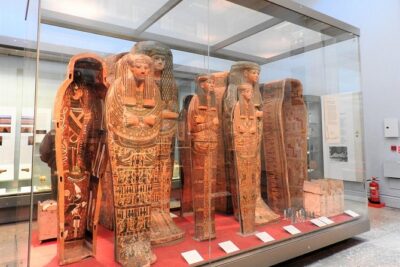
Private Guided Tour of the British Museum – Tickets Included
Read our review →
British Museum Guided Tour with Priority Timeslots(Small Group)
Read our review →
Explore Biblical Artifacts at the British Museum
Read our review →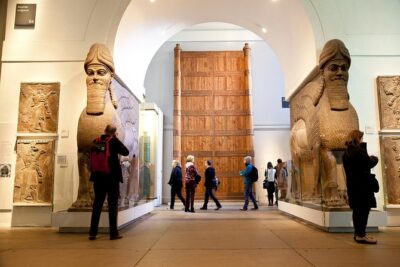
British Museum Highlights Private Tour in London including the Rosetta Stone
Read our review →
Crash course in archaeology at the British Museum
Read our review →Browse the lists this tour appears in