
Reviewed · OXFORD TOURS
Extended: Oxford University & City Tour With Christ Church
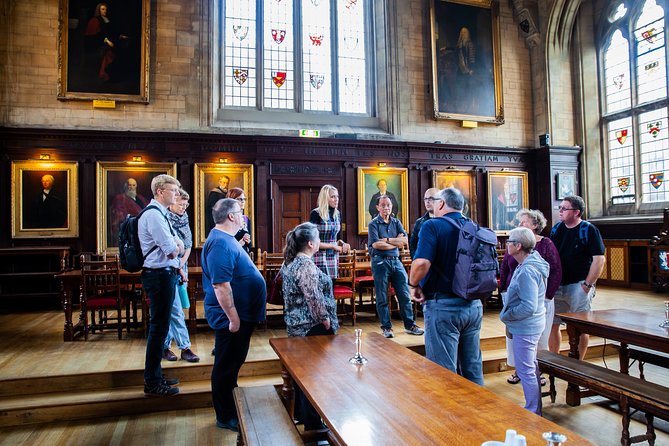
Oxford’s oldest colleges, grand libraries, medieval lanes, and student traditions all come together on this walking tour. The best part is the student guide’s view of Oxford, which adds daily university life to the stonework and dates. You may hear guides such as Luke, Antonia, Rose, Sam, or Oliver explain not just what a building is, but how the university works today.
I like the wide sweep of the route, from Balliol and Magdalen to the Radcliffe Camera and Christ Church Meadow. I also like the practical extras: a small group capped at 19 people, headsets that help you hear the guide, and entry to selected college buildings. The main drawback is timing. Christ Church comes near the end, and its one-hour self-guided visit can feel rushed if closing times or room closures cut into your visit.
Key points to know before booking
- A student-led walk through Oxford’s main sights: Expect history, traditions, college rivalries, and current student life rather than a quick photo stop.
- Christ Church is the extended tour’s main prize: You receive an external introduction from the guide, then enter independently with a multimedia audio guide.
- The route covers a lot of ground: Wear comfortable shoes and expect frequent walking between colleges, libraries, churches, and public squares.
- Some interiors are included, but access can change: Trinity College and the Bodleian Library are listed with admission, while the Divinity School can close during busy months.
- The tour can begin in London or Oxford: Pickup from Gloucester Road in London is the more expensive option; the Oxford meeting point is at 15 Broad Street.
- It offers good value for first-time visitors: You avoid arranging several separate entrances, but independent visitors may prefer a slower, less structured day.
Why this Oxford tour works for first-time visitors
Oxford can feel confusing at first. The colleges are scattered through the city, many entrances are easy to miss, and the university is not one single campus with a clear gate. A guide gives the streets a framework.
This route is especially useful if you want a broad introduction in a short time. In roughly three hours, you pass or enter a long list of important sites, then spend about an hour exploring Christ Church on your own. It is not a quiet, scholarly visit to one college. It is a brisk survey of Oxford’s main ideas, buildings, personalities, and traditions.
The guide-led portion is built around stories. A student guide can explain the difference between a college and the wider university, describe college life, and add the sort of small details that make the setting easier to remember. Guides named in the tour feedback, including Luke, Antonia, Rose, Sam, Oliver, Ben, and Olli, were praised for humor, clear explanations, and personal insight into student life.
Headsets are an important practical touch. Oxford streets can be crowded, and the group may spread out when people stop for photographs. A headset lets you keep looking around without losing the guide’s explanation. It also helps people who walk more slowly catch up without asking the guide to repeat every point.
A few more Oxford half days worth a look
- Oxford University Walking Tour With University Alumni Guide
★ 5.0 · 6,905 reviews - 1.5-hour Oxford City and University Walking Tour
★ 4.5 · 1,383 reviews - Oxford Official University & City Tour
★ 5.0 · 1,134 reviews
Balliol, Trinity, Exeter, and Hertford
The opening stops introduce the collegiate system through four very different institutions.
Balliol College is often argued to be Oxford’s oldest college. The point is less about settling a centuries-old argument than seeing how early Oxford’s colleges began to form. The short stop is an orientation, not a full interior visit.
Trinity College, founded in 1555, receives a longer visit and is one of the colleges included with admission. Its buildings are often described as among Oxford’s most beautiful, so this is one of the early chances to see college architecture from closer range rather than simply hearing about it from the street.
Exeter College dates to 1314 and has a literary connection through J.R.R. Tolkien, who attended there as a student. That gives the guide a useful opening to discuss the people who shaped Oxford’s cultural life. You get only about five minutes here, so expect a focused explanation rather than a long wander through the college.
Hertford College has roots going back to 1282 and is known for a more progressive character. Its inclusion helps correct the old picture of Oxford as frozen in the past. The university has ancient customs, but its colleges are not identical in outlook or student culture.
These early stops are short by design. You see more of Oxford, but you will not linger at every doorway. If you want detailed interiors and long photo sessions at each college, this is not the right format.
Magdalen College and its deer park
Magdalen College gets the longest stop on the early walking route, around 20 minutes. Founded in 1458, it is the largest college in Oxford and has extensive grounds, including a deer park.
That open space offers a welcome change from the tight streets and stone courtyards. It also shows why Oxford colleges are more than classroom buildings. Their grounds support a distinct community life, with gardens, paths, dining rooms, chapels, and private spaces used by students and staff.
Magdalen is linked with C.S. Lewis and Oscar Wilde, two figures who give the college a strong literary appeal. The tour does not turn into a literary pilgrimage, but these connections help place the college within Oxford’s long academic and artistic story.
One unnamed stop in the route refers to a college built in 1427 with a historic rivalry with its neighbors. Since the exact name is not specified, treat this as part of the passing commentary rather than a guaranteed interior visit. Oxford is full of rivalries, and they are often a lively way to understand the personalities of its colleges.
Science, books, and Oxford’s darker past
The History of Science Museum is a brief stop, but it comes with an excellent detail: Albert Einstein’s chalkboard, preserved with his markings from a series of lectures he gave in Oxford. You may not have time for a full museum visit, but the chalkboard gives science a physical place in a city better known for medieval stone and formal ceremonies.
The Weston Library provides one of the sharpest visual contrasts on the route. Its Brutalist design breaks from Oxford’s familiar Victorian Gothic style. The library holds more than five million books, including documents of major importance to world history, and its modern interior was extensively renovated.
You should not expect to browse the entire collection. The value here is understanding how Oxford’s old scholarly purpose continues in a modern building. The stop also reminds you that the university is not only about ancient colleges. It is an active center for research and conservation.
The Martyrs’ Memorial is easy to overlook, but its story is grim and important. It recalls the religious conflict between Protestants and Catholics in England, a period that led to public executions and violent persecution. This is a useful correction to the postcard image of Oxford. The city’s beauty sits alongside a history of fear, authority, and religious struggle.
A completely different sort of day out in Oxford:
- City Sightseeing Oxford Hop-On Hop-Off Bus Tour
★ 4.5 · 1,042 reviews - Harry Potter Walking Tour of Oxford Including New College
★ 4.5 · 930 reviews - Oxford Sightseeing River Cruise Along The University Regatta Course
★ 4.5 · 652 reviews - Afternoon Tea Sightseeing River Cruise in Oxford
★ 5.0 · 583 reviews
The Sheldonian Theatre and New College
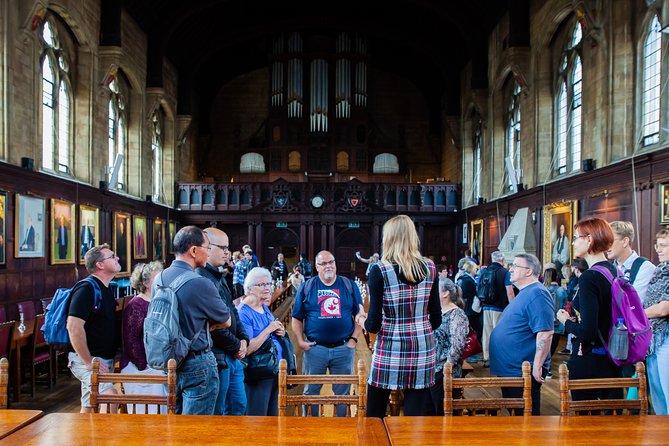
The Sheldonian Theatre was completed in 1669 by Sir Christopher Wren. It hosts major university ceremonies, so the building represents Oxford as a working institution, not just a film set or historic monument.
The tour gives you a short exterior-focused visit, enough to place the theatre within Oxford’s academic rituals. If you enjoy ceremony and university customs, listen closely here. The building’s role matters as much as its architecture.
New College is another reminder that Oxford’s names can mislead. Despite being called New College, it dates to 1379. It also served as an important model for the development of later colleges. The five-minute stop is brief, but the name alone makes it a memorable part of the walk.
Bodleian Library, Divinity School, and the city’s famous views
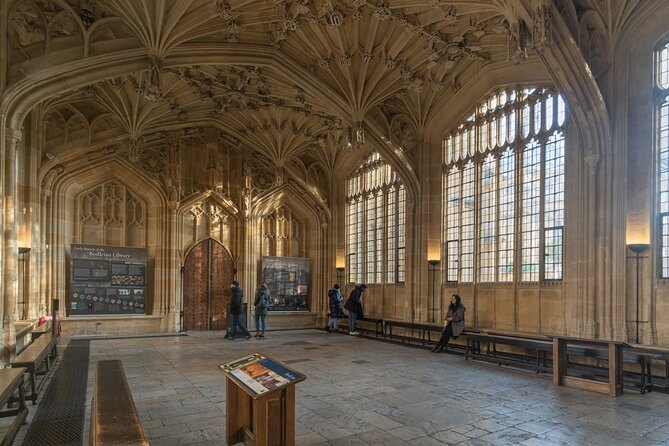
The Bodleian Library is one of the tour’s major draws. Built in 1602, it is responsible for more than 12 million books, with documents dating back to the time of the pharaohs. The route includes admission, but access to working library spaces can change without notice.
That point matters. The Bodleian is not simply a museum. It is an operating academic library, and ceremonies, research needs, or university schedules can restrict entry. If the interior is closed, you may still see the building from outside, but that will feel disappointing if the library was your main reason for booking.
The nearby Divinity School is a medieval highlight. Built in 1427 as the first purpose-built lecture room, it is one of Europe’s finest examples of medieval architecture. Its vaulted interior has also appeared in Harry Potter and other films, though its real purpose was academic and ceremonial long before the cameras arrived.
During June through August, access to the Divinity School is especially uncertain because of frequent closures and high demand. If it is unavailable, the operator says it will substitute another university college entrance. That is a sensible safeguard, but you should not book on the assumption that this particular room is guaranteed in summer.
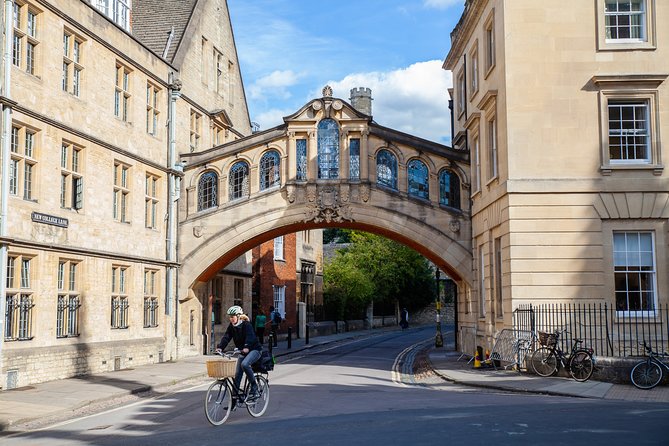
The Bridge of Sighs is Oxford’s most photographed site, and it is easy to see why. The enclosed bridge makes a strong picture from the street, though the stop is short. Bring your camera, but do not expect a long photography session.
The Radcliffe Camera is the city’s iconic postcard view. It is worth the attention, but its function is often misunderstood. The round building is a reading room and library space, not a standard public lending library. The guide helps explain why it looks so grand and how it fits into the wider Bodleian system.
All Souls College follows, with its reputation as Oxford’s most exclusive academic institution. It is associated with Laurence of Arabia and with some of the university’s most distinctive traditions. The stop is generally an exterior overview, so treat it as a chance to understand the institution rather than an invitation to wander freely inside.
St. Mary’s, Merton, and Christ Church Meadow
The University Church of St. Mary the Virgin is described as the heart of Oxford University, reflecting the institution’s religious foundations. Its grotesques, the carved figures that decorate the building, add a lively visual detail to the stop.
Merton College, founded in 1264, has a reputation for serious academic work and is one of the crucial early colleges in Oxford’s story. A lighter detail about its excellent student food helps keep the explanation from becoming a list of dates and founders.
Christ Church Meadow changes the pace again. This broad public space sits in the center of Oxford and has a strong connection with Alice’s Adventures in Wonderland. It gives you room to see the relationship between the college, the city, and the open ground around them.
The meadow is also a useful transition before the final major visit. After a long stretch of streets and college fronts, you get a different view of Oxford, one that feels less formal and more like a shared city space.
Christ Church, Harry Potter, and the one-hour finish

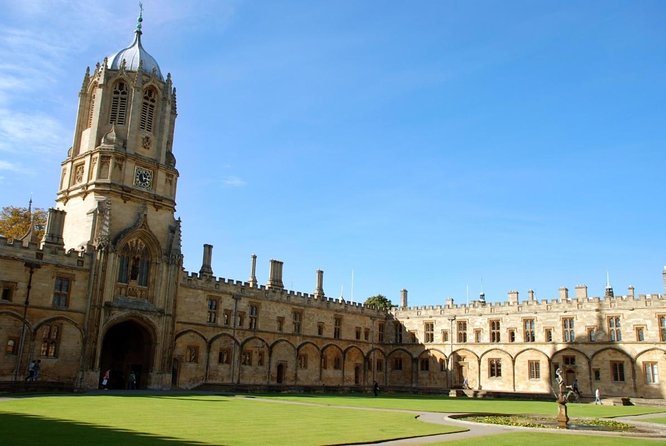
Christ Church is the centerpiece of the extended option. Nearly 500 years old, it combines impressive buildings with connections to Harry Potter and Alice’s Adventures in Wonderland.
Your guide first gives you an external explanation of the college and its grounds. You then enter independently with a multimedia audio guide produced by the Christ Church team. The arrangement has a clear advantage: you can move at your own pace instead of staying with the walking group.
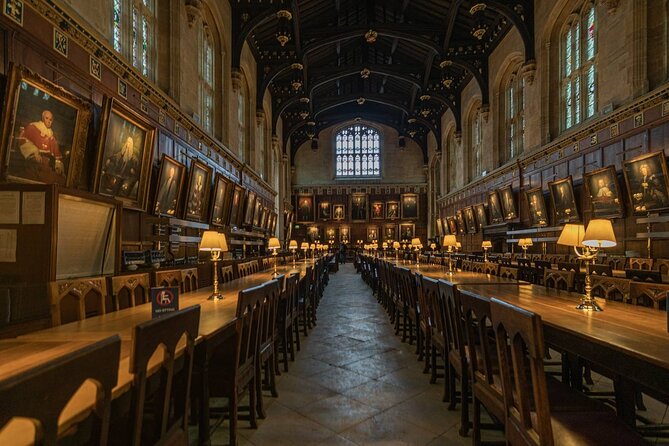
Allow the full hour. One person who needed to catch a train regretted not having more time, and that is easy to understand. Christ Church has enough rooms, courtyards, and historic details to reward a slower visit. In some periods, sections may close early, and the dining hall may not open until 2 p.m., so follow the suggested order from the guide and check the available areas promptly.
This is also where the tour’s schedule can cause trouble. If you arrive close to closing time, you may be ushered through rooms or find sections shut before you reach them. The operator allows about one hour, which is usually workable, but it is not generous if you want to stop for many photos or read every display.
The self-guided finish is ideal for people who like freedom after a structured walk. It is less ideal if you want a guide beside you explaining every room. Think of Christ Church as a separate final visit attached to the walking tour, not simply another five-minute stop.
Price, transport, and the real value
At $110.90 per person, the tour is not cheap. Its value depends largely on how much help you want arranging Oxford in a single day.
The price covers a small-group guide, selected college and library admissions, and the Christ Church entrance. You also get a planned route through many key places, which saves you from working out which colleges are open, where to buy tickets, and how to fit them together.
If you choose the pickup option, the meeting point is Gloucester Road Underground station in South Kensington, London. The departure time is 8 a.m., and missing it for any reason means no refund. The tour ends back at the meeting point, so the London option is convenient for a planned day trip but leaves little room for a late start.
If you do not choose pickup, the meeting point is 15 Broad Street in Oxford. This is the better choice if you are already staying in Oxford or arranging your own transport. Confirm which meeting point you selected, since the two options are not interchangeable.
The group can have up to 19 people. That is small enough for a personal feel, though not private. The headset system helps keep the group together, especially when the guide is explaining something in a busy street.
Who should book it?
I would choose this tour if you have limited time in Oxford, want the major sights explained in a sensible order, and value a student’s view of college life. Families can also do well with it, since guides such as Ruth have balanced stories for adults and children.
It suits people who enjoy walking and historical context. You should have moderate physical fitness, wear good shoes, and bring a rain jacket. Oxford weather can turn unpleasant, and the tour continues outdoors.
I would skip it if your main goal is photography, quiet wandering, or a long visit inside one college. Independent visitors can move more slowly and adjust their day around opening times. I would also think twice if the Bodleian Library or Divinity School is your single reason for booking, since university access can change.
Should you book this Oxford tour?
Book it if you want a lively introduction to Oxford with a student guide, a broad route, and Christ Church included at the end. The strongest parts are the human stories, the range of colleges, the useful headsets, and the chance to see sites that are awkward to organize alone.
Before paying, check the start point, allow extra time after the tour if possible, and accept that the Divinity School or Bodleian interior may be replaced or restricted. With those limits in mind, this is a good-value choice for a first Oxford visit, especially from London. If you want the deepest possible Christ Church visit, book a separate time with a generous schedule instead.
FAQ
How long does the Oxford University and City Tour with Christ Church last?
The guided experience lasts about three hours, followed by roughly one hour to explore Christ Church independently with its multimedia audio guide.
Where does the tour start?
With the pickup option, it starts at Gloucester Road Underground station in South Kensington, London. Without pickup, the meeting point is 15 Broad Street in Oxford.
Is transport from London included?
Transport is associated with the pickup option from the London meeting point, which is the more expensive choice. The tour information does not give further transport details.
Will I enter Christ Church?
Yes. The guide provides an external introduction, then you enter Christ Church independently with a multimedia audio guide created by the Christ Church team.
Is the Divinity School guaranteed?
No. From June through August, access is especially limited because of closures and demand. If it is unavailable, the operator says it will substitute another university college entrance.
Can I cancel for a full refund?
You can cancel for a full refund up to 24 hours before the experience start time. Cancellations or changes made less than 24 hours before departure are not refunded or accepted.
Recently added around Oxford
- CS Lewis & Tolkien Tour with Magdalen Entry Public tour 13.45★ 5.0 · 8 reviews
- Oxford: to Cotswolds (Half Day)★ 5.0 · 8 reviews
- Oxford Private Guided Walking Tour★ 4.5 · 8 reviews
- Oxford Scenic Cycle Tour- 2 persons minimum summer season★ 5.0 · 8 reviews
- Ashmolean Museum Tour – by Uncomfortable Oxford™★ 5.0 · 9 reviews
- Oxford Walking Tour – Discover its University and Traditions★ 4.0 · 9 reviews
- Oxford PRIVATE Pub and City Evening Walking Tour★ 5.0 · 10 reviews
- Harry Potter in Oxford Tour Divinity School entry Private Tour★ 5.0 · 10 reviews
Oxford Tours, compared.

Oxford University Walking Tour With University Alumni Guide
Read our review →
1.5-hour Oxford City and University Walking Tour
Read our review →

City Sightseeing Oxford Hop-On Hop-Off Bus Tour
Read our review →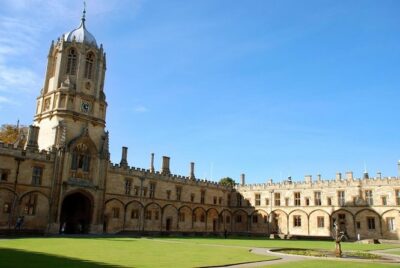
Harry Potter Walking Tour of Oxford Including New College
Read our review →
Oxford Sightseeing River Cruise Along The University Regatta Course
Read our review →
Afternoon Tea Sightseeing River Cruise in Oxford
Read our review →
Inspector Morse, Lewis and Endeavour Oxford Walking Tour
Read our review →Browse the lists this tour appears in