

Reviewed · OXFORD TOURS
Oxford University Walking Tour With University Alumni Guide
Oxford reveals itself best on foot, with a student guide who can explain not only the grand stone buildings but also how college life works today. This two-hour tour moves through Radcliffe Camera, the Bodleian Library, Trinity College, and several colleges while guides such as Tom, Sam, Lucy, or Alex add personal insight from their own time at Oxford.
I like the student-led point of view, which turns names and dates into practical details about admissions, college funding, and daily study. I also like the route’s range, from medieval ceremony rooms to the modern Weston Library. The main catch is speed: two hours covers a lot, and the Divinity School may be closed, especially from June through August.
Key points to know before booking
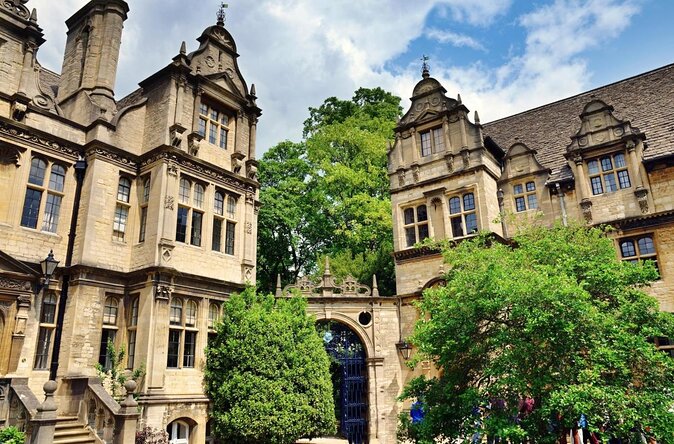
- A student’s view of Oxford: Guides explain college life, admissions, traditions, and the way Oxford’s many colleges work.
- A strong central route: You see Radcliffe Camera, the Bodleian Library, Merton College, Trinity College, All Souls College, and more.
- Divinity School access is not guaranteed: Summer closures and high demand can remove this interior visit.
- Two transport choices: Meet in Oxford for the lower price, or choose the more expensive option with round-trip London transport.
- Small-group feel is a major advantage: Groups are intended to be personal, though the stated maximum is 100 people.
- Arrive early for the 8 a.m. departure: Missing it for any reason means no refund.
Why a student guide changes the Oxford experience
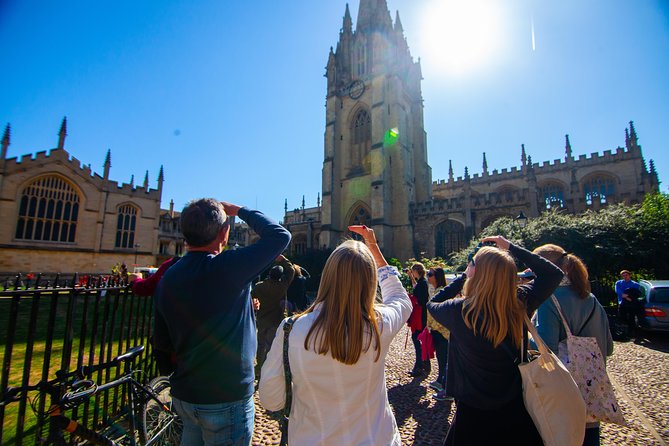
Oxford can look like one grand university from the outside. In reality, it is a collection of colleges, libraries, faculties, and traditions spread across the city. The first useful thing your guide does is explain that structure.
A current student or graduate can tell you how college choice works, how funding is handled, and how students use the buildings today. That practical layer is what separates this walk from simply following a map between pretty courtyards.
The guides also bring different personalities. Tom is described as funny and quick with answers. Sam is warm and enthusiastic. Lucy has a strong storytelling style, while Alex focuses clearly on how Oxford is organized. Names change by departure, so you should not book expecting one particular person, but the tour’s student-led format remains the central idea.
You should also expect humor. Guides such as Aran, Suzy, Antonia, Freddy, Michael, Megan, Luke, and Eloise have all led departures, and the tone tends to be lively rather than formal. That suits Oxford well. The subject can become a pile of dates and royal connections, but a young guide who has actually studied inside the system can make it feel immediate.
More Walking Tours in Oxford
- 1.5-hour Oxford City and University Walking Tour
★ 4.5 · 1,383 reviews - Harry Potter Walking Tour of Oxford Including New College
★ 4.5 · 930 reviews - Inspector Morse, Lewis and Endeavour Oxford Walking Tour
★ 5.0 · 574 reviews
The opening view of the University of Oxford
The walk begins with the University of Oxford as a whole, a useful orientation before the route narrows to individual colleges. The university spans nearly 800 years and includes more than 38 colleges, libraries, and faculty buildings.
You will not absorb every part of that system in ten minutes. Still, this opening gives you the basic framework: Oxford is not one enclosed campus, and each college has its own buildings, rules, traditions, and identity.
That distinction matters later. When you look at Merton, Oriel, Trinity, or All Souls, you are not simply seeing separate departments. You are looking at institutions with their own histories and student communities.
Merton College and the oldest-college debate

Merton College is one of the early stops. The guide uses it to explore the argument over which Oxford college is the oldest, a question with more than one answer depending on how you define a college’s founding and continuity.
That is a good example of the tour’s approach. Instead of presenting a single neat date, the guide explains why the claim is disputed. You also hear about Merton’s unusual chapel, described as one of the more peculiar religious spaces in Oxford.
The stop itself is listed at about ten minutes, so do not expect a full architectural survey. Think of it as a compact introduction to college rivalries, early university development, and the fact that Oxford’s past is often less tidy than its stonework suggests.
The Bodleian Library and the limits of access

The Bodleian Library is one of the tour’s key sights. It is a copyright library with a collection of more than 12 million books and miles of shelving space. Your guide explains the wider Bodleian complex and how students use it now.
One detail is worth clarifying before you book: seeing the Bodleian from the outside is not the same as entering every library room. One experience description says the route enters the Old Schools Quadrangle for a closer explanation of the complex, while a booking note specifically cautions that the tour does not include going into the library itself.
I would treat this as an architectural and institutional introduction, not a full library tour. If your priority is reading rooms and book collections, check the exact access offered on your date. The tour does provide a useful sense of the Bodleian’s scale and purpose, but it cannot promise unrestricted entry.
A completely different sort of day out in Oxford:
- Oxford Official University & City Tour
★ 5.0 · 1,134 reviews - City Sightseeing Oxford Hop-On Hop-Off Bus Tour
★ 4.5 · 1,042 reviews - Oxford Sightseeing River Cruise Along The University Regatta Course
★ 4.5 · 652 reviews - Afternoon Tea Sightseeing River Cruise in Oxford
★ 5.0 · 583 reviews
St. Mary’s Church and Oxford’s academic center
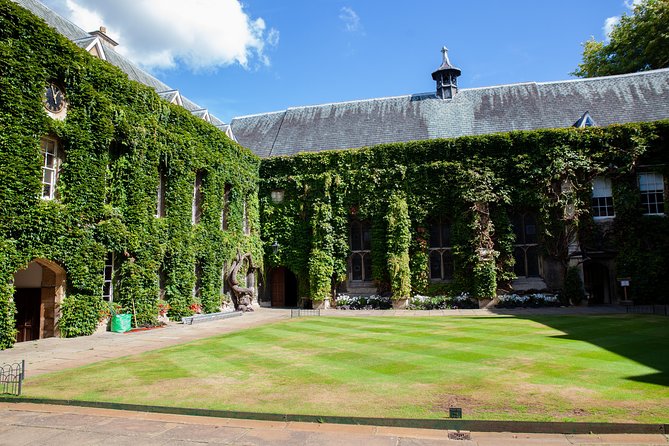
The University Church of St. Mary the Virgin is presented as a historical center of Oxford University. Its importance is tied to the university’s early academic and religious life, making it more than another attractive church façade.
Your guide places the building within Oxford’s development as a place of teaching, debate, worship, and ceremony. The ten-minute stop is brief, but it helps connect the university’s intellectual traditions with the buildings around them.
This is also a good point to pay attention to the guide’s storytelling. The appeal here comes less from ticking off a church and more from understanding why this particular church mattered to the university.
Oriel College and a controversial Oxford statue

Oriel College adds a more modern layer of controversy. The tour discusses its disputed statue and the drama connected with one of Oxford’s most notorious graduates.
The subject is useful because Oxford is not only a collection of old buildings and charming traditions. Its colleges continue to debate how they represent difficult people and uncomfortable parts of their past. A guide can give you the context that a quick photograph cannot.
As with several college stops, the schedule is tight. You will hear the story and see the setting, but this is not a long interior visit or a detailed treatment of every argument surrounding the statue.
The Divinity School, Oxford’s medieval showpiece
The Divinity School is the tour’s most important possible interior. Built as Oxford’s first purpose-made lecture room, it is one of the finest medieval buildings in Europe and later became familiar to film fans through Harry Potter and other productions.
The room’s original purpose is just as interesting as its screen appearance. It was designed for teaching and ceremony, and your guide can explain how those functions shaped the architecture. Seeing the space with someone who has attended Oxford ceremonies adds a useful connection between the building’s past and its continued role.
But you should not treat entry as guaranteed. From June through August, frequent closures and high demand make access especially limited. The tour provider states this plainly, which is helpful. A promised interior that turns out to be closed can sour a short visit, so plan to value the whole route rather than booking solely for this room.
In rare cases, other site entrances may also be unavailable. If the necessary visits cannot take place, the guide is expected to explain the situation at the start, with a full refund available in those unusual circumstances.
Radcliffe Camera and Oxford’s most famous view

Radcliffe Camera is the visual star of the walk. Built in 1748, this round building forms part of the Bodleian Library and is one of Oxford’s most recognizable landmarks.
The tour gives you an external view from several angles, which is exactly what you need here. The building changes as you move around it, with its curves, columns, and pale stone framed by the surrounding streets and colleges.
You do not enter the Radcliffe Camera on this walk. The value lies in the setting and the explanation of its role within the Bodleian system. This is one of those stops where a guide earns the fee by pointing out relationships between buildings that might otherwise seem like separate monuments.
Have your camera ready, but keep listening. The best part is not only the familiar picture. It is learning why the building belongs to the library complex and how it fits into Oxford’s academic center.
Trinity College and the college ideal
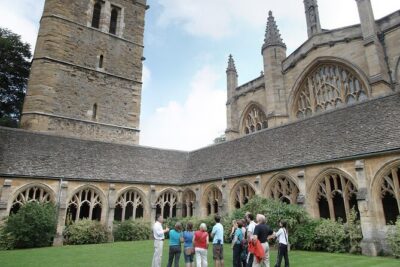
Trinity College is described as one of Oxford’s most beautiful colleges. Its buildings bring together the features people expect from Oxford: formal architecture, enclosed college spaces, and layers of academic and social tradition.
This stop gives you a chance to compare one college with the others on the route. Merton feels tied to early Oxford, Oriel brings controversy, and Trinity presents a polished version of the college ideal.
Entry is listed as included, but access can depend on the day’s conditions and site rules. The route is not designed as a leisurely college-by-college tour, so you should expect a focused visit rather than unlimited time to wander.
All Souls and Hertford College
All Souls College is introduced through its traditions and academic prestige. The guide uses it to discuss the unusual customs that set one college apart from another.
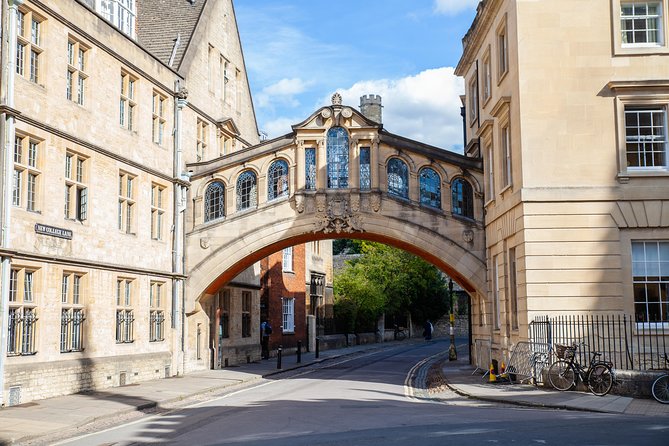
Hertford College brings a different angle. It is known as a progressive institution and features one of the most photographed places in Oxford. Together, these stops show how varied the colleges can be, even when they share similar stone façades and formal entrances.
This is where the guide’s personal experience becomes particularly useful. A student can explain the difference between a college’s public image and the way it functions as a place to study and live. You get a better sense of Oxford as a working university, not only a film set.
The Weston Library and a modern contrast
The Weston Library provides a change of mood. It forms part of the Bodleian but has a modern grand entrance hall, creative use of light, and a clear contrast with the medieval and Georgian buildings seen earlier.
The discussion turns to preserving more than 12 million books. That makes the stop practical as well as visual. You learn how the collection is cared for and why a major research library needs both historic rooms and updated facilities.
I like this addition because it keeps the tour from becoming a procession of old façades. Oxford is still an active institution, and the Weston helps show how it protects its collections while serving present-day students and researchers.
What the two-hour schedule feels like
Twelve stops in roughly two hours means the pace is brisk. Most listed stops receive about ten minutes, though that does not mean you spend exactly ten minutes at each site. Some are viewing points, some are short talks, and some may include access inside a college or building.
You will walk through central Oxford, pause often, and need to keep up with the group. One departure was described as very fast, with so much information that it became hard to absorb at times. That is the main practical weakness of the tour.
The upside is coverage. In a short visit, you see many of the places most people want to find, from Radcliffe Camera to the Bodleian and Trinity. If you want slow photography, extended interiors, or time to sit in each courtyard, you will need to explore more after the tour.
Wear comfortable shoes and allow enough time to stay with the guide. The stated fitness level is moderate, so this is not presented as a demanding hike, but it is still a city walking tour with frequent movement.
Choosing between Oxford and London departure points
You have two basic choices. The lower-priced option meets at 15 Broad Street in Oxford. The more expensive pickup option begins at Gloucester Road Tube Station in South Kensington, London, and includes round-trip transport in a luxury minibus.
The London option is useful if you want one arranged day from the capital and do not want to plan the journey yourself. It also changes the day’s timing, since the departure from Gloucester Road is at 8 a.m.
Be strict about that start time. If you miss the 8 a.m. departure for any reason, there is no refund. Confirm which meeting point you selected when booking, since the Oxford and London arrangements are not interchangeable.
If you are already staying in Oxford, the Oxford meeting point offers better value and leaves you in control of your arrival. If you are based in London, the transfer upgrade may justify its higher price by reducing planning and connections.
Is $41.59 good value?
At $41.59 per person, the Oxford walking option is fairly priced for a two-hour tour led by a current or former Oxford student. You are paying for interpretation, access where available, and a carefully arranged route through buildings that can be confusing to connect on your own.
The value is strongest if this is your first Oxford visit or if you have limited time. You see a wide range of colleges and receive context about admissions, student life, traditions, libraries, and architecture in one compact walk.
The price is less compelling if you want guaranteed interior access. The Divinity School may close, library entry is limited, and the tour does not promise a long visit inside every college. Think of it as an informed orientation, not a complete university admissions or architecture tour.
The London transfer option costs more, but it may still make sense for a day tripper who values simplicity. Compare the upgrade with the cost and effort of arranging your own transport, then decide if convenience matters more than flexibility.
Who will enjoy this tour most?
I would choose this tour for:
- First-time visitors who want a clear introduction to Oxford.
- Families who prefer stories and student insight to a dry lecture.
- Film fans interested in the Divinity School and famous Oxford settings.
- People making a short visit who want to cover major sights quickly.
- Anyone curious about how Oxford colleges work today.
- London visitors who want an arranged day trip with optional transport.
I would be more cautious if you dislike brisk walks, want long periods for photographs, or are booking mainly to enter the Divinity School. Those priorities do not match the tour’s limits.
The format also works well for mixed-age groups. One family of six adults, ranging from their parents to siblings in their thirties, found the route enjoyable, and the guides are expected to answer questions along the way. The tone is social and accessible rather than stiff.
Booking details that matter
Confirmation is provided at booking, and the tour is offered in English with a mobile ticket. Pickup is available only with the more expensive London option, while the standard Oxford option uses the Broad Street meeting point.
Service animals are allowed, and the meeting point is near public transport. Group arrangements follow the stated social distancing rules, with a maximum of 100 people, although the experience is promoted as small-group and some departures may be much smaller.
Free cancellation is available up to 24 hours before the start time. Inside that window, refunds are not provided and changes are not accepted. Check local time carefully, especially if you are coordinating the tour with a train or a London departure.
Should you book the Oxford University walking tour?
Book it if you want a fast, lively introduction to Oxford led by someone who has studied within its system. The strongest part is the combination of architecture and personal student insight. You learn what the colleges are, how they differ, and how the university still functions today.
Do not book it expecting guaranteed access to every building. The Divinity School can close, library entry is limited, and two hours moves quickly. For most first visits, though, the route offers strong value and a useful sense of Oxford’s character.
Choose the Oxford meeting point for the best price if you are already nearby. Choose the London minibus option if transport planning is the part you want taken care of. Either way, arrive early, wear comfortable shoes, and keep your expectations focused on a broad, well-told introduction rather than an exhaustive tour.
FAQ
How long does the Oxford University walking tour last?
The tour lasts approximately two hours.
Where does the standard Oxford tour meet?
The standard option meets at 15 Broad Street in Oxford.
Where does the London pickup option meet?
The pickup option meets at Gloucester Road Tube Station, Gloucester Road, South Kensington, London SW7.
Does the tour include transport from London?
Round-trip transport from London is available as an upgrade using a luxury minibus. The standard Oxford option does not include that pickup.
What language is the tour offered in?
The tour is offered in English.
Is the Divinity School guaranteed to be open?
No. From June through August, closures and high demand can make access extremely limited, and the Divinity School may not be included.
Does the tour include entry to the Bodleian Library?
The tour discusses the Bodleian Library complex and includes information about its collections and student use. A booking note says the tour does not include going into the library itself.
What happens if a site entrance is unavailable?
The guide will explain the situation at the start of the tour. In rare cases when the necessary site visits cannot take place, a full refund may be available.
Can I cancel for a full refund?
Yes. You can cancel at least 24 hours before the experience starts for a full refund. Cancellations within 24 hours are not refunded.
What happens if I miss the 8 a.m. departure?
If you miss the 8 a.m. departure for any reason, you will not receive a refund.
Recently added around Oxford
- CS Lewis & Tolkien Tour with Magdalen Entry Public tour 13.45★ 5.0 · 8 reviews
- Oxford: to Cotswolds (Half Day)★ 5.0 · 8 reviews
- Oxford Private Guided Walking Tour★ 4.5 · 8 reviews
- Oxford Scenic Cycle Tour- 2 persons minimum summer season★ 5.0 · 8 reviews
- Ashmolean Museum Tour – by Uncomfortable Oxford™★ 5.0 · 9 reviews
- Oxford Walking Tour – Discover its University and Traditions★ 4.0 · 9 reviews
- Oxford PRIVATE Pub and City Evening Walking Tour★ 5.0 · 10 reviews
- Harry Potter in Oxford Tour Divinity School entry Private Tour★ 5.0 · 10 reviews
Oxford Tours, compared.
1.5-hour Oxford City and University Walking Tour
Read our review →

City Sightseeing Oxford Hop-On Hop-Off Bus Tour
Read our review →
Harry Potter Walking Tour of Oxford Including New College
Read our review →
Oxford Sightseeing River Cruise Along The University Regatta Course
Read our review →
Afternoon Tea Sightseeing River Cruise in Oxford
Read our review →
Inspector Morse, Lewis and Endeavour Oxford Walking Tour
Read our review →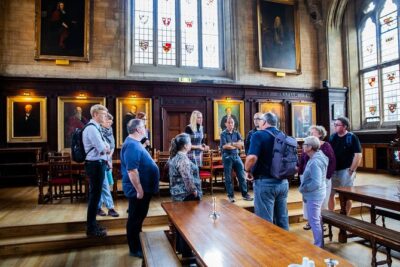
Extended: Oxford University & City Tour With Christ Church
Read our review →Browse the lists this tour appears in