
Reviewed · JACK THE RIPPER TOURS
Jack the Ripper: Night Murder Mystery Walking Tour in London
London’s Jack the Ripper story is best understood on foot, after dark, in the narrow lanes of Whitechapel. This two-and-a-half-hour walking tour connects the crime sites in chronological order, turning a grim case into a moving lesson about poverty, crowded housing, vulnerable women, and Victorian London.
I like two things right away. First, the route gives real weight to the victims, not just to the killer’s identity. Second, the guides bring more than a memorized script. Tyson, Kory, Dougal, Hadi, Lisa, and Korhan are among the guides praised for their storytelling, historical detail, and willingness to discuss competing theories.
The main drawback is simple: this is a long outdoor walk with few chances to sit. Cold, rain, poor street noise, or a guide who turns away while speaking can make parts hard to follow, so good shoes and warm clothing matter.
Key points before you book
- Seven Whitechapel locations: Visit Brick Lane, Princelet Street, Puma Court, Ten Bells, Gunthorpe Street, Goulston Street, and St Botolph without Aldgate.
- A chronological route: The stops follow the order of events, helping you see how the case unfolded across the district.
- Victims receive serious attention: The tour places their lives and social conditions beside the more familiar Ripper theories.
- A small-group feel: The maximum group size is 25, large enough for energy but still manageable in narrow streets.
- Night adds atmosphere: Dark lanes and cool weather make the setting more evocative, though they also make hearing and walking more demanding.
- Good value at $22.93: For 2 hours and 30 minutes of guided walking through central London, the price is modest, especially for history and true-crime fans.
Why the Whitechapel setting matters
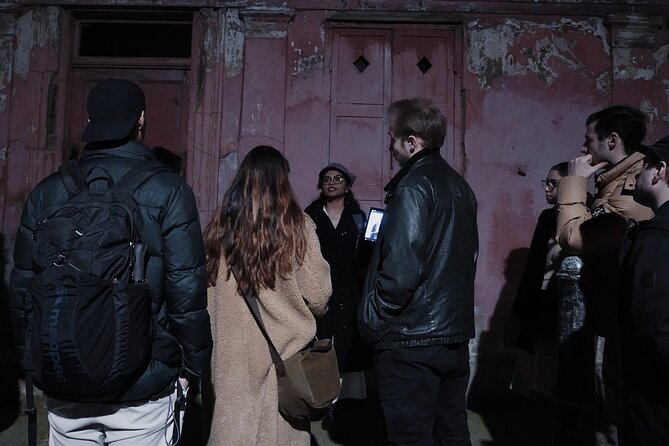
Jack the Ripper tours can easily become theatrical. This one works best when it steps back from the legend and looks at the district itself.
Whitechapel in the late 19th century was marked by poverty, overcrowding, and unstable work. The women associated with the case lived within a hard social system, and many had few safe choices. A useful guide does not treat the murders as a spooky puzzle alone. The setting helps you understand why certain streets mattered, why women were exposed to danger, and why the police investigation became such a public obsession.
The route also shows how much of the neighborhood survives. Some streets have changed, while others remain narrow and enclosed. You are not walking through a preserved crime museum. You are moving through a living part of London, where modern shops, traffic, homes, and nightlife sit beside places connected to the case.
That contrast is part of the experience. It can feel strange to discuss a brutal Victorian murder beside an ordinary city street, but it also keeps the story grounded. The tour is not a haunted-house attraction. It is a history walk with a dark subject.
More Walking Tours in London
- Tour for Muggles The Ultimate Harry Potter Walking Tour in London
★ 5.0 · 4,684 reviews - London Jack The Ripper Guided Walking Tour
★ 5.0 · 3,131 reviews - Changing of the Guard Guided Walking Tour in London
★ 5.0 · 1,793 reviews
Starting at St Marys Whitechapel Church Memorial
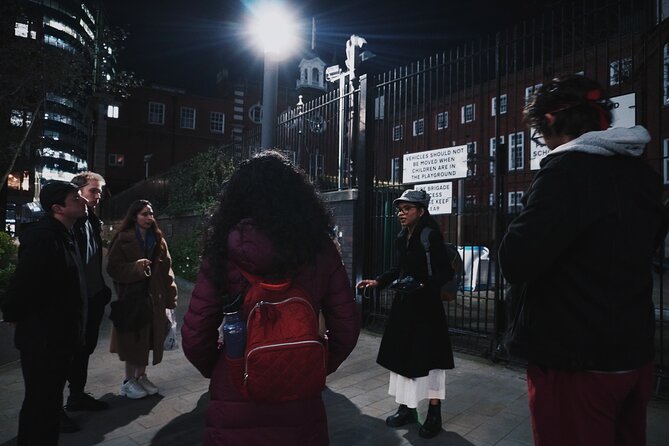
The tour begins at the St Marys Whitechapel Church Memorial on an unnamed road in London E1 1FE. This is an important practical point: check the exact meeting location before setting out, and allow time to find it.
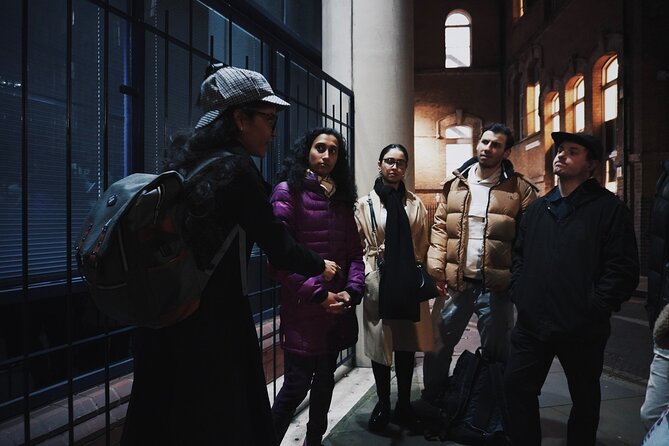
From the start, you can expect an English-speaking guide who presents the story in the style of a Ripperologist. The best guides establish the timeline early, explain what is documented, and separate fact from theory. Guides including Tyson, Kory, Dougal, and Hadi have been praised for keeping the group together and making the material accessible.
The tone matters here. The subject includes murder, sexual violence, poverty, and the deaths of women who were already socially vulnerable. Hadi, in particular, was praised for handling the material with care and without gratuitous detail. That is the right approach for this tour. You get a darker side of London without turning real victims into props.
Brick Lane and the poverty behind the crimes
The first stop is Brick Lane, now a popular cultural district but once part of Victorian slum life. You spend about 17 minutes here discussing poverty, overcrowding, and desperation.
This is one of the strongest parts of the route because it supplies the social background that a simple killer hunt often leaves out. You begin to see that the case did not happen in an empty foggy street. It happened in a packed district where many people lived close together, privacy was scarce, and vulnerable residents could disappear into the crowd.
The stop is free, as are the other locations, because the experience is entirely outdoors. That keeps the price down, but it also means you are exposed to the weather from the moment the walk begins.
Princelet Street and the lives behind the names
Princelet Street is quieter and narrower. Here the guide connects the area with the Ripper case and discusses conditions faced by women such as Annie Chapman.
This is where the tour begins to shift from a general portrait of Whitechapel to individual lives. Annie Chapman is not just a name in a case file. Her circumstances help you understand the limited options available to women living on the edge of Victorian society.
I value this part because the route does not treat every stop as a clue in a detective game. The human story stays in view. You will still hear theories and questions, but the focus is not only on guessing the murderer. It is also on remembering the women whose lives have often been reduced to their final moments.
More Ripper walks after dark:
- London Jack the Ripper Guided Tour with Ripper-Vision
★ 4.5 · 4,840 reviews - Ultimate Jack the Ripper : Guided Tour of London
★ 5.0 · 1,495 reviews - The Original Jack the Ripper : Guided Tour
★ 5.0 · 1,264 reviews - London Jack The Ripper Small-Group Walking Tour
★ 5.0 · 1,013 reviews
Puma Court and the power of narrow streets
Puma Court remains almost unchanged from the 19th century. It is a narrow passage where the physical setting does much of the work.
You can see how easily a person could vanish into shadow here. The lane gives you a better sense of distance, enclosure, and limited visibility than a photograph or lecture can provide. The guide explains the connection to the case while you look at the actual scale of the space.
This is also a good example of why the tour should not be judged only by the amount of information delivered. The value comes from pairing the facts with location. A sentence about a narrow passage is one thing. Standing in one, at night, gives it weight.
Keep your group close at these points. The route uses public streets, and the narrow spaces can make it harder to hear if you drift toward the back.
The Ten Bells and the final hours of the victims
The Ten Bells is one of the best-known names connected with the Jack the Ripper story. The group stops outside the pub to discuss its links with several victims and the hours before their deaths.
The tour does not include a pub visit as a separate drinking stop. You learn about the site from outside its doors, so you should not book this expecting a pub crawl or an indoor break. The pub works here as a historical marker, a place tied to the ordinary routines of the women involved.
That detail is important. The Ripper story can make the victims seem to exist only in relation to the murders. A stop at the Ten Bells helps restore the ordinary part of their lives: where they went, how they moved through the neighborhood, and how a familiar local place became linked forever to tragedy.
It is also one of the more crowded parts of the route. Other groups may be nearby, and your guide may need to position the group carefully so everyone can see and hear.
Gunthorpe Street and the question of Martha Tabram
Gunthorpe Street is described as the place where Martha Tabram was brutally murdered. Some experts consider her a possible early Ripper victim, while others do not.
This stop gives the tour its mystery element. The question is not settled, and a good guide will show you why. You examine the clues and the reasoning used by people who include Tabram in the victim list, rather than receiving a forced answer.
That uncertainty is one of the better features of the experience. The Ripper case is famous partly because the evidence is incomplete and the identity of the killer remains disputed. You get more from the tour if you enjoy weighing theories instead of expecting a final solution.
The word murder mystery in the tour title points to this interactive quality. You are invited to consider evidence and connections as you move from site to site. It is not a formal theatrical game with actors or costumes based on the information provided, but the guide uses the route to make you think through the case.
Goulston Street, the apron, and the chalk message
At Goulston Street, the guide discusses a bloody piece of apron belonging to Catherine Eddowes. Nearby, a chalk message became one of the case’s most controversial clues.
This is likely to be a highlight for anyone who enjoys police history and unsolved cases. The apron and message have inspired theories, arguments, and conspiracy claims for generations. The key is to listen for the difference between what is known and what people have inferred.
The stop also shows how quickly a crime can become a public spectacle. A physical clue, a handwritten message, and an uncertain interpretation were enough to fuel fear and debate across London.
You might find this section more demanding than the earlier stops because there are several details to hold in your head. The chronological order helps. Guides who explain the sequence clearly, as Tyson and Kody were praised for doing, make the complicated parts easier to follow.
St Botolph without Aldgate and a wider social failure
The church of St Botolph without Aldgate provides a pause to consider the women who sought refuge in the area. The guide uses the site to discuss how Victorian society failed people living with poverty and danger.
This is the most reflective stop on the route. It moves beyond the question of who Jack the Ripper was and asks why the victims were so exposed in the first place.
I appreciate that the tour makes room for this wider question. The killer’s nickname has become famous, but the women’s lives are often treated as background. By placing the church, local poverty, and social vulnerability into the story, the walk gives you a fuller picture of the period without pretending that every problem can be explained by one criminal.
The stop may feel quieter than the clue-based sections. That is a strength if you want historical context, but anyone seeking nonstop suspense may find the change of pace less exciting.
Ending near Mitre Square
The route ends at Mitre Square in London EC3A 5DE. The location is linked with Catherine Eddowes and the final part of the tour’s account of the murders.
The finish gives the walk a clear sense of progression. You begin in the broader district, move through specific streets and clues, and finish at a site tied closely to the case. Guides often leave room for questions and theories after the formal walk, which is useful if you want to discuss possible suspects or competing explanations.
Do not count on the ending as a long seated break. The tour is primarily a street walk, and the supplied details indicate few places to sit until the very end. If you need regular rest stops, this may not be the right London activity for you.
The guides make or break the evening
The strongest praise goes to the guides rather than to any single landmark. Kory and Korey are described as strong storytellers who add neighborhood history, old news reports, and photographs from the period. Dougal is praised for creating a detailed sense of 19th-century London, while Tyson combines facts with humor and keeps going even in heavy rain.
Hadi received particular praise for a calm, respectful approach. That matters because the material is difficult. You want a guide who can hold your attention without making the victims into entertainment.
There is one practical weakness to keep in mind. At least one experience was harder to follow because the guide sometimes looked away while speaking. Street noise and group spacing can also affect the sound. Stay near the guide, ask for repetition when needed, and do not assume every sentence will carry clearly to the back.
The group limit of 25 helps, but it is still a group walk. Your experience will depend partly on the guide assigned that night and partly on where you walk within the group.
Is $22.93 good value?
At $22.93 per person, I consider this a fair price for London. You get about 2 hours and 30 minutes, seven stops, a specialist subject, and a guided route through streets you might not choose to explore on your own.
The value is strongest if you would otherwise spend an evening reading about the case or visiting Whitechapel without understanding the geography. The guide supplies structure, context, and the connections between places. You are paying for interpretation, not admission tickets.
It is less attractive if you dislike long walks, outdoor tours, or unresolved theories. The low price does not change the basic tradeoff: there is no indoor museum, no guaranteed seat, and no promise of perfect hearing in a busy city at night.
Group discounts may make it cheaper for a larger party. Mobile tickets are offered, and confirmation arrives at booking. You can cancel for a full refund up to 24 hours before the local start time. Changes or cancellations inside that window are not refunded.
Who should book this London night walk?
I would choose this tour if you like dark history, Victorian London, true crime, or city walks that connect streets with real events. It also suits people who want an evening activity outside the usual central London circuit.
History fans will appreciate the social context. Mystery fans will enjoy the unresolved questions about Martha Tabram, the Goulston Street message, and the killer’s identity. You do not need to know the case in advance, though prior interest will give you more theories to test.
Families should consider the subject carefully. The tour deals with murder and vulnerable women, so it is not a light ghost story. Most people can participate, and service animals are allowed, but the route remains a serious nighttime walk.
Wear shoes suited to roughly two and a half hours on foot. Bring warm or waterproof clothing, and keep your phone charged if you rely on the mobile ticket. If the forecast is poor, remember that rain has already tested the tour, and even a cheerful guide cannot make a soaked walk comfortable for everyone.
Should you book it?
Book this Jack the Ripper night tour if you want Whitechapel explained through its streets, not just through a list of suspects. The best part is the balance between mystery and human history: you follow clues, but you also learn about Annie Chapman, Martha Tabram, Catherine Eddowes, and the social world around them.
Skip it if you want an indoor attraction, plenty of seating, or a neat answer to the case. For $22.93, though, the length, route, and quality of the better guides make it a strong-value London evening for anyone comfortable with a serious subject and a brisk walk.
FAQ
How long is the Jack the Ripper walking tour?
The tour lasts approximately 2 hours and 30 minutes.
How much does the tour cost?
The listed price is $22.93 per person.
Where does the tour begin?
It begins at the St Marys Whitechapel Church Memorial, on an unnamed road in London E1 1FE, UK.
Where does the tour end?
The tour ends at Mitre Square, London EC3A 5DE, UK.
What locations are visited?
The route includes Brick Lane, Princelet Street, Puma Court, the Ten Bells, Gunthorpe Street, Goulston Street, and St Botolph without Aldgate.
Is the tour offered in English?
Yes. The tour is offered in English.
How many people can join the tour?
The maximum group size is 25 people.
Is the tour suitable for most people?
Most people can participate, and service animals are allowed. Keep in mind that it is a long outdoor walking tour with limited opportunities to sit.
Can I cancel for a refund?
Yes. You can cancel at least 24 hours before the start time for a full refund. Cancellations or changes made less than 24 hours before the start time are not accepted or refunded.
More evening outings in London
- London by Night Bus Tour with Christmas Lights and Live Guide
★ 4.5 · 2,040 reviews - London by Night Sightseeing Tour – Open Top Bus
★ 4.5 · 1,060 reviews - London by Night Sightseeing Open Top Bus Tour with Live Guide
★ 4.5 · 977 reviews - River Thames Evening Cruise with Sparkling wine and Canapés
★ 4.0 · 569 reviews
Recently added around London
- London’s Crown Secret: Self-Guided Royal Puzzle Quest★ 4.5 · 8 reviews
- Postcard London★ 5.0 · 8 reviews
- Private Tour: Downton Abbey London Locations by Taxi★ 5.0 · 8 reviews
- Windsor Castle, Stonehenge & Roman Baths Private Tour★ 4.5 · 8 reviews
- Cotswolds Private Driving Tour from London★ 5.0 · 8 reviews
- A Silent Disco Adventure in London★ 5.0 · 8 reviews
- Skip-the-line London Westminster Abbey and City of Westminster Kid-Friendly Tour★ 5.0 · 8 reviews
- Private Full Day Cotswolds Tour From London★ 5.0 · 8 reviews
Jack the Ripper Tours, compared.
London Jack the Ripper Guided Tour with Ripper-Vision
Read our review →
Ultimate Jack the Ripper : Guided Tour of London
Read our review →

London Jack The Ripper Small-Group Walking Tour
Read our review →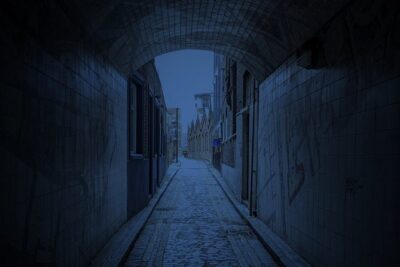

The Original Jack the Ripper Coach Tour of Haunted London
Read our review →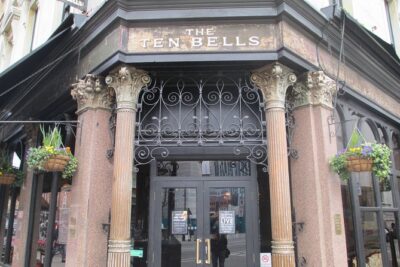
Browse the lists this tour appears in