
Reviewed · JACK THE RIPPER TOURS
London – Jack the Ripper Small Group Tour
Jack the Ripper’s story is best understood on foot, in the streets where the murders happened. This 2-hour-15-minute evening walk follows the route from Whitechapel Road to Liverpool Street, using old images, crime-scene details, and theories about the killer’s movements.
I like the intimate group size, capped at 15, and the radio microphone with earphones, which helps you hear Richard Walker clearly beside traffic and evening crowds. I also like the focus on the victims and their lives rather than treating them as props in a spooky murder tale.
The main drawback is the pace and format. You cover about 1.5 miles and spend long stretches standing while Richard explains the evidence, so this is not the best choice if you want a theatrical ghost walk, frequent seating, or graphic scares.
Key points to know before you book
- Richard Walker leads the walk: He brings a strong personal interest in the case, Victorian Whitechapel, and competing theories about the killer.
- The tour visits real murder locations: Stops include Whitechapel Road, Buck’s Row, the Brick Lane area, and Spitalfields.
- The victims receive serious attention: You hear about Emma Elizabeth Smith, Polly Nichols, Annie Chapman, Elizabeth Stride, Catherine Eddowes, and Mary Jane Kelly within the wider story.
- The technology is genuinely useful: A radio microphone and earphones make it easier to follow the talk, while an iPad shows historical images.
- It is not a horror show: Expect history, evidence, and theory, with limited emphasis on gore or theatrical scares.
- The route ends near Liverpool Street Station: That gives you easy connections on several Underground lines and the Elizabeth line.
What this Jack the Ripper walk is really about
Many London Ripper walks sell atmosphere first: dark alleys, famous names, and a little theatrical shudder. Richard Walker’s tour takes another path. It treats the murders as a historical investigation and gives considerable space to the women who died, the poverty around them, and the assumptions made by police and the public.
That difference matters. If you want a scary night out, this may feel too restrained. If you want to understand how the crimes fit into late Victorian London, you get far more than a list of suspects.
Richard’s approach also questions familiar claims. The women are often described in simple terms, especially the repeated claim that all were prostitutes. This walk asks you to look more carefully at what was actually known about their lives, their movements, and the witnesses who saw them.
You will hear theories rather than a tidy solution. Jack the Ripper’s identity remains unknown, so Richard examines possible suspects and points out where the evidence is weak, disputed, or based on later assumptions. That makes the experience a better fit for curious history fans and true-crime readers than for anyone seeking a final answer.
More Ripper walks after dark:
- London Jack the Ripper Guided Tour with Ripper-Vision
★ 4.5 · 4,840 reviews - London Jack The Ripper Guided Walking Tour
★ 5.0 · 3,131 reviews - Ultimate Jack the Ripper : Guided Tour of London
★ 5.0 · 1,495 reviews
Starting on Whitechapel Road at 7 pm
The meeting point is 279 Whitechapel Road, opposite the London Hospital. The start time is 7 pm, when the East End takes on a different feel from the daytime sightseeing circuit.
The first stop concerns Emma Elizabeth Smith, described here as the first victim of the Whitechapel Murders. She died after a brutal attack on April 3, 1888. Richard begins with her story and the location connected with her death, giving you an early sense that the tour is about more than the best-known five victims.
This opening also sets up an important distinction. Emma Smith is often included in the wider Whitechapel murder story, but the later group of five women is usually called the canonical victims. Richard’s presentation gives the surrounding case room instead of rushing straight to the most familiar names.
You do not need to pay an admission fee at this stop. The setting is part of the public street, and the value comes from connecting the modern road with the old account Richard presents.
Buck’s Row and Polly Nichols
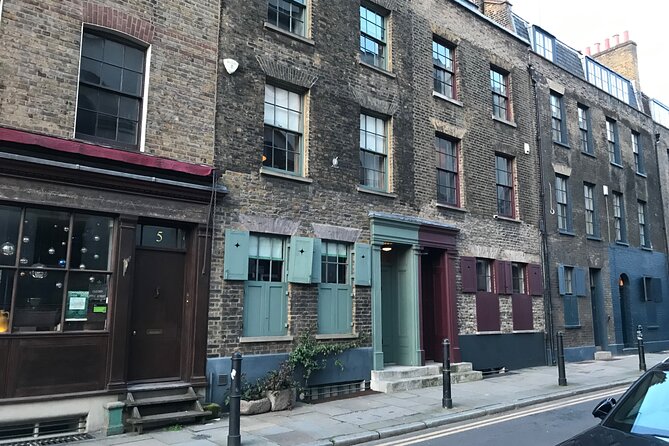
The walk continues into Whitechapel to Buck’s Row, the former name of the location connected with Polly Nichols. Here Richard examines the first murder generally attributed to Jack the Ripper.
This is one of the strongest parts of the route for anyone who likes the investigative side of true crime. You hear about when and where the murder took place, how the attack may have happened, and why Polly Nichols became the first canonical victim.
Richard also introduces a first suspect at this point. He does not present the theory as settled fact. Instead, the location gives you a way to consider practical questions: how quickly the killer may have acted, how witnesses interpreted what they saw, and how a crowded district could still contain dark, quiet corners.
The stop lasts about 20 minutes. You should expect to remain standing while the evidence is explained. That creates a clear drawback for anyone with limited stamina, especially since the tour includes several similar periods of listening.
Brick Lane, lodging houses, and the killer’s territory
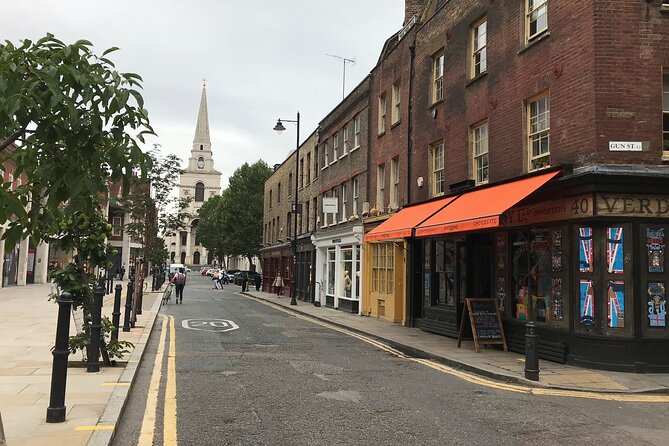
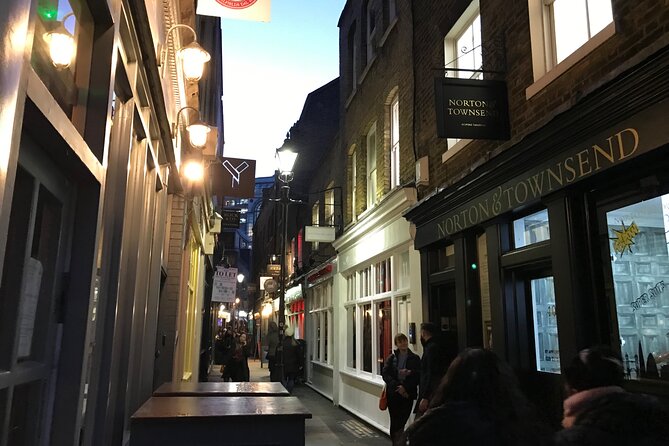
Brick Lane is now famous for curry restaurants and East London food, but the tour uses it as a map of the victims’ world. Richard explains that it formed the eastern boundary of the area where all five canonical victims lived at the time of the murders.
The nearby streets carry much of the story. Thrawl Street ran from Brick Lane toward Commercial Street, and Polly Nichols stayed at Wilmott’s Lodging House. Flower and Dean Street was linked with the third and fourth victims. Richard also discusses the belief that Scotland Yard placed Jack the Ripper somewhere in this part of London.
This is where the geographical theory becomes especially useful. Instead of treating the murders as isolated events, you see how close the locations were to one another. Richard pairs the Scotland Yard geographical profile with a profile created by FBI Special Agent John Douglas, then considers a second suspect who appears to fit both.
You should not expect a definitive criminal case. The pleasure here comes from weighing the evidence and seeing how distance, lodging houses, work, and nightly routines shaped the investigation.
The Brick Lane section lasts about 20 minutes. It is also an example of the tour’s unusual balance. You are in a lively modern neighborhood while hearing about deprivation, danger, and police work from 1888. That contrast can be eerie without relying on staged effects.
A few more London half days worth a look
- Stonehenge, Windsor Castle, and Bath from London
★ 4.5 · 18,662 reviews - London Big Bus Hop-On Hop-Off Tour with Optional River Cruise
★ 3.5 · 10,803 reviews - London Small Group Tour of Historical Pubs
★ 5.0 · 10,422 reviews - Stonehenge, Windsor Castle and Bath with Pub Lunch in Lacock
★ 4.5 · 7,402 reviews
Christ Church Spitalfields and the Ten Bells
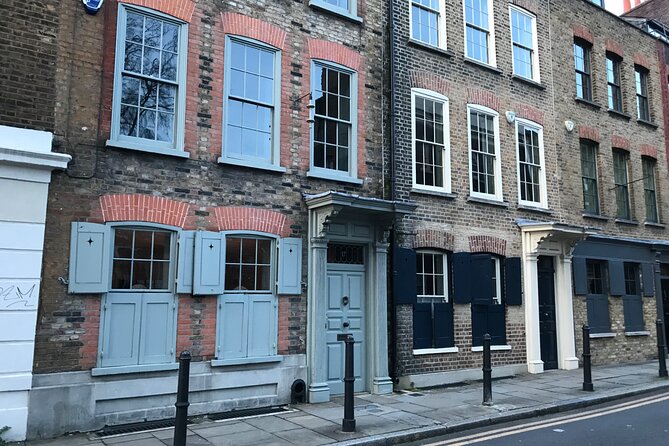
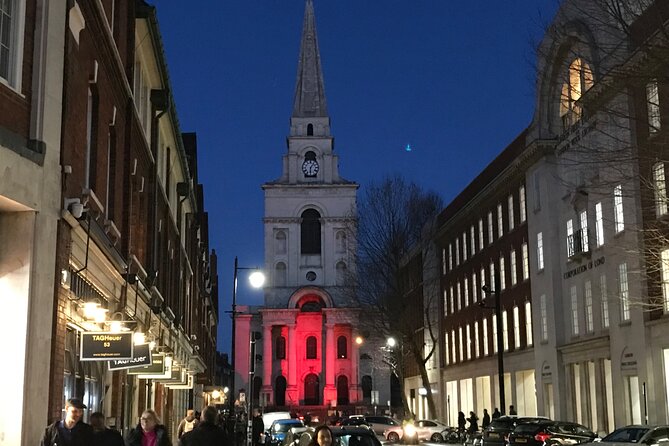
The next stop is Christ Church Spitalfields, the grand Hawksmoor church opposite the Ten Bells pub. The church provides a striking visual break from the narrower streets and is one of the area’s major architectural landmarks.
The Ten Bells is tied to the Ripper story because the victims drank there. Its name comes from the church bells across the road. Richard uses this location to connect ordinary daily life with the later mythology surrounding the murders.
Admission to the church or pub is not included, so treat this as an exterior stop within the walking route rather than a ticketed visit. The stop lasts about 15 minutes.
This part of the tour also highlights the difference between history and legend. The pub is strongly associated with the case today, but association alone does not prove what happened inside or who the killer was. Richard’s presentation is at its best when it separates a place’s later fame from the evidence available at the time.
Old Spitalfields Market and Victorian poverty
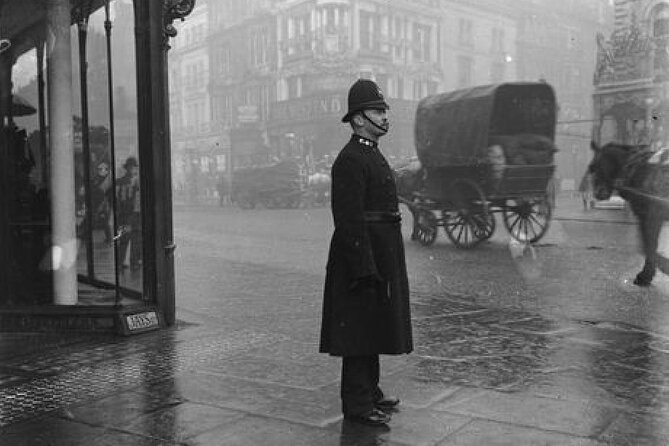
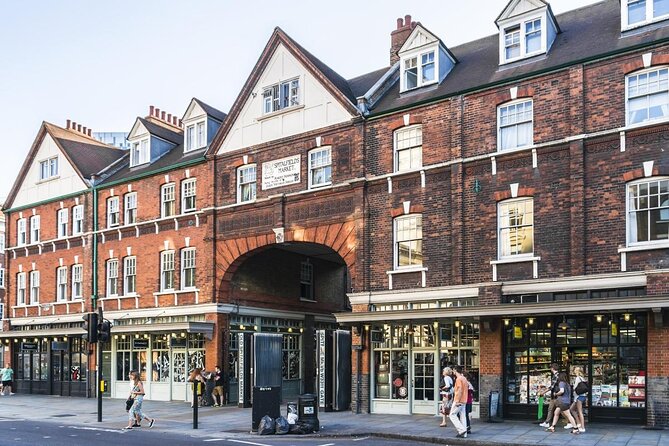
Old Spitalfields Market has served as a community center for centuries. During the walk, Richard brings in the observations of the American writer Jack London, who saw severe poverty in Victorian London.
This stop widens the subject beyond murder. Whitechapel was not simply a stage for one unknown killer. It was a district shaped by insecure housing, poverty, lodging houses, and hard daily choices. Without that context, the victims can become names on a crime list. With it, you get a better sense of the pressures that shaped their lives.
The stop lasts around 15 minutes and has no separate admission charge. It is particularly useful if you are interested in London social history, not just the identity of Jack the Ripper.
The tradeoff is that the tour’s social context may not satisfy someone who booked mainly for suspects and crime-scene detail. Richard’s method is deliberately broader, and you should know that before paying.
Spitalfields, Dorset Street, and Mary Jane Kelly
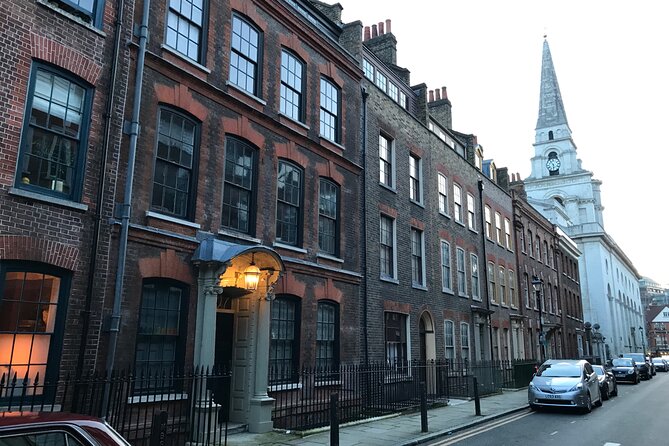
The final Spitalfields section brings together several major threads. Richard identifies the location of what was once described as the worst street in London and discusses Annie Chapman, who lived there until the night of her murder.
He also covers Mary Jane Kelly, who lived and died in the area. Her circumstances and the nature of her death make her a different kind of victim within the case, and Richard introduces a third convincing suspect through her story.
This section can be the most intense, even though the tour avoids making gore its main attraction. Mary Jane Kelly’s murder is among the most notorious episodes in the case, but Richard’s emphasis remains on context, evidence, and the question of how later storytelling changed public memory.
The route finishes at 126A Middlesex Street, by Liverpool Street Station. The station serves the Central, Circle, Hammersmith and City, and Metropolitan lines, along with the Elizabeth line. That makes the ending practical if you want to return to another part of London without arranging a taxi.
Richard Walker’s guiding style
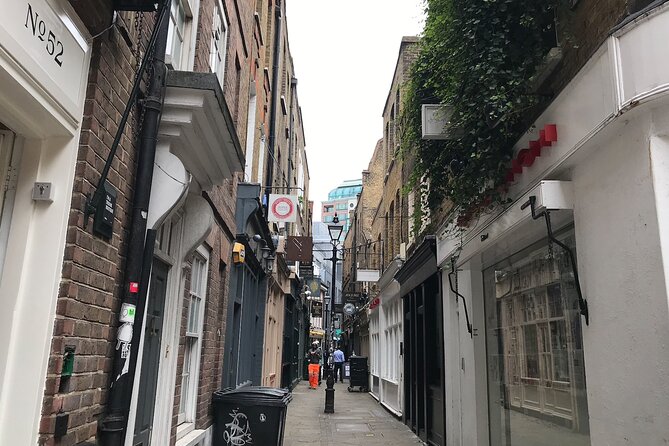
Richard is the central reason to choose this particular walk. His style is energetic and personal, with a clear enthusiasm for the subject. He is also willing to explain why he favors one theory over another rather than presenting every suspect as equally convincing.
The small group helps. The maximum is 15 people, and groups can be smaller. In one especially intimate version of the tour, only a family of four attended. A smaller group gives you more room to ask questions and makes it easier to stay close to the guide.
The radio microphone is a smart practical touch. Whitechapel streets can be noisy, and you do not have to strain to catch every word. The iPad adds old images that help you picture streets and buildings that have changed since 1888.
Still, this is mainly a listening tour. Richard welcomes questions, but your group may be quiet, and much of the time is spent standing in one place as he explains the story. One useful tip is to wear comfortable shoes and dress for an evening outdoors.
Price, group size, and what you get for $41.67
At $41.67 per person, this is not the cheapest way to hear the Jack the Ripper story in London. It is priced above some large group walks, but the smaller maximum changes the value.
You are paying for a focused route, a guide who has spent years studying the case, the audio equipment, historical images, and the chance to ask questions without shouting across a crowd. Larger Ripper groups can reach around 40 or more people, so the difference is practical, not just a marketing label.
The tour includes the radio microphone, earphones, and iPad images. Tea and coffee are not included. There are no paid attractions built into the route, so the price is mainly for the guiding and the small-group format.
For me, the price makes sense if you care about clear explanations and a more thoughtful account of the victims. It makes less sense if you want a quick, dramatic walk with lots of movement and theatrical suspense.
Who will enjoy this walk most
I would choose this experience if you:
- Like Victorian London and social history as much as the murder case
- Have read about Jack the Ripper and want less familiar theories
- Prefer a small group to a large crowd
- Want to hear about the victims as people, not just crime-scene names
- Appreciate evidence, geography, and competing explanations
- Can walk about 1.5 miles and remain on your feet for much of the evening
Families can also consider it. The material is serious, but the presentation is not designed as a horror show, and the tour has been suitable for children in at least one family booking.
I would skip it if your main goal is graphic detail, haunted atmosphere, or a fast-moving route with regular opportunities to sit. The tour is educational and theory-driven, not a staged fright night.
Practical details for a smoother evening
The tour starts at 7 pm on Whitechapel Road and ends near Liverpool Street Station. Confirmation arrives at booking, and the meeting point is near public transport.
You need a moderate level of physical fitness. The route covers about 1.5 miles, with several extended periods standing. Comfortable footwear is more important here than stylish footwear.
The experience is offered in English and uses a mobile ticket. Since it takes place at night, keep your phone charged and make sure you can follow the group through busy streets. The audio equipment helps, but you still need to stay with the guide.
The booking is non-refundable and cannot be changed for any reason. Make sure your date and group plans are settled before paying.
Should you book the Jack the Ripper Small Group Tour?
Book it if you want a serious, victim-focused walk through Whitechapel and Spitalfields, led by Richard Walker and supported by maps, images, and competing theories. The small group, useful audio system, and Liverpool Street ending add real value.
Do not book it expecting a spooky ghost tour. The experience favors history, social context, and careful questioning over gore and theatrical drama.
For true-crime fans who already know the basic story, this offers a fresh way to examine the evidence. For first-time visitors, it gives you a grounded introduction to one of London’s most famous unsolved cases, provided you are happy to spend a good part of the evening listening on your feet.
FAQ
How long does the Jack the Ripper tour last?
The tour lasts approximately 2 hours and 15 minutes.
Where does the tour begin?
The meeting point is 279 Whitechapel Road, London E1 1BY, opposite the London Hospital.
Where does the tour finish?
The tour ends at 126A Middlesex Street near Liverpool Street Station.
What time does the tour start?
The stated start time is 7 pm.
How large is the group?
The tour allows a maximum of 15 people.
What is included in the price?
The experience includes a radio microphone, earphones, and an iPad used to display images. Tea and coffee are not included.
Is the tour suitable for people with walking difficulties?
The tour requires a moderate level of physical fitness, covers about 1.5 miles, and includes extended periods of standing. It is not suitable for people with walking difficulties.
Recently added around London
- London’s Crown Secret: Self-Guided Royal Puzzle Quest★ 4.5 · 8 reviews
- Postcard London★ 5.0 · 8 reviews
- Private Tour: Downton Abbey London Locations by Taxi★ 5.0 · 8 reviews
- Windsor Castle, Stonehenge & Roman Baths Private Tour★ 4.5 · 8 reviews
- Cotswolds Private Driving Tour from London★ 5.0 · 8 reviews
- Skip-the-line London Westminster Abbey and City of Westminster Kid-Friendly Tour★ 5.0 · 8 reviews
- A Silent Disco Adventure in London★ 5.0 · 8 reviews
- Gangster Tour of Soho★ 4.5 · 8 reviews
Jack the Ripper Tours, compared.
London Jack the Ripper Guided Tour with Ripper-Vision
Read our review →
Ultimate Jack the Ripper : Guided Tour of London
Read our review →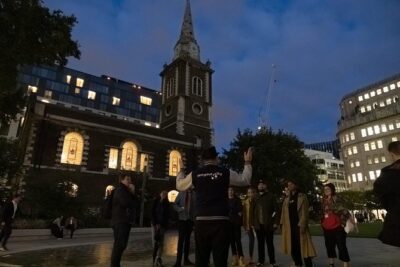
London Jack The Ripper Small-Group Walking Tour
Read our review →
The Original Jack the Ripper Coach Tour of Haunted London
Read our review →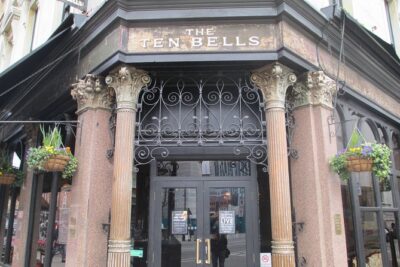
Browse the lists this tour appears in