
Reviewed · ENGLAND
Outdoor Rock Climbing Taster Day in Peak District
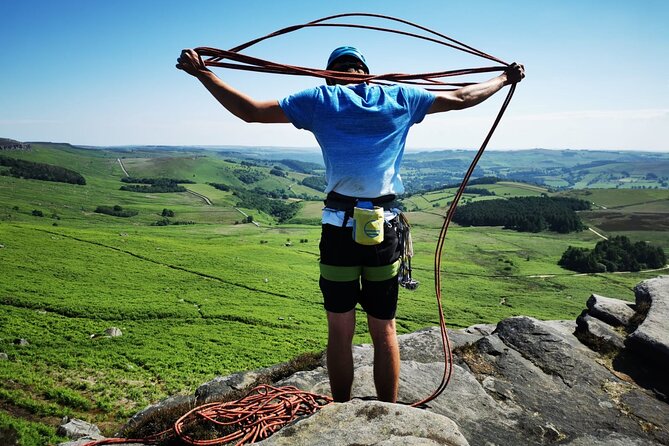
The best part of this Peak District rock-climbing day is that you move quickly from a short safety lesson to real rock. You learn to tie in, belay, and abseil, then spend most of the day climbing routes chosen for your group. Instructors such as Owen, Emma, Neal, Sandra, and Rachel are praised for patient coaching and careful gear checks.
I like the tiny group size, capped at six people, because it gives you plenty of turns on the rope. I also like the range of challenge: complete beginners can start gently, while indoor climbers can try longer or harder outdoor routes. The main consideration is the weather. This is an all-weather activity, so you need proper clothing and a reasonable level of fitness.
Key points at a glance
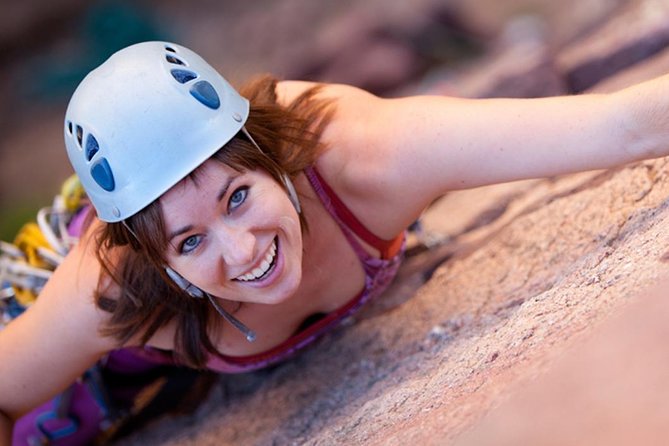
- Real rock from the first day: Move beyond an indoor wall and climb in classic Peak District locations, including Stanage Edge.
- A proper skills foundation: Learn knots, belaying, abseiling, and safe rope work before tackling routes.
- Small groups matter: A maximum of six people allows the instructor to adjust climbs to ability and confidence.
- Good for mixed experience: Nervous beginners, rusty climbers, and regular indoor climbers can all be given suitable challenges.
- A full day outdoors: The 9:30 am start usually runs until about 5 pm, with most of the day spent climbing.
- Useful comforts at base: Tea, coffee, free Wi-Fi, parking at the base site, and access to public transport make the morning easier.
Why this is a better first outdoor climb than going it alone
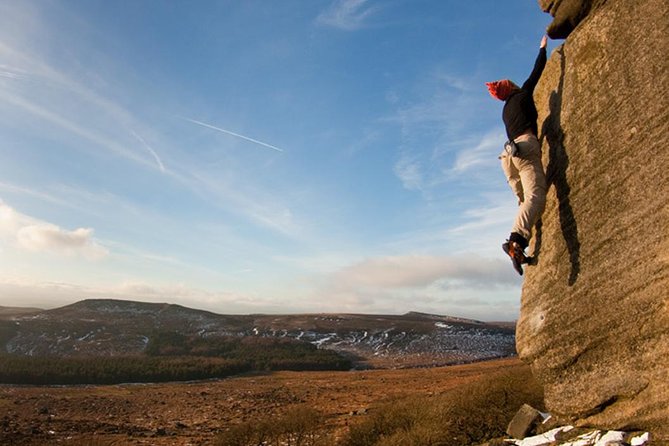
Indoor climbing teaches movement, balance, and grip. Outdoor climbing adds rope systems, knots, route reading, weather, uneven ground, and the mental hurdle of looking down from real rock. This course gives you a controlled way to meet all of that at once.
I like that the teaching is not limited to a quick demonstration followed by a few token climbs. The opening session covers the basics needed to climb safely, then the day shifts toward hands-on practice. You can work on tying into the rope, learn how to belay someone else, and get an introduction to abseiling before spending more time on the crag.
That matters because climbing outdoors is not only about reaching the top. You need to understand what the rope is doing, how the person belaying you keeps you safe, and how to prepare for the next climb. By the end, you should have a much clearer idea of whether outdoor climbing is something you want to pursue.
The course also suits people who already climb indoors. One participant with two years of indoor experience found the beginner day useful, but the advice was to consider the intermediate course if you already have solid indoor skills. That is a fair warning. Indoor ability helps, but it does not automatically make you ready to manage outdoor rope systems.
What else people book in England on the same trip:
- Stonehenge, Windsor Castle, and Bath from London
★ 4.5 · 18,662 reviews - London Big Bus Hop-On Hop-Off Tour with Optional River Cruise
★ 3.5 · 10,803 reviews - London Small Group Tour of Historical Pubs
★ 5.0 · 10,422 reviews
Meeting in Bamford at 9:30 am
The meeting point is in Bamford, in the Hope Valley, at postcode S33. The activity begins at 9:30 am and finishes back at the meeting point. The day is run by Pure Outdoor Ltd, with the outdoor centre providing the starting point and basic comforts before you head to the climbing area.
Arrive ready for a short introduction and paperwork. You can have tea or coffee on arrival, which is a small but welcome touch when you are facing a full day outside. Free Wi-Fi is also available at the centre, useful if you want to let people know where you are or check messages before leaving the base.
Parking is available at the main site, and the meeting point is near public transportation. Once the group moves to the climbing area, parking can be more limited. I would therefore pay attention to the meeting instructions and avoid assuming that parking beside the rock will be as easy as parking at the base.
The small group limit is one of the strongest practical features here. With no more than six people, the instructor can watch your knot, check your harness, answer questions, and adapt the routes without trying to manage a large crowd. You may still have to wait while another person climbs, but that wait is part of learning how an outdoor climbing group works.
The first safety lesson: knots, harnesses, and rope work
The opening briefing is designed to be short but useful. You will learn how to tie into the rope correctly before climbing, along with the basics of belaying and abseiling. The aim is not to turn you into an independent outdoor climber in one morning. It is to give you enough understanding to take part safely under professional supervision.
The knot work deserves attention. Several people finish the session feeling more confident about tying in and belaying, and one participant went on to consider a longer course after learning these skills. Do not rush this part just because you are eager to reach the rock. A clean, correctly checked knot is more important than getting to the first route quickly.
Your instructor also checks your equipment before each climb. Owen, for example, was praised for double-checking gear before every ascent, while Sandra was noted for close attention to safety without making the session stiff or joyless. That combination is exactly what you want from a first outdoor course: firm systems, calm explanations, and room to ask what may feel like a very basic question.
You should expect to learn by doing. The instructor explains the rope system, then gives you a chance to practise it. The group format means you will see other people make the same adjustments and ask questions you may not have thought of yourself.
From the centre to Peak District rock
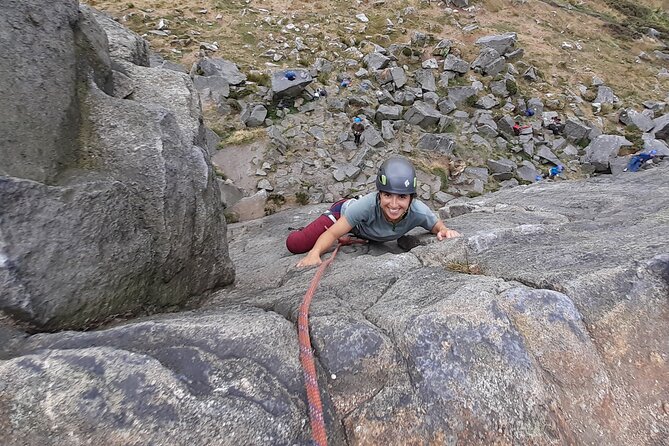
The exact climbing site depends on the day, weather, and the group’s ability. The Peak District gives Pure Outdoor several accessible options, and Stanage Edge is one location used for the climbing. That flexibility is useful because a good instructor needs to match the rock and route to the people in front of them.
At the crag, the character of the day changes. You are no longer looking at coloured holds on an indoor wall. You are working with real rock, natural footholds, varied surfaces, and a much stronger sense of exposure. The views across the Peak District add something special, but they can also make the height feel more real if you are nervous.
The instructor chooses climbs of different difficulty, length, and style. Beginners can start with manageable routes, while stronger members of the group can be offered harder options. This was especially helpful for groups that included total novices, people returning to climbing after a break, and climbers with indoor experience.
Do not expect everyone to climb the same route. The value of a small group is that the instructor can keep the party together while giving individuals a suitable challenge. One person may be working on confidence and foot placement, while another is practising movement on a more demanding line.
A completely different sort of day out in England:
- Beatles Magical Mystery Tour
★ 5.0 · 9,266 reviews - Liverpool: “Blue Route” – City & Beatles Tour
★ 5.0 · 8,562 reviews - Stonehenge, Windsor Castle and Bath with Pub Lunch in Lacock
★ 4.5 · 7,402 reviews - Oxford University Walking Tour With University Alumni Guide
★ 5.0 · 6,905 reviews
What you actually do during the seven hours
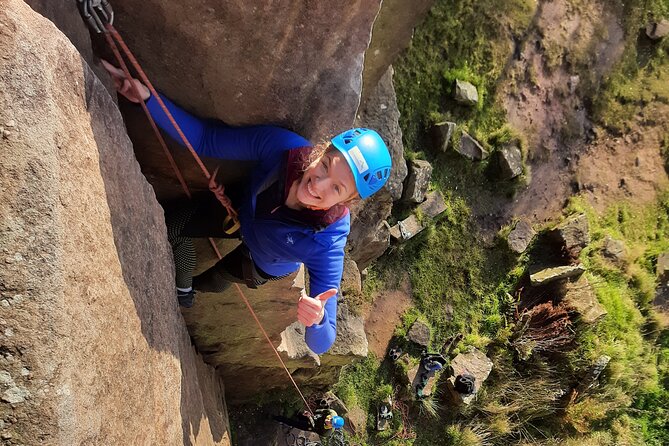
After the safety briefing, most of the day is given to climbing practice. You should have time to repeat routes, make adjustments, and try different grades rather than climbing once and packing up. That extra time is important for beginners. Your first climb may be more about understanding the rope and finding your feet than reaching the top smoothly.
The coaching focuses on climbing efficiently, not simply pulling harder. You may receive advice on where to place your feet, how to conserve energy, and how to use the shape of the rock. The goal is to build confidence while showing you that good technique can make a route feel less demanding.
Belaying gives you another role in the group. You are not only waiting for your turn to climb. You may also learn how to manage the rope for another person under the instructor’s direction. That makes the day more useful than a simple guided ascent because you begin to understand the teamwork behind climbing.
Abseiling adds a different challenge. Going down a rock face can feel more intimidating than climbing up, particularly if heights make you uneasy. The instructor’s job is to explain the system clearly and keep the pace comfortable. You are encouraged to test yourself, but you are not expected to pretend that exposure feels easy.
The day can run close to its full advertised length. One account describes finishing at about 5 pm, which fits the seven-hour schedule from 9:30 am. Plan your day around a full outdoor activity rather than a short morning attraction.
Coaching for nervous beginners and mixed abilities
This course is aimed at people with little or no outdoor climbing experience. You do not need to arrive already confident with ropes. If you are nervous about heights, the instructor can build the day around smaller steps and suitable routes.
Rachel was singled out for handling a group that included a rusty climber, a complete beginner, and someone nervous about heights. That sort of mixed group is common in a family or couples booking, and it is where instructor skill matters most. The course is not based on pushing everyone at the same speed.
Positive reinforcement is a repeated theme in the instruction. Emma is praised for moving the group from basic climbs toward harder routes with encouragement, while Neal is described as bringing a strong enthusiasm for climbing to a mixed-ability group of six. That does not mean the coaching is soft. You still need to make the moves yourself, but you get useful direction rather than being left to guess.
Teenagers from age 13 can take part, making this a possible family activity for older children. The minimum age is 13, and participants should have moderate physical fitness. The day involves climbing effort and outdoor conditions, so it is not a passive sightseeing trip.
Service animals are allowed. The activity operates in all weather, which means rain or cold may change the feel of the day even if the course still goes ahead. Dress appropriately for outdoor conditions and be ready for the fact that the rock may not provide the same comfort as the centre.
The Peak District setting adds real value
You are paying for more than instruction beside a wall. You get access to one of the UK’s best-known climbing areas, with real crags and broad views around the Hope Valley. Stanage Edge, when used, gives the day a strong sense of place and a memorable setting for a first outdoor climb.
The scenery also helps explain why this course is worth considering for people who are unsure about climbing itself. Even if you find the harder routes too much, you are spending the day outside in a striking part of England and learning a skill that can lead to longer climbing courses.
There is a practical limit, though. A seven-hour climbing day can feel long if you discover that heights are not for you. The instructor can adjust the challenge, but this is still a climbing course, not a general Peak District walk with a short activity added. Book it because you want to try climbing, not simply because you want a scenic day in the valley.
Is $137.37 good value?
At $137.37 per person, this is not a cheap casual attraction. I think the price makes reasonable sense if you use the full day. You are getting roughly seven hours, professional instruction, equipment guidance, several climbing attempts, rope skills, belaying, abseiling, and access to outdoor climbing sites.
The value is strongest for a complete beginner who would otherwise need to buy or hire equipment and work out the safety systems alone. It is also useful for an indoor climber who wants a structured introduction to real rock without committing immediately to a longer course.
The price may feel less attractive if you already have strong outdoor skills. In that case, a more advanced or intermediate course could make better use of your time. The beginner taster is built around explanation, confidence, and repetition, so experienced outdoor climbers may find the early teaching slow.
With a 4.9 rating from 74 published ratings and 97 percent recommending it, the experience has a strong record. I would still treat those numbers as a guide, not a promise. Weather, your group’s ability, and your own comfort with heights will shape the day.
Booking, cancellation, and useful planning details
You receive confirmation at booking in most cases. If you book within seven days of the date, confirmation can arrive within 48 hours and remains subject to availability.
Free cancellation is available until 24 hours before the start time for a full refund. Changes or cancellations made inside that 24-hour window are not accepted for a refund. The cut-off uses local time, and the activity requires a minimum number of participants. If Pure Outdoor cancels because that minimum is not reached, you are offered another date or experience, or a full refund.
I would keep the day free from other plans. The activity ends back at the meeting point, but the climbing session can use the full scheduled time. Bring clothing suited to the forecast, and expect the weather to remain part of the experience rather than a reason the activity automatically stops.
Who should book this climbing day?
I would choose this course if you are completely new to outdoor climbing, curious about moving from an indoor wall to real rock, or planning an active day with a partner or teenager aged 13 or older. It is especially suitable if you want coaching rather than a simple equipment hire arrangement.
It also works well for a mixed group. The instructors have experience adjusting routes for different abilities, including people who are rusty, nervous, or already comfortable indoors. The six-person limit gives the teaching a personal feel without turning the experience into a private lesson.
I would hesitate if you dislike outdoor conditions, have low physical fitness, or want a relaxed sightseeing day. I would also consider a higher-level course if you have already climbed outdoors or have substantial indoor experience and want technical progress rather than an introduction.
Should you book Pure Outdoor’s Peak District taster day?
Book it if you want a real first taste of outdoor climbing, not just a quick photo opportunity. The strongest reasons are the full day of practice, the small groups, the varied routes, and the steady attention to safety shown by instructors such as Owen, Sandra, Neal, Emma, and Rachel.
The main risk is simple: climbing outdoors can be tiring, weather-dependent, and mentally demanding. If that sounds exciting rather than alarming, $137.37 buys a solid introduction in a classic English climbing area, with enough time to find out if you want to continue.
FAQ
Where does the Outdoor Rock Climbing Taster Day start?
The meeting point is in Bamford, Hope Valley, England, at postcode S33. The activity starts at 9:30 am and ends back at the meeting point.
How long does the climbing experience last?
The activity lasts approximately seven hours. With a 9:30 am start, it may finish around 5 pm.
Do I need previous climbing experience?
No. The course is designed for people with little or no prior climbing experience. It can also suit people who climb indoors and want to try real outdoor rock.
What climbing skills will I learn?
You learn the basics of tying into the rope, belaying, and abseiling. The instructor also gives practical advice on climbing safely, confidently, and efficiently.
How many people can join the activity?
The group has a maximum of six participants. Routes and difficulty can be adjusted for different abilities within the group.
Can I cancel for a full refund?
Yes. You can cancel at least 24 hours before the local start time for a full refund. Cancellations or changes made less than 24 hours before the start are not accepted for a refund.
Recently added around England
- Brighton to Heathrow Airport private taxi transfers★ 5.0 · 8 reviews
- London’s Crown Secret: Self-Guided Royal Puzzle Quest★ 4.5 · 8 reviews
- The Condensed Canterbury Tour★ 5.0 · 8 reviews
- Postcard London★ 5.0 · 8 reviews
- Private Tour: Downton Abbey London Locations by Taxi★ 5.0 · 8 reviews
- Windsor Castle, Stonehenge & Roman Baths Private Tour★ 4.5 · 8 reviews
- CS Lewis & Tolkien Tour with Magdalen Entry Public tour 13.45★ 5.0 · 8 reviews
- Cotswolds Private Driving Tour from London★ 5.0 · 8 reviews