
Reviewed · WALKING TOURS
Roman Ruins to Blitz Bombings: A Walking Tour of London’s Fiery History
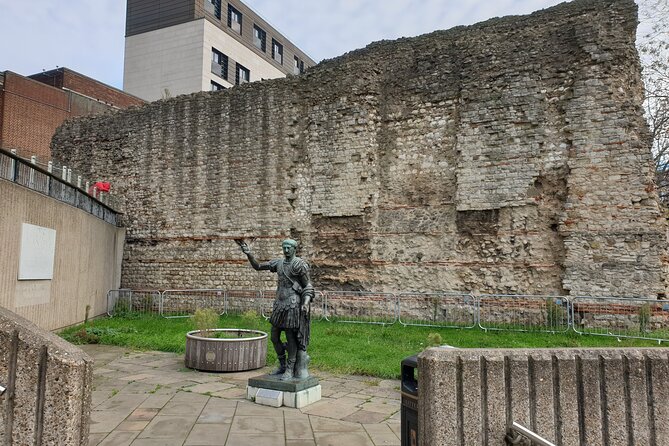
London’s story is written in layers. On this two-hour walk, you move from the Tower of London and Roman traces to a church ruined by wartime bombs, then finish near Fleet Street. It is a brisk way to see how fire, war, kings, commerce, and legend have shaped the city.
I like the small maximum of 15 people, which gives guide Tom room to answer questions and point out details you could easily miss. I also like the route’s variety: St. Dunstan in the East feels quiet and surprising, while the Monument and St. Paul’s connect London’s worst disasters to its rebuilding.
The main drawback is the pace. You cover a lot of ground in about two hours, and one review specifically warns that this is not a good choice if you have mobility problems. Some admission fees are also extra, so this is mainly a guided outdoor history walk rather than a ticketed tour of every site.
Key points to know before booking
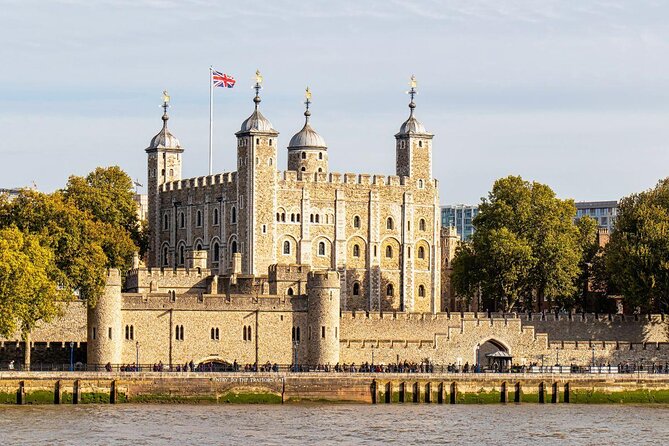
- Seven major stops in about two hours: The route links the Tower of London, St. Dunstan in the East, the Monument, London Stone, the Bank of England Museum, Guildhall, and St. Paul’s Cathedral.
- Tom brings the history to life: His approach is engaging and clear, with time for questions and suggestions for other places to visit.
- A small group keeps the walk personal: No more than 15 people can join, a useful size for hearing stories and asking questions.
- The route mixes famous sights and overlooked corners: St. Dunstan in the East offers a different mood from the grand buildings nearby.
- Admission is not included at several stops: The tour price covers the guided walk, not entry to the Tower, Monument, Bank of England Museum, Guildhall, or St. Paul’s.
- Plan for steady walking: The tour begins at Trinity Square near the Tower and ends outside Ye Olde Cheshire Cheese on Fleet Street.
London’s past, packed into one compact route
This is a walking tour for people who want connections, not just a parade of famous buildings. The route moves through London’s oldest eastern quarter and then west toward St. Paul’s and Fleet Street, linking events that are often studied separately.
You begin with royal power, move through medieval religion and old city legends, confront the Great Fire of 1666, and finish with Christopher Wren’s great cathedral. Along the way, the Second World War enters the story through the ruins of St. Dunstan in the East.
That range is the tour’s main strength. You do not spend two hours on only one period. Instead, you get a quick but useful framework for understanding why central London looks the way it does.
Tom is the named guide associated with this experience. His style, based on the details available, is friendly and energetic rather than dry or lecture-like. You can expect stories, explanations, and answers to questions, along with suggestions for places to explore after the walk.
The high rating and full recommendation rate point to a consistently strong experience, but I would keep your expectations sensible. This is not a private tour, and two hours is not enough for lengthy visits inside every building. Its value comes from the route and the guide’s interpretation.
More History Tours in London
- London Small Group Tour of Historical Pubs
★ 5.0 · 10,422 reviews - Soho Music & Historic Pubs Tour
★ 5.0 · 1,993 reviews - Royal Historic Pubs Walking Guided Tour in London
★ 5.0 · 803 reviews
Starting at the Tower of London
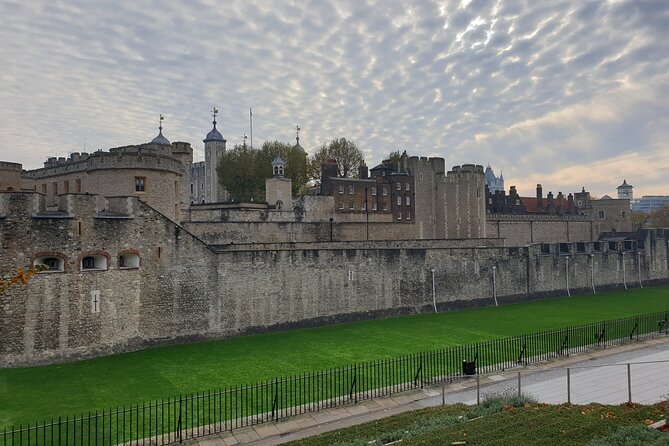
The meeting point is 38 Trinity Square, London EC3N 4DJ, close to the Tower of London. This gives the tour a dramatic opening. The Tower is described as Europe’s oldest surviving royal palace, so the first stop immediately places you in the heart of London’s royal and political story.
The scheduled time here is about five minutes. That tells you how to use the stop: expect an introduction and historical context, not a full Tower visit. Admission is not included, and the tour does not present itself as an inside tour of the complex.
That distinction matters. If the Tower is high on your list, you should plan a separate visit and allow much more time. The walking tour gives you a way to understand the building’s place in London before or after that visit, but it does not replace a ticket.
I like this beginning because it gives the route a clear anchor. You start with one of London’s best-known historic sites, then move into less familiar corners. The contrast keeps the walk from feeling like a simple checklist of postcard sights.
St. Dunstan in the East and the quiet marks of war
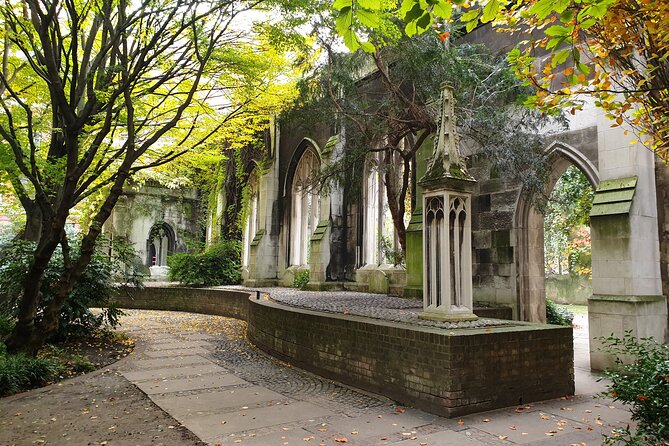
The next stop is St. Dunstan in the East, a medieval church whose gardens occupy the remains of a building destroyed during the Second World War. The stop lasts about five minutes, and admission is free.
This is one of the most memorable locations on the route because it shows destruction without requiring a long explanation. The church ruins and garden create a sharp change of mood from the royal grandeur of the Tower. You see how London has repeatedly adapted old spaces instead of erasing every trace of damage.
The Blitz connection gives the tour its modern historical edge. London’s past is not only about monarchs, fires, and medieval stone. It also includes the bombing of the Second World War and the decisions made afterward about what to preserve.
You should not expect a long garden visit during the tour. Five minutes is enough for the guide to explain the site and for you to take in the setting, but not enough for a leisurely pause. If the ruins appeal to you, note the location and return later at your own pace.
The Monument and the Great Fire of 1666
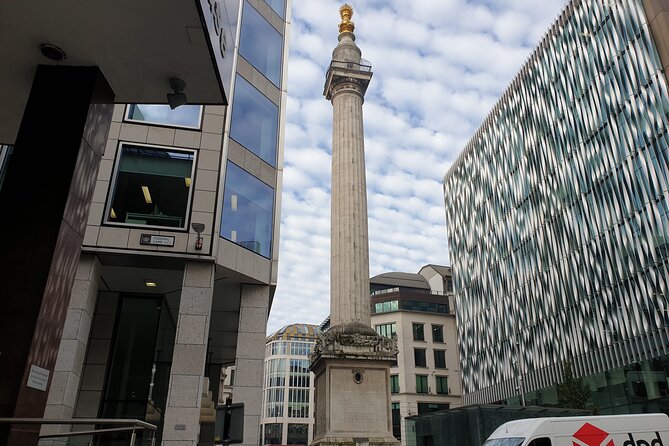
The route then reaches the Monument to the Great Fire of London, which commemorates the disaster of 1666. The stop is again about five minutes, and admission is not included.
The Monument works well in this tour because it turns a citywide disaster into a physical point on the street. You can connect the marker with the broader changes that followed the fire, including the rebuilding of central London and the later importance of St. Paul’s Cathedral.
The short stop also keeps the story moving. You receive the setting and the key context, but you do not climb or make a full visit as part of the tour. If you want to go inside or explore further, you will need to arrange that separately and pay any required admission.
I like the way this stop follows St. Dunstan in the East. One location recalls wartime destruction, the other recalls the Great Fire. Together, they show that London’s appearance has been shaped by repeated crises rather than by one clean period of growth.
More Walking Tours in London
- Tour for Muggles The Ultimate Harry Potter Walking Tour in London
★ 5.0 · 4,684 reviews - London Jack The Ripper Guided Walking Tour
★ 5.0 · 3,131 reviews - Changing of the Guard Guided Walking Tour in London
★ 5.0 · 1,793 reviews - The Great British Rock and Roll Walking Tour
★ 5.0 · 1,371 reviews
London Stone, where legend meets the street
Next comes London Stone, a famous stone with remarkable legends attached to it. Admission is free, and the scheduled visit is about five minutes.
This is a smaller and more unusual stop than the Tower or St. Paul’s. It is the kind of object that can be easy to pass without knowing its name or why people care about it. The guide’s role matters here, since the interest lies in the stories and traditions linked to the stone as much as in its physical size.
You should approach this part with an open mind. The description points to legends, not proven claims, so the appeal is the mixture of folklore and city history. London has plenty of grand monuments, but small objects like this can reveal how people have remembered the city across generations.
The stop also gives the walk a welcome change of scale. After the Monument’s public statement, London Stone brings the story down to one compact, storied object.
The Bank of England and the city’s financial power
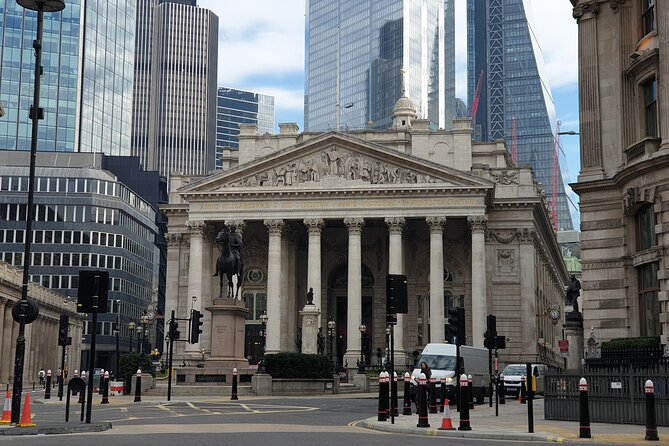
The route continues to the Bank of England Museum, the home of the United Kingdom’s central bank. The stop lasts about five minutes, and admission is not included.
This location broadens the tour beyond royal and religious history. London’s story is also a story of money, trade, banking, and civic power. The Bank of England helps explain why this part of the city became such an important center of national finance.
Since the scheduled time is short and admission is extra, treat this as a guided orientation rather than a museum visit. The tour can point you toward the institution and explain its place in the city, while a separate visit would be needed if you want to spend time inside.
That makes the stop useful for first-time visitors who want a wider picture of London. The route is not only asking who ruled here or what burned. It also asks how the city functioned and how its commercial power grew.
Guildhall and the medieval City of London
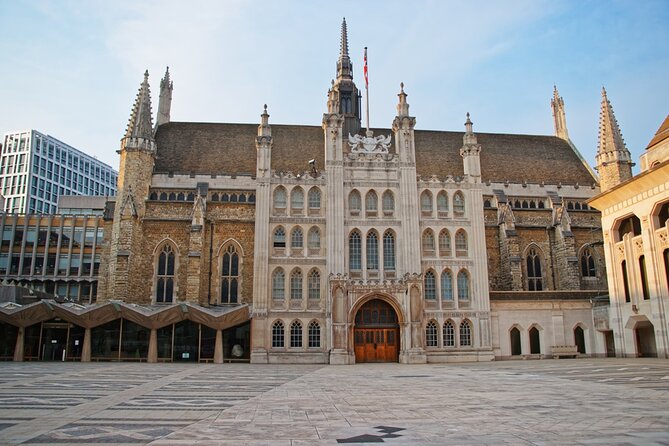
The next stop is Guildhall, a fifteenth-century hall and home to the Corporation of London. Admission is not included, and the tour allows about five minutes here.
Guildhall adds civic history to the route. The Tower represents royal authority, the Bank of England represents financial authority, and Guildhall represents the city’s own institutions. Together, these sites show that London has never been shaped by one power alone.
The building’s age also connects the stop to the medieval city. You are still in the same broad area where older streets, institutions, and stories overlap with modern offices and daily business. That contrast is part of what makes this walk worthwhile.
Again, five minutes is a brief introduction. If you are especially interested in historic buildings or the Corporation of London, you should make a note to return. The tour gives you the reason to care, but not the time for a detailed interior visit.
St. Paul’s Cathedral and the rebuilt city
The final major sight is St. Paul’s Cathedral, Christopher Wren’s seventeenth-century cathedral. The route spends about five minutes here, and admission is not included.
This is a strong closing point because St. Paul’s represents rebuilding on a grand scale. After the Great Fire, the cathedral became part of the new architectural identity of London. Ending here lets the guide bring together the earlier references to fire, civic power, and the reshaping of the city.
Do not confuse this stop with a cathedral tour. The schedule allows for an outside introduction, not a full interior visit. If you want to enter St. Paul’s, you will need a separate ticket and additional time.
For me, this ending gives the walk a satisfying arc. You begin with an ancient royal site and finish with one of London’s most famous rebuilt landmarks. The route does not pretend that the city has one simple story. It shows a place repeatedly damaged, repaired, and given new meaning.
Ending near Fleet Street
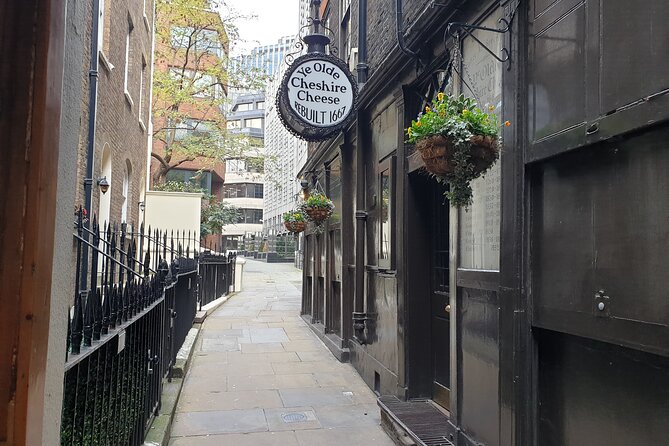
The tour ends outside Ye Olde Cheshire Cheese, 145 Fleet Street, London EC4A 2BP, not far from Blackfriars Station. This is a practical finish because you can continue sightseeing, find food, or use public transport from there.
The ending also places you near one of London’s best-known old streets. The tour does not include a meal or a pub visit, but the location gives you an easy next step after the walk. Tom may also be able to suggest places to visit afterward, a useful benefit if you still have energy for more history.
Because the walk begins near the Tower and ends west of St. Paul’s, you should think of it as a point-to-point route. Do not leave a car at the starting point and expect to return there quickly. Public transport is nearby, and the experience is listed as close to public transportation.
Is the $27.78 price good value?
At $27.78 per person, the tour is reasonably priced for a two-hour guided walk, especially with a group capped at 15. You are paying for the guide’s time, the route, and the explanations that connect seven historic places.
The value is strongest if you would otherwise walk past these sites without understanding them. London is full of historic markers, ruins, churches, and institutions, but the meaning is not always obvious from the pavement. A good guide turns separate sights into one clear story.
The price looks less attractive if you expect entry to the Tower, Monument, Bank of England Museum, Guildhall, or St. Paul’s Cathedral. Those admission costs are not included, and the short stop at each location means you are buying context rather than a series of full visits.
I would see this as a city orientation for history fans, not a substitute for major attractions. Book it early if your dates are fixed. It is booked, on average, 37 days ahead, which suggests that planning several weeks out is sensible.
Pace, group size, and comfort
The maximum group size is 15 people. That is small enough for a guide to respond to questions and for you to stay connected to the story without the feel of a large coach excursion.
The two-hour duration sounds manageable, but the walk is described as long and can feel demanding because the route covers several parts of central London. One direct warning is important: people with mobility issues may find this tour unsuitable.
The supplied information says most people can participate, and service animals are allowed. Still, you should judge the walk by your own needs. If standing and walking for roughly two hours is difficult, a route with fewer stops or more opportunities to sit would be a better choice.
Wear comfortable shoes and avoid filling the time with a heavy meal immediately before starting. Those are ordinary walking-tour precautions, but they matter here because the route keeps moving and has several brief stops rather than one long rest.
The tour is offered in English. That is useful to know if you are comparing it with multilingual options. The storytelling style appears conversational and accessible, with information delivered in a way that does not overwhelm you.
Who will get the most from this walk?
I would recommend it most strongly to:
- First-time London visitors who want a historical framework for the City of London
- People interested in Roman traces, medieval buildings, the Great Fire, and the Blitz
- Repeat visitors who have seen the main sights but want smaller historical details
- Travelers who prefer a guide’s stories to reading plaques on their own
- Visitors who enjoy asking questions in a small group
It is less suitable for anyone seeking long interior visits. It is also a poor match if you need a slow pace, frequent seated breaks, or a route designed around limited mobility.
The tour works especially well near the start of a London stay. It can help you decide which places deserve a separate visit, and the ending near Fleet Street makes it easy to continue exploring.
Booking and cancellation details
You receive confirmation at the time of booking, and the experience accepts mobile tickets. The tour is offered in English, allows service animals, and has a maximum of 15 participants.
Free cancellation is available if you cancel at least 24 hours before the local start time. Canceling less than 24 hours before the start, or making changes during that final 24-hour period, does not qualify for a refund.
Should you book Roman Ruins to Blitz Bombings?
Book this tour if you want a lively historical walk rather than a string of admission tickets. The route covers an impressive range of subjects, and Tom’s clear, enthusiastic style appears to be a major part of its appeal.
The best reason to choose it is the combination of famous landmarks and easily missed details. You get the Tower, the Monument, Guildhall, and St. Paul’s, but also St. Dunstan in the East and London Stone. That mix gives the walk character.
Skip it if you have mobility concerns or want to spend serious time inside each attraction. For everyone else, $27.78 is a fair price for a compact introduction to London’s disasters, legends, institutions, and rebuilding. Bring comfortable shoes, arrive ready to keep moving, and leave room in your schedule to revisit the places that catch your interest.
FAQ
How long does the walking tour last?
The tour lasts approximately two hours.
How much does the tour cost?
The listed price is $27.78 per person.
Where does the tour begin?
The meeting point is 38 Trinity Square, London EC3N 4DJ, UK.
Where does the tour end?
The tour ends outside Ye Olde Cheshire Cheese at 145 Fleet Street, London EC4A 2BP, not far from Blackfriars Station.
What language is the tour offered in?
The tour is offered in English.
Are admission tickets included?
The tour itself is included, but admission is not included for the Tower of London, the Monument to the Great Fire of London, the Bank of England Museum, Guildhall, or St. Paul’s Cathedral. St. Dunstan in the East and London Stone are listed as free.
How many people can join the tour?
The maximum group size is 15 travelers.
Recently added around London
- London’s Crown Secret: Self-Guided Royal Puzzle Quest★ 4.5 · 8 reviews
- Postcard London★ 5.0 · 8 reviews
- Windsor Castle, Stonehenge & Roman Baths Private Tour★ 4.5 · 8 reviews
- Private Tour: Downton Abbey London Locations by Taxi★ 5.0 · 8 reviews
- Cotswolds Private Driving Tour from London★ 5.0 · 8 reviews
- Skip-the-line London Westminster Abbey and City of Westminster Kid-Friendly Tour★ 5.0 · 8 reviews
- A Silent Disco Adventure in London★ 5.0 · 8 reviews
- Gangster Tour of Soho★ 4.5 · 8 reviews
Walking Tours, compared.

Oxford University Walking Tour With University Alumni Guide
Read our review →
Tour for Muggles The Ultimate Harry Potter Walking Tour in London
Read our review →

Cambridge University Walking Tour by Alumni™ Kings College Option
Read our review →
Blackbeard to Banksy – The Ultimate Walking Tour of Bristol
Read our review →
Air Raid Shelter + St. Nicholas Market Walking Tour
Read our review →
Walking Tour of Bath with Blue Badge Tourist Guide
Read our review →
Changing of the Guard Guided Walking Tour in London
Read our review →Browse the lists this tour appears in