
Reviewed · WALKING TOURS
Roman London Private Walking Tour
Roman London is not a single grand ruin waiting in the open. It is a wall beneath a car park, a temple under a modern building, a bath house below street level, and an amphitheatre tucked under the Guildhall. This tour helps you spot that lost city.
I like the private format, which lets your guide adjust the pace and answer questions without a group of strangers pulling the conversation in different directions. I also like the hotel pickup option and the route’s unusual sights, especially the amphitheatre and Mithraeum.
The main catch is the amount of walking. You may cover several miles in three to four hours, with little time to sit, and the per-person price of $254.93 is a serious outlay for one person or a small party.
Key points to know before you book
- The Roman Amphitheatre sits beneath the Guildhall, giving you a rare look at Londinium below today’s City streets.
- The route follows Roman walls in scattered fragments, including sections in alleys, churches, and places you would likely miss alone.
- Kevin and Stephen Liddell lead the experience, bringing in Roman, medieval, Saxon, wartime, and modern London along the way.
- Hotel pickup is available in central London, followed by public transport to the starting point near St Paul’s.
- The walk finishes at the London Mithraeum, close to Bank Underground Station and only a short distance from the opening area.
- A solid level of fitness helps, since the pace is reasonable but the route can involve seven or more miles of walking.
Why Roman London rewards a guided walk
London’s Roman past is easy to miss because the modern City of London was built directly over it. The Roman town of Londinium did not survive as one tidy archaeological park. Instead, pieces appear among office towers, medieval churches, underground spaces, markets, and busy roads.
That is the real value here. You are not simply checking off famous sights. You are learning how to read the city beneath the city. A guide can point out where a wall once ran, explain why a cathedral occupies a particular rise, and connect a basement ruin to the Roman street plan.
Kevin and Stephen Liddell are named as guides for this experience. The strongest praise centers on their storytelling, patience, and ability to bring in later chapters of London’s past. You might hear about Roman engineering at one stop, the Blitz at another, and Dickens, medieval London, or modern architecture a few minutes later.
That wider context suits London. The Roman remains are often small, so the story around them matters. A short stretch of stone becomes much more meaningful when you understand what it once protected and how later buildings swallowed it.
More Walking Tours in London
- Tour for Muggles The Ultimate Harry Potter Walking Tour in London
★ 5.0 · 4,684 reviews - London Jack The Ripper Guided Walking Tour
★ 5.0 · 3,131 reviews - Changing of the Guard Guided Walking Tour in London
★ 5.0 · 1,793 reviews
Starting beneath St Paul’s Cathedral
The morning begins at Panyer Alley near St Paul’s Cathedral at 9:30 a.m. If you arrange pickup, your guide can meet you at a central London hotel and travel with you by Tube to the starting point. Transportation to and from attractions is not included, so carry a contactless card or Oyster card and allow for that small extra cost.
St Paul’s is an effective opening because the site reaches back before the cathedral. The area was associated with a Roman temple dedicated to Diana, according to the tour’s historical interpretation. Your guide uses the cathedral’s setting to show how old religious and civic locations can persist even when the buildings themselves change.
A few feet away, the Church of St Vedast Alias Foster provides the first Roman remains. The stop is brief, only about five minutes, but that is typical of the walk. You pause, look closely, and move on before the modern city takes over again.
This is not a cathedral interior tour. Admission to St Paul’s is not included, and the cathedral is used mainly as a landmark and historical starting point.
Following walls through alleys and wartime gaps
The route then shifts into the less obvious corners of the City. At Noble Street, you see a stretch of Roman wall whose discovery was linked to bombing during the Second World War. The Blitz destroyed later buildings and exposed sections of the much older city below.
That contrast is one of the walk’s recurring pleasures. Roman stone appears beside office buildings, in narrow lanes, and in areas that feel more like service spaces than sightseeing stops. At Cripplegate Street, the route reaches an old Roman gate with well-preserved wall sections nearby.
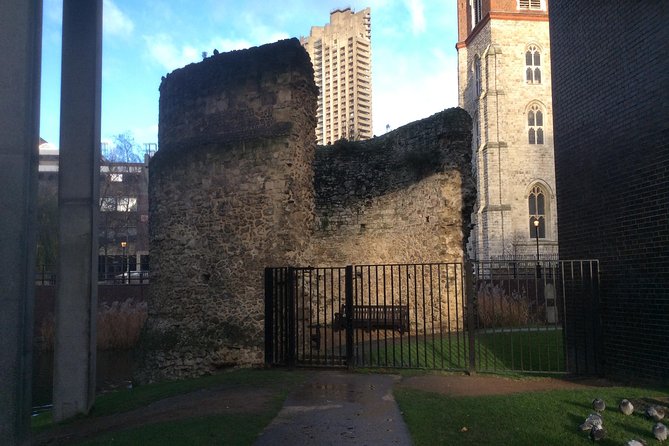
You also visit several parts of London Wall. Do not expect one continuous fortification. The remains survive in separate pieces, and your guide explains how they once worked together to encircle Roman London.
The Guildhall adds another layer. Its grand square and old civic buildings can easily distract you from the Roman material beneath. Look down and around rather than only at the impressive architecture above. The Roman connections are part of the point, and admission to Guildhall itself is not included.
This portion is especially useful if you enjoy urban archaeology. You are not walking through a reconstructed Roman town. You are learning to identify fragments in a city that kept rebuilding itself.
The amphitheatre beneath the Guildhall
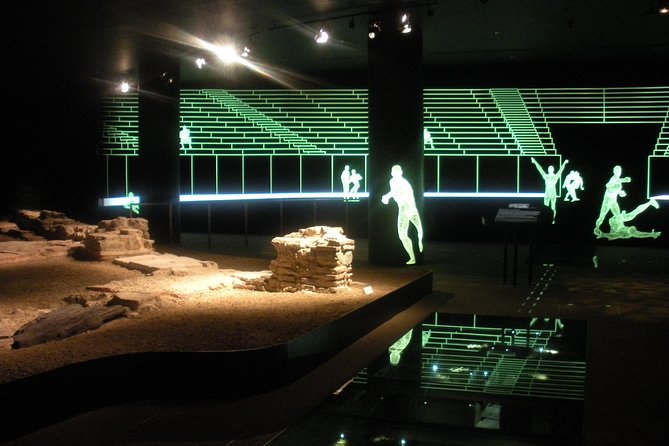
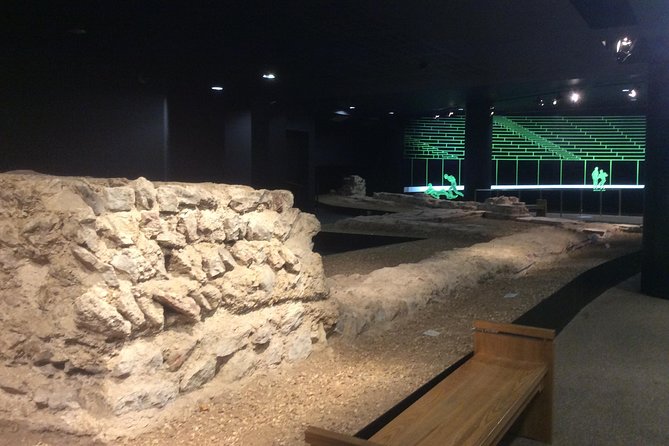
The Roman Amphitheatre is one of the tour’s best stops. It lies beneath the original Roman streets and was discovered only a few decades ago. Here, you can stand where gladiatorial contests took place, below the modern City.
The visit lasts about 25 minutes, longer than most of the quick outdoor stops. Admission is included, which helps justify part of the tour cost. The controlled setting also gives you a chance to slow down and absorb the scale of what you are seeing.
The old official residence of the Lord Mayor of London is also part of this section of the route, although the supplied details do not assign it a separate stop time or admission note. Treat it as a passing point rather than a separate attraction with a guaranteed interior visit.
The amphitheatre is a strong reason to choose this walk over a general London history tour. You get a physical sense of Roman public life, not only a date and a paragraph. Still, the space is compact, so your appreciation will depend heavily on the guide’s explanation.
A completely different sort of day out in London:
- Stonehenge, Windsor Castle, and Bath from London
★ 4.5 · 18,662 reviews - London Big Bus Hop-On Hop-Off Tour with Optional River Cruise
★ 3.5 · 10,803 reviews - London Small Group Tour of Historical Pubs
★ 5.0 · 10,422 reviews - Stonehenge, Windsor Castle and Bath with Pub Lunch in Lacock
★ 4.5 · 7,402 reviews
Bank, the Royal Exchange, and Roman commercial London
From Guildhall, the walk heads toward the Bank of England and the Royal Exchange. These buildings represent the financial heart of the modern City, but the location has been commercially important for much longer.
The Bank of England stop is brief and mainly exterior. Its monumental stone architecture can feel overpowering, yet it helps show how the old Roman core remains the center of London’s financial district.
At the Royal Exchange, you pause in front of a building whose grand design can make you think of ancient Rome. Admission is listed as included, though the experience is not presented as a long indoor visit. The main reward is the setting and the connection between Roman civic life and the City’s later commercial role.
Leadenhall Market brings the past closer to street level. The Victorian market was built over its Roman predecessor, and, if access allows, you may see a surviving piece of that earlier development. The stop lasts about 15 minutes and offers a pleasant change from walls and excavated rooms.
The precise Roman fragments available at these locations can depend on access. That is normal in a working business district. A private guide is useful here because you can ask questions and spend a little longer when a detail catches your eye.
Roman memorials near the Gherkin and Aldgate
The route continues toward 30 St Mary Axe, better known as the Gherkin. In its shadow is an unexpected Roman memorial. The stop is only about two minutes, but it makes a larger point: ancient London and twenty-first-century London often occupy the same few yards.
Nearby, the Tomb of the Unknown Roman Girl offers a more personal connection to the past. It is a memorial to one of London’s oldest citizens, and the brief stop gives the route a human scale after the larger walls and public buildings.
At Aldgate Square, the remains of the Roman gate are buried beneath the newly landscaped park. You can still follow the line of the wall and understand the gate’s position, even without a large exposed ruin.
Vine Street brings another archaeological stop, with Roman wall sections and artefacts near one of London’s newer museums. The details supplied for the tour do not promise a full museum visit, so think of this as a short look at the remains rather than an extended indoor museum session.
These stops are good examples of why a guide matters. On your own, you could walk past a memorial or paved-over gate without knowing what you are seeing.
Trajan, the Tower, and an old Roman home
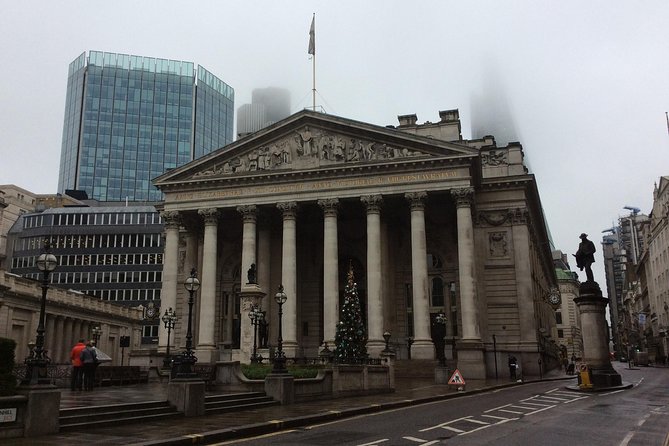
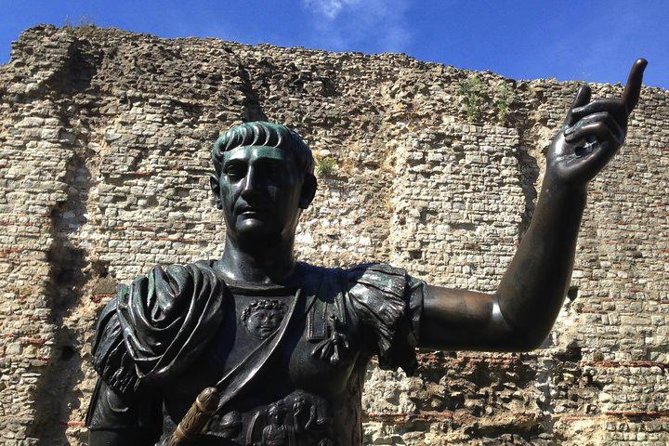
Outside the Tower of London, a statue of Emperor Trajan provides a clear visual link to the Roman world. The Tower itself is medieval, not Roman, but the statue helps place the route within the wider story of imperial Britain.
You then visit more sections of London Wall, including a portion where admission is included. Since the wall appears in several different settings, these visits gradually build a picture of the city’s former perimeter rather than presenting one isolated relic.
All Hallows by the Tower is a particularly layered stop. Inside or around this old church, you can see what is described as London’s oldest archway along with remains of a Roman house. The visit lasts about 15 minutes and shows how Roman structures were reused, covered, and preserved within later religious buildings.
The walk then pauses at St Dunstan in the East. This ruined church is not strictly Roman, but it is one of the most peaceful and attractive ruins in London. It gives your legs a brief visual rest and adds a later chapter to the story. The site is included in the route, though the experience remains a walking tour rather than a formal church visit.
Baths, the first London Bridge, and the Great Fire
At Billingsgate, the route reaches the location of London’s Roman bath house. The stop is short, about five minutes, and admission is not included. The value lies in understanding where the baths fit into Roman Londinium, even if you should not expect a long examination of a fully exposed complex.
St Magnus the Martyr brings you to what may be the only surviving part of the original Roman London Bridge. Admission is included, and the church offers another example of Roman material surviving within a much later building.
The Monument to the Great Fire of London shifts the timeline forward. You stand near the place where the fire began and see displays that help picture Roman Londinium two thousand years ago. It is a useful reminder that London’s story is not a straight Roman-to-modern progression. Fire, rebuilding, war, and commerce repeatedly changed the surface while older traces remained below.
This part of the walk is also a good test of your interests. If you want only Roman ruins, the later London material may feel like a detour. I see it as a strength because it explains why the Roman remains are so fragmented today.
Finishing underground at the Mithraeum
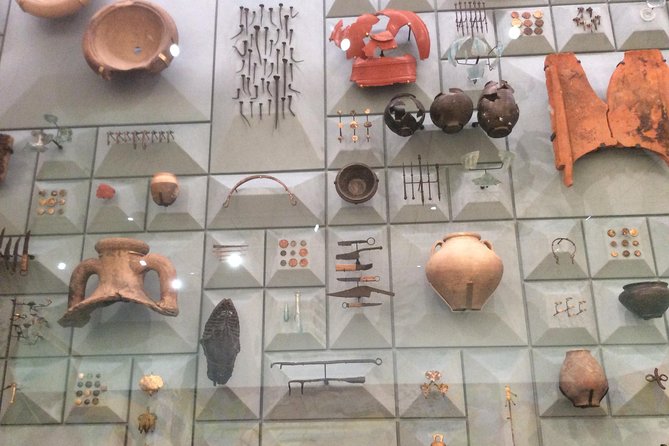
The final major stop is the London Mithraeum Bloomberg SPACE on Walbrook. You first see hundreds of Roman artefacts before going underground to the Temple of Mithras.
The temple is the natural climax. It gives you an enclosed sacred space after a morning spent tracking walls and street plans. The visit lasts about 20 minutes, and admission is included.
Access to the temple is guaranteed only with advance booking during peak periods. That point matters. If seeing the Mithraeum is the main reason you are booking, confirm that the required reservation is in place, especially for a busy travel season.
The tour ends at 12 Walbrook, close to Bank Underground Station and only a few minutes from the opening area near St Paul’s. That makes it easy to continue sightseeing, find lunch, or return to your hotel.
The London Stone is also included near the end of the route. This legendary stone is described as being as old as London itself. It is a small final stop, but fitting for a tour built around fragments that gain meaning from their setting.
Price, pace, and practical value
At $254.93 per person, this is expensive for a walking tour if you are alone or traveling as a couple. The private format changes the calculation for a family or larger group, particularly because group discounts are available. Ask how the final cost changes with your party size before booking.
You are paying for a private guide, route planning, access to several included sites, and the ability to ask questions throughout. You are also paying to avoid spending hours hunting for ruins that are poorly marked or tucked below modern buildings.
The tour lasts about three to four hours, but the walking can be substantial. One person reported covering more than seven miles, while another described three solid hours without a break. The pace itself is generally reasonable, but you should wear your best walking shoes and bring water.
The experience operates in all weather. Smart casual clothing is requested, and you should dress for rain, wind, or sun. There is no promise of a long café stop, so do not plan this as a slow morning stroll.
The tour is offered in English with a mobile ticket. Confirmation is sent within 48 hours, subject to availability. Free cancellation is available up to 24 hours before the start time, but cancellations or changes inside that window are not refunded or accepted.
Who will enjoy this Roman London tour?
I would choose this for anyone fascinated by archaeology, urban history, Roman Britain, or the way old cities grow over themselves. It also suits repeat visitors who have already seen the Tower, St Paul’s, and the main royal sights and now want a less obvious side of London.
Families can do well here if teenagers are happy to walk and listen. One reported family included two adults and two teenagers, all of whom enjoyed the experience. The private setting also helps if your group has different interests or wants to ask plenty of questions.
I would hesitate to book it for someone with limited walking ability or anyone seeking a relaxed, seated tour. The route has many short stops, but the full experience requires steady movement through central London.
Should you book Roman London Private Walking Tour?
Book it if you want to understand how Roman Londinium survives inside the modern City, not just see a famous ruin. The Roman Amphitheatre, scattered wall sections, All Hallows, the possible bridge remains, and the Mithraeum create a varied morning, while Kevin or Stephen Liddell can connect those places to later London.
Think carefully about the cost if you are alone, and confirm Mithraeum access in advance if that temple is essential. For a group that values personal guiding and can handle a long walk, the tour offers far more than a do-it-yourself route through scattered fragments. For a small party on a tight budget, the price may be harder to justify.
FAQ
Where does the Roman London Private Walking Tour start?
The tour starts at Panyer Alley, London EC2V 6AA, near St Paul’s Cathedral.
What time does the tour begin?
The scheduled start time is 9:30 a.m.
Where does the tour end?
The tour ends at the London Mithraeum Bloomberg SPACE at 12 Walbrook, near Bank Underground Station.
Is hotel pickup available?
Yes. The guide can meet you at any central London hotel before traveling by Tube to the starting point.
Is transportation included?
Transportation to and from attractions is not included. The guide accompanies you by public transport from a central London hotel pickup to the starting point when that option is arranged.
How long does the tour last?
The tour lasts approximately three to four hours.
Is the tour private?
Yes. Only your group participates in the private activity.
Is admission to the London Mithraeum included?
Yes, admission to the London Mithraeum is included. Guaranteed access to the temple requires advance booking during peak times.
Can I cancel for a full refund?
Yes, if you cancel at least 24 hours before the experience start time. Cancellations or changes made less than 24 hours before the start are not refunded or accepted.
Recently added around London
- London’s Crown Secret: Self-Guided Royal Puzzle Quest★ 4.5 · 8 reviews
- Postcard London★ 5.0 · 8 reviews
- Windsor Castle, Stonehenge & Roman Baths Private Tour★ 4.5 · 8 reviews
- Private Tour: Downton Abbey London Locations by Taxi★ 5.0 · 8 reviews
- Cotswolds Private Driving Tour from London★ 5.0 · 8 reviews
- Skip-the-line London Westminster Abbey and City of Westminster Kid-Friendly Tour★ 5.0 · 8 reviews
- A Silent Disco Adventure in London★ 5.0 · 8 reviews
- Gangster Tour of Soho★ 4.5 · 8 reviews
Walking Tours, compared.

Oxford University Walking Tour With University Alumni Guide
Read our review →
Tour for Muggles The Ultimate Harry Potter Walking Tour in London
Read our review →

Cambridge University Walking Tour by Alumni™ Kings College Option
Read our review →
Blackbeard to Banksy – The Ultimate Walking Tour of Bristol
Read our review →
Air Raid Shelter + St. Nicholas Market Walking Tour
Read our review →
Walking Tour of Bath with Blue Badge Tourist Guide
Read our review →
Changing of the Guard Guided Walking Tour in London
Read our review →Browse the lists this tour appears in