
Reviewed · BIRMINGHAM TOURS
Digbeth, Public Art & Peaky Film
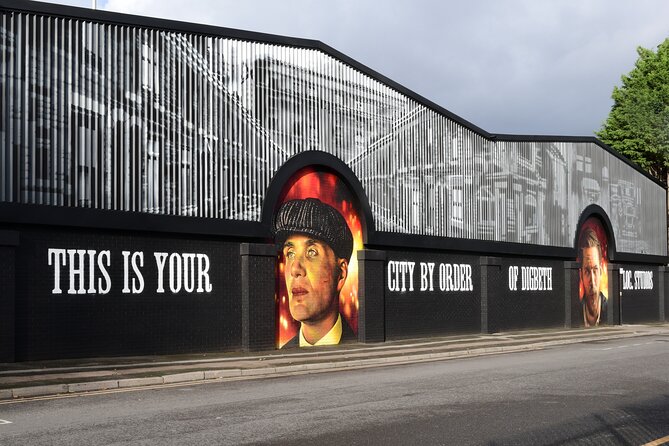
Digbeth is where Birmingham’s past and present collide. Old industrial streets, bold murals, unexpected graffiti and the former home of Bird’s Custard create a very different city experience from the usual centre walk. Jonathan Berg, a local author, links the art to Birmingham’s story and the coming Peaky Blinders feature film.
I like the audio receiver, which helps you hear Jonathan on busy streets or if you pause to study a mural. I also like the mix of public art and local history: you learn how Birmingham began, then see how artists are reshaping one of its most atmospheric districts.
The main point to consider is pace. The route covers a fair amount of ground in about two hours, and Jonathan has been described as a speedy walker. You need moderate fitness, comfortable shoes and your own earphones with a 3.5 mm jack, or you can arrange a pair for about £1.
Key points to know before you book
- Digbeth is the star of the walk: Expect atmospheric streets, large murals and art tucked into surprising corners.
- Jonathan Berg leads the tour: He is a Birmingham author who brings local history, artists and city change together.
- The audio system is genuinely useful: You can adjust the volume and keep listening while looking at a wall or falling a little behind.
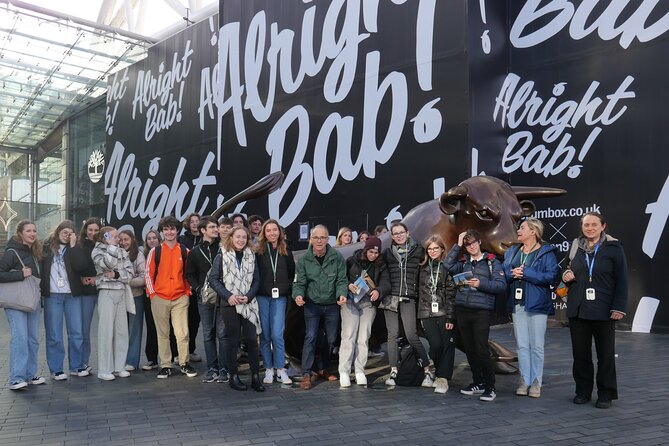
- The route begins and usually ends at the Bullring: This makes it easy to fit into a day of sightseeing and shopping.
- Peaky Blinders adds a film connection: Digbeth provides the backdrop for filming connected with the Peaky Blinders feature film.
- The price is modest for a guided city walk: At $19.43 per person, the tour offers more context than simply finding murals on your own.
Why Digbeth makes such a good walking subject

Many city walks stay on the polished central streets. This one heads into Digbeth, a district with a more rough-edged feel and a strong connection to Birmingham’s industrial beginnings. The setting matters. You are not looking at public art in a tidy outdoor gallery. You are finding it on working streets, old walls and buildings with their own scars and stories.
That gives the tour a useful sense of place. Jonathan does not just point at a painted wall and name an artist. He places the work within the story of Birmingham, from the city’s early growth to its current cultural life. You get a clearer idea of why Digbeth has become associated with art, film and creative projects.
I particularly like the way this helps first-time visitors get beyond the centre. Birmingham can be hard to read at street level if you do not know where to go. The tour takes you to areas you might otherwise pass by, then gives you a reason to stop and look closely.
The route is also useful for people who already live in Birmingham. One person who had lived in the city all their life said the walk revealed how little they had noticed about its public art. That is a fair warning for locals: familiar streets can hide a surprising amount.
A few more Birmingham half days worth a look
- Entry ticket to Hoo Zoo and Dinosaur World in Telford
★ 5.0 · 591 reviews - Cadbury World Entry Ticket
★ 3.0 · 524 reviews - Birmingham Walking Tour: Canals, Victorians & Today (1:30pm)
★ 5.0 · 346 reviews
Starting beneath the Bullring
The meeting point is by the Bull statue at the Bullring Shopping Centre walkway. This is a practical place to begin. It is central, easy to find and close to public transport, with the tour generally returning to the same area.
The opening section passes St. Martin in the Bull Ring, the historic church beside the shopping centre. The stop itself is brief, about five minutes, so do not expect a full church tour. Instead, it gives Jonathan a chance to set the older Birmingham against the modern shopping district around you.
That contrast is one of the tour’s useful themes. The Bullring is busy and contemporary, while St. Martin’s points to an older city that existed long before the present retail centre. From here, the walk turns toward Digbeth and the character of the route changes.
The first stages are short, but they help you understand the geography. You start in a place most visitors will already recognize, then move toward streets that feel less obvious and more textured.
Walking into Digbeth’s art-filled streets
The Digbeth section takes about an hour, making it the main part of the experience. This is where you spend time looking at murals, graffiti and public art while Jonathan explains the people, places and history connected with them.
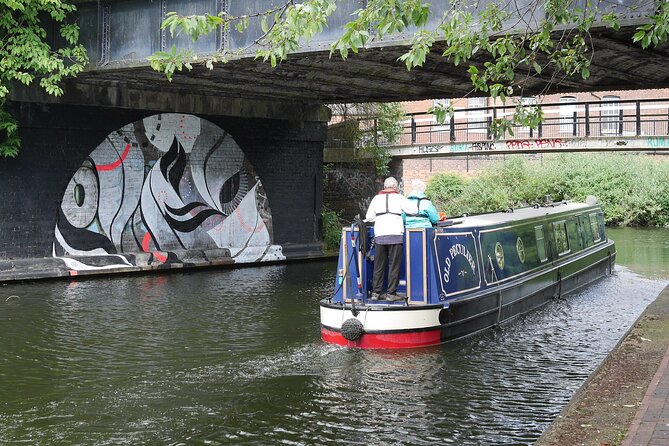
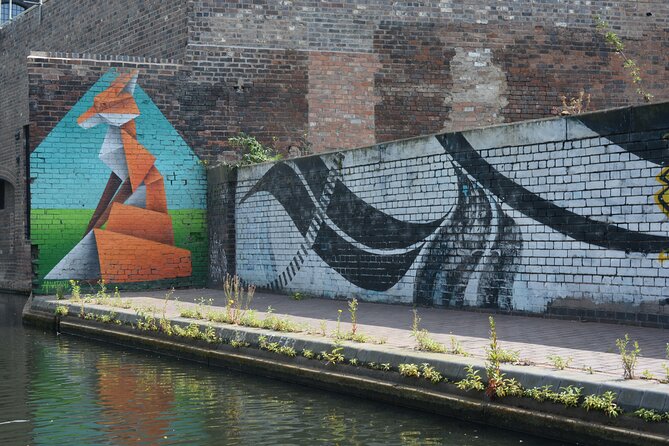
The distinction between graffiti and street art becomes part of the fun. You may not remember every artist’s name, but you will begin to notice different styles, approaches and levels of detail. The guide encourages questions, and the audio system means you can keep listening while standing back from a wall.
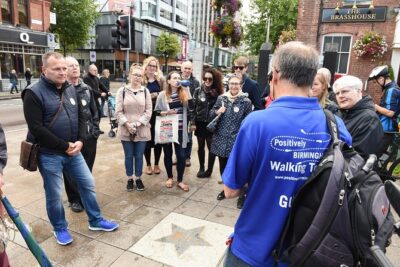
That equipment solves a common problem on walking tours. You do not have to crowd around the guide or miss a sentence when traffic and city noise rise. You can set your own volume, move a little to one side and still follow the commentary. Bring wired earphones with a standard 3.5 mm jack. If you do not have them, the operator can provide a pair for around £1.
Digbeth is particularly good for visitors who enjoy photography, but the tour is not simply a mural hunt. Jonathan connects the artwork to Birmingham’s development and to the way the district is changing. The result is a walk about both art and urban change.
The art can appear in unexpected places, including walls and corners you might not think to inspect. That is why following a local guide adds value. You could walk through Digbeth alone, but you would not necessarily know which surfaces matter, who created them or how they fit into the wider city.
Jonathan’s energy is a central part of the experience. He is described as funny, lively and willing to answer questions. His local connection comes through his writing as well as his guiding, and he has written about Birmingham’s public art. He is also the author of Birmingham: A Drone’s Eye View, published in November 2025 according to the tour information.
There is one trade-off. The pace can be brisk because the group covers a lot of ground. If you like long, unhurried stops at every artwork, this may feel quick. The audio receiver helps if you fall behind, but you still need to keep moving and pay attention to where the group is going.
The Custard Factory and Birmingham’s creative side
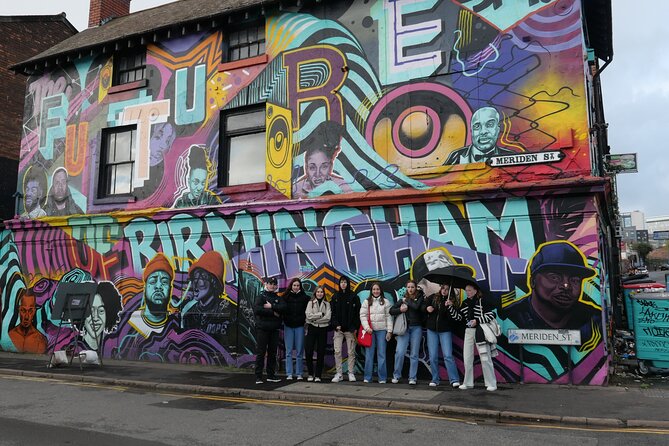
The walk continues to the Custard Factory, a former Bird’s Custard site that now forms part of Digbeth’s bohemian character. The stop lasts around 15 minutes, enough to take in the setting and the art rather than explore every part of the complex.
The Custard Factory works well as a final major stop because it brings several themes together. There is industrial history, creative reuse and graffiti in places you might not expect. It shows how an old commercial site can take on a new cultural role without losing its connection to Birmingham’s working past.
You should keep your eyes open here. The appeal is not only a single famous mural. The art may be spread across surfaces and tucked into corners, so the guide’s direction helps you see more than you would on a quick visit.
The area also gives the walk a more relaxed, creative mood after the longer stretch through Digbeth. Jonathan’s commentary continues to provide the thread, tying the art to the district rather than treating each piece as an isolated attraction.
A completely different sort of day out in Birmingham:
- Discovering Birmingham 2 hour Walking Tour to the Jewellery Quarter
★ 5.0 · 333 reviews - Birmingham Slogging Gangs Walking Tour with Edward Shelby
★ 4.5 · 306 reviews - Birmingham City Centre Daily Walking Tour (10:30am & 2pm)
★ 5.0 · 265 reviews - SEA LIFE Birmingham Admission Ticket
★ 3.0 · 218 reviews
Peaky Blinders without the usual city-centre script
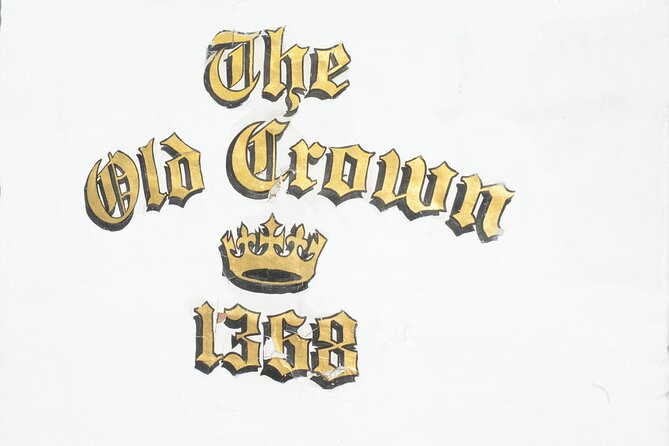
The film connection gives this tour an extra hook. Digbeth’s atmospheric streets will form the backdrop for filming connected with the Peaky Blinders feature film, so you see the kind of setting that suits the series: old urban spaces, industrial edges and strong visual character.
This is not presented as a dedicated television tour with a long list of show locations. The focus remains Birmingham’s history and public art, with Peaky Blinders adding a modern film angle. That balance is important. If you want only screen trivia, another experience may suit you better. If you like film connections alongside real city context, this is a more rounded choice.
The film link also helps explain why Digbeth matters beyond its past. The district is not frozen as an old industrial quarter. It is being used, reimagined and presented as part of Birmingham’s current identity.
Centenary Square and Grand Central in the wider route
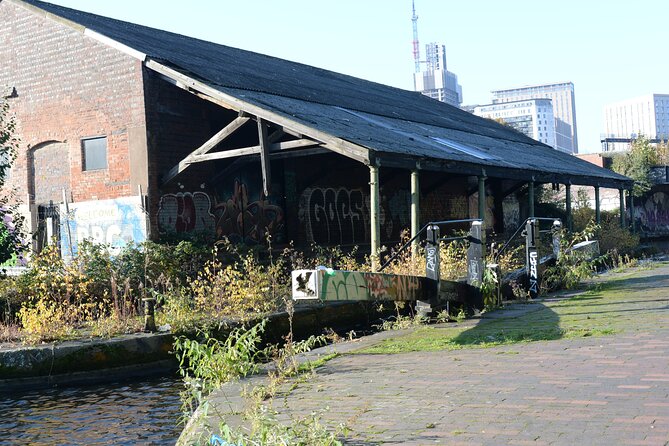
The tour highlights also include Centenary Square and Grand Central as you explore Birmingham. The supplied route details focus most closely on the Bullring, St. Martin’s, Digbeth and the Custard Factory, so you should treat the exact sequence and time spent at Centenary Square and Grand Central as part of the wider city walk rather than expect a long stop at each.
These locations help frame the change from Birmingham’s established centre to Digbeth’s more alternative streets. Grand Central is tied to the modern central city, while Centenary Square is one of the major civic spaces. Their presence broadens the walk beyond street art and gives you more of Birmingham’s changing public face.
If seeing major central landmarks is your main goal, check the guide’s route on the day. The strongest emphasis is clearly Digbeth and its art, not an extended architectural tour of every central landmark.
What the two-hour format feels like
The stated duration is about two hours and 15 minutes, while the main walking sections are often described as taking roughly two hours. That makes this a compact experience for a city visit, but it is not a slow stroll.
You should plan to be on your feet for most of the time. Moderate physical fitness is recommended, and comfortable shoes are sensible. The tour does not involve an admission charge at the listed stops, so the time is spent walking, listening and examining the streets rather than waiting to enter attractions.
A maximum group size of 35 people keeps the tour from becoming enormous, though that is still a sizeable group for narrow pavements. The audio receiver is especially helpful in a group of this size. It also means you do not have to stand directly beside Jonathan to catch every detail.
Rain need not ruin the walk, since the experience is outdoors and continues through the city streets, but you should dress for Birmingham weather. The focus is on seeing walls and details, so an umbrella can be awkward. A waterproof jacket leaves your hands free for photographs.
Is $19.43 good value?
At $19.43 per person, I consider this a good-value introduction to Digbeth, especially if you are new to Birmingham. You are paying for a local guide, a planned route and commentary that helps you understand why the art is there. The audio equipment adds practical value rather than being a decorative extra.
You could walk through Digbeth without paying, but the challenge is knowing where to go and what you are seeing. The tour saves you that research time and brings together art, local history and the Peaky Blinders connection in one outing.
The value is strongest for people who enjoy interpretation. If you only want to photograph murals, you might prefer to explore independently and spend nothing. If you want the background, artist context and a route that avoids aimless wandering, the price is reasonable.
Admission is free at the listed stops. Earphones are the only small extra to plan for. Bring your own wired pair, or budget about £1 for a supplied set.
Who should book this walk?
I would recommend this tour to:
- First-time visitors who want an introduction to Birmingham beyond the main shopping streets.
- People interested in street art, graffiti and public art.
- Fans of Peaky Blinders who also want real local context.
- Birmingham residents who suspect they have overlooked parts of their own city.
- Visitors who prefer a guide with a strong personal connection to the place.
- Anyone with around half a day available and enough energy for a brisk urban walk.
It is less suitable if you have limited mobility, dislike walking at a steady pace or want a seated museum experience. The tour is also not designed as a full interior visit to the Custard Factory or St. Martin’s. Its strength is the street-level view.
Service animals are allowed. The start point is near public transportation, and confirmation is provided when you book. You can cancel for a full refund up to 24 hours before the start time. Changes or cancellations inside that window are not accepted for a refund.
My verdict on Digbeth, Public Art & Peaky Film
Book this if you want Birmingham explained through its walls, old industrial streets and changing districts. Jonathan Berg brings a local author’s eye to the walk, and the audio receiver makes the busy route easier to follow.
The strongest feature is the combination of art, history and place. The second is the chance to see Digbeth with purpose rather than simply passing through it. Just allow for a brisk pace, bring suitable earphones and do not expect every stop to be a long formal attraction visit.
For $19.43, this is a smart choice for curious visitors and locals who want a sharper sense of Birmingham’s creative side. It gives you plenty to notice after the tour ends, which is often the mark of a useful city walk.
FAQ
Where does the tour start?
The tour starts by the Bull statue at the Bullring Shopping Centre walkway in Birmingham, B5 4BU.
Where does the tour finish?
It usually finishes back at the Bullring Shopping Centre in Birmingham.
What time does the tour start?
The stated start time is 10:30 am.
How long does the walk last?
The experience lasts approximately 2 hours and 15 minutes.
Do I need to bring earphones?
Yes. Bring earphones with a 3.5 mm jack for the live audio receiver. Earphones can also be supplied for about £1.
Is the tour suitable for everyone?
A moderate level of physical fitness is recommended. Service animals are allowed, and the tour is near public transportation.
Recently added around Birmingham
- Best of Birmingham 12km Running Tour★ 5.0 · 12 reviews
- Birmingham Private Self-Guided Walking Tour★ 4.0 · 13 reviews
- On the Origins of Charles Darwin: A Self-Guided Audio Tour of Shrewsbury★ 4.5 · 16 reviews
- Taste of Shrewsbury Food and Drink Tour with Guide★ 5.0 · 22 reviews
- Cotswolds Full-Day Tour From Birmingham★ 4.5 · 30 reviews
- From Birmingham Stonehenge and Bath Day Tour★ 4.5 · 33 reviews
- Birmingham Ghost Hunt: Haunted Self-Guide Tour & Quest★ 4.5 · 37 reviews
- 2.5-Hours Walking Tour of Birmingham into Black Heritage Madiba★ 5.0 · 49 reviews
Birmingham Tours, compared.

Entry ticket to Hoo Zoo and Dinosaur World in Telford
Read our review →
Birmingham Walking Tour: Canals, Victorians & Today (1:30pm)
Read our review →
Discovering Birmingham 2 hour Walking Tour to the Jewellery Quarter
Read our review →
Birmingham Slogging Gangs Walking Tour with Edward Shelby
Read our review →
Birmingham City Centre Daily Walking Tour (10:30am & 2pm)
Read our review →

Fun, Flexible Treasure Hunt Around Birmingham with Cryptic Clues & Hidden Gems
Read our review →Browse the lists this tour appears in