

Reviewed · MANCHESTER TOURS
Street Art: The Modern History of the Northern Quarter
Manchester’s Northern Quarter is more than colorful walls and cool cafés. This two-hour walk uses 25 years of street art to explain how a neglected district changed, who helped change it, and what may be lost as property prices and development rise.
I like the ceramic art trail, which helped give the area a new public face, and I like the tour’s willingness to discuss gentrification and public space rather than present the neighborhood as a simple success story. Hayley brings an engaging local voice, with sharp anecdotes about the old fish market, politics, and artworks many people walk past.
The main consideration is that this is an outdoor walking tour built around ideas as much as sights. The experience requires good weather, and anyone looking only for quick mural photographs may find the social and political discussion more substantial than expected.
Key points to know before you book
- A 25-year story: Follow the Northern Quarter from decline after the Arndale Centre opened to its present mix of art, shops, bars, and development.
- Art beyond the usual list: See ceramic works, installations, and street art that are easy to miss and often left out of standard Manchester guides.
- A candid local voice: Hayley explains the area through counterculture, social justice, architecture, and the politics behind public art.
- A two-hour city walk: Start at Shudehill at 11 a.m. and finish near Black Dog Ballroom on Church Street.
- A tour with a purpose: Ten percent of profits goes to local causes, adding a useful community angle to the ticket price.
- Small enough for conversation: The group can have up to 30 people, and you can ask for suggestions about places to eat and other things to do.
Why Northern Quarter street art tells a bigger story
The Northern Quarter’s painted walls are the visible part of the story. The less obvious part is how a district with fine old buildings became neglected, emptied, and later repackaged as one of Manchester’s best-known urban districts.
The walk begins with this change rather than rushing straight to murals. Since the 1970s, the area had been in decline, made worse by the opening of the Arndale Centre, Manchester’s first American-style shopping mall. Retail moved toward the new complex, while older streets lost businesses and purpose.
By the early 1990s, the district had become so empty that Tony Wilson described it as our Detroit. That comparison gives you a sense of the scale of the problem: not merely a few closed shops, but an area that had lost much of its daily life.
You’ll also hear why the Northern Quarter matters architecturally. It has the city’s highest density of protected buildings, so its revival was never simply a matter of clearing land and starting again. The old structures helped give the area its character, but preserving them also shaped what could happen next.
This context makes the public art easier to understand. A mural is not just decoration when it appears in a district trying to attract people back. A ceramic plaque or street installation can help turn a neglected route into a place worth exploring. At the same time, successful art-led renewal can make an area more desirable, more expensive, and less available to the people who gave it its character.
That tension is central to the experience. I appreciate that the tour does not treat regeneration as an uncomplicated victory. You get the pleasures of seeing the Northern Quarter at street level while considering who benefits from the changes.
More street art walks in Manchester:
- London Bike Tour: Landmarks, Secret Gems, Pub Stop & Street Art
★ 5.0 · 943 reviews - Shoreditch Street Art Tour London
★ 5.0 · 481 reviews - The Original London Street Art Tour
★ 5.0 · 303 reviews
Starting at Shudehill and entering the old Northern Quarter
The meeting point is on Shudehill, with the walk beginning at 11 a.m. This is a practical starting place because the tour can move directly into the district’s streets rather than spending much of its time on a formal introduction.
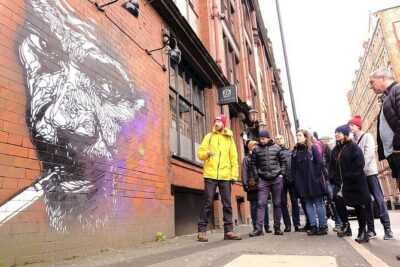
Expect to walk through the Northern Quarter while Hayley links visible buildings and artworks to the area’s past. The route is not presented as a collection of isolated stops. Instead, the pieces help mark different stages in the neighborhood’s transformation.
This is where the tour’s counterculture angle matters. You are not only shown what has been painted on a wall. You are asked to consider why public art appeared, how it changed the way people used the streets, and how political ideas can shape what becomes part of a city’s visual identity.
The group limit is 30 people. That is large enough to provide a lively atmosphere, but it is not a private walk, so your position may affect how easily you see smaller pieces or hear every comment. If you want the best chance of staying close to the guide, arriving at the meeting point with time to spare is sensible.
The tour is near public transportation, which makes it easy to fit into a day of exploring Manchester. It ends at Black Dog Ballroom, 52 Church Street, so you finish in a useful part of the Northern Quarter rather than being returned to the starting point.
The ceramic art trail and the art that changed the area
The ceramic art trail is one of the most distinctive parts of the walk. Street art tours often focus on large painted walls, but ceramic pieces work differently. They can blend into brickwork, doorways, and street corners, rewarding you for looking carefully.
Here, the trail is tied to the Northern Quarter’s revival. The art helped draw attention to the district and gave people a reason to wander through streets that had once been overlooked. That is a more interesting story than simply finding attractive objects for your camera.
Hayley’s role is important because the pieces may not explain themselves. A work can look playful or decorative while carrying links to local politics, past industries, or the people who shaped the area. The tour gives you the background needed to see these installations as part of a wider effort to bring public life back to the streets.
You may also notice how different kinds of art occupy the same district. A planned ceramic trail, a contemporary mural, and a small installation can each reflect a different idea of public space. Some works may feel official, while others feel more spontaneous or tied to the counterculture.
One of the strongest reasons to choose this walk is that it takes you to works not usually found in standard guidebooks or online lists. That does not mean every piece will be dramatic. Some of the pleasure comes from spotting art that is modest, easily missed, or meaningful because of where it sits.
If you have lived in Manchester for years, this part could still change how you see familiar streets. The area is visually busy, and it is easy to pass a small work without noticing it. A guide who knows the pieces and their setting can make the ordinary route feel newly readable.
From counterculture to commercial success
The Northern Quarter’s revival grew from more than paint on walls. It also involved music, independent businesses, old buildings, and a counterculture that saw value in a district other parts of the city had abandoned.
The tour traces this development without turning it into a simple tale of plucky locals saving a neighborhood. A successful cultural district attracts investment. New businesses arrive, buildings gain value, and the same qualities that once made the area affordable can become selling points.
That is where the discussion of gentrification comes in. You will consider how an area can become more popular while becoming less accessible to some of the people and groups associated with its earlier identity.
The topic may be uncomfortable, but it gives the tour purpose. You are not asked to admire street art in a vacuum. You are encouraged to think about who controls public space, who decides which art remains, and how a city presents its past while planning its future.
The Northern Quarter’s protected buildings add another layer. Heritage can preserve a sense of place, but it can also become part of a commercial image. The walk helps you notice both sides: the value of retaining old streets and the risk of turning them into a polished backdrop without retaining the life that made them matter.
I would choose this tour over a standard art walk if you want Manchester explained through its conflicts as well as its attractions. It is especially useful early in a visit because it gives you a set of ideas to carry into later walks around the city.
More History Tours in Manchester:
- Angel Meadow Manchester History Tour with Author Dean Kirby
★ 5.0 · 65 reviews - London Small Group Tour of Historical Pubs
★ 5.0 · 10,422 reviews - Soho Music & Historic Pubs Tour
★ 5.0 · 1,993 reviews - Shadows of York: Ghost Walk and Horrible History.
★ 5.0 · 1,403 reviews
Political stories behind the walls
One of the tour’s most useful features is the attention to political influence. Hayley does not simply identify an artist or point toward a colorful wall. She explains how ideas, campaigns, and local attitudes can affect what appears in public space.
The old fish market is part of the story, and the anecdotes connected to it help bring the former Northern Quarter into focus. Details like this can do more than a list of dates. They suggest how the district worked as a place of trade and everyday activity before its current reputation took shape.
The tour also deals with social justice. That can include questions about access to public areas, the voices represented in art, and the way city projects affect different communities. The information provided does not promise a fixed set of artworks on every date, so you should expect the exact balance of stops and discussion to depend on the route and conditions.
Hayley’s style, based on the available feedback, is engaging and clear. She is praised for explaining both the district’s past and its present plans, and for showing pieces that even a long-term Manchester resident had never noticed. That combination of storytelling and close looking is the tour’s main strength.
You should also have a chance to ask questions. The experience specifically allows you to seek suggestions about where to eat and what else to do, which is useful if the Northern Quarter is your base for the day.
Film locations and less obvious corners
The walk includes off-the-path film locations, adding another reason to look beyond the best-known murals. These stops connect the Northern Quarter to the way Manchester is used on screen, but they also keep the tour from becoming a predictable circuit of famous walls.
Film locations can be enjoyable even if you are not a serious cinema fan. They show how streets can be presented differently through framing and story, and they reveal why certain corners have a strong visual identity.
The key benefit is variety. You may move from a ceramic work to a political discussion, then to a film-related location or a small piece of contemporary street art. The experience should feel like an investigation of the district rather than a single-theme photo stop.
There is a trade-off. The more subjects the walk covers, the less time it can spend on each one. In two hours, you will receive a connected overview rather than a specialist course in individual artists, film production, or urban policy.
That is the right level for most people visiting Manchester for a few days. If you want detailed artist biographies or a technical account of mural techniques, you may prefer a more focused art event. If you want to understand how art, memory, commerce, and city planning meet on one set of streets, this format works well.
What the $20.70 price delivers
At $20.70 per person, the tour sits at a reasonable price for a two-hour guided city walk. The value depends on what you want from a tour.
You are paying for more than directions to public art. The ticket includes interpretation of the Northern Quarter’s decline and revival, discussion of gentrification and public space, access to lesser-known pieces, local anecdotes, and the chance to ask questions. Ten percent of profits goes to local causes, which gives the price an added social purpose.
The value is strongest if you would otherwise walk through the district without understanding its changes. A self-guided route can show you murals, but it may not explain why the ceramic trail mattered or how cultural activity helped reposition the neighborhood.
The price is less compelling if you only want a short list of photo locations. You can see some public art independently, and the two-hour format asks you to listen, think, and keep moving. This is a guided conversation about a city, not just an outdoor gallery visit.
The mobile ticket keeps the booking simple, while free cancellation is available if you cancel at least 24 hours before the 11 a.m. start. Changes or cancellations inside that window are not refunded. Because the walk requires good weather, poor conditions can lead to a different date or a full refund, and a cancellation caused by too few bookings also brings the choice of an alternative or a refund.
Who will get the most from this walk
I would recommend this experience to first-time visitors who want Manchester beyond football, music landmarks, and major museums. It gives you a grounded introduction to one district and helps explain why the city’s public art feels tied to its social past.
It also suits people who already know Manchester. The emphasis on lesser-seen installations means you might notice new works even on familiar streets, while the talk about current plans adds more than a simple nostalgia tour.
This is a good match for:
- People interested in street art, architecture, and urban change
- Visitors who prefer a local voice to a standard sightseeing script
- Anyone curious about counterculture and social justice
- Guests who want a two-hour walk that fits around other plans
- Those who like to ask questions about food and nearby places to explore
It may not suit you if you dislike political discussion, need a completely weather-proof activity, or want a fast mural checklist. The group can reach 30 people, so anyone seeking a highly personal private tour should take that into account.
Service animals are allowed, and most people can take part. The experience is near public transportation, but the supplied details do not specify the route’s walking distance or whether every surface is step-free, so ask the provider directly if you have specific mobility needs.
Should you book the Northern Quarter street art tour?
Book it if you want public art with context. The best part is not simply seeing more murals. It is learning how art helped revive a declining district, then considering the costs of that success.
Hayley’s ability to connect small details, such as the fish market and overlooked installations, with larger questions about politics and public space gives the walk a clear point of view. The 99 percent recommendation rate and 5 out of 5 score suggest the experience has delivered strongly for its audience, but your enjoyment will still depend on liking discussion as much as sightseeing.
At $20.70, I think it is good value for a curious visitor, especially early in a Manchester stay. Bring sensible outdoor clothing, arrive ready to walk for about two hours, and choose this over a standard mural tour if you want to understand what the Northern Quarter became and what it may become next.
FAQ
Where does the tour start?
The tour starts at Shudehill in Manchester, M4, UK.
Where does the tour finish?
It finishes at Black Dog Ballroom, 52 Church Street, Manchester, M4 1PW.
What time does the tour begin?
The scheduled start time is 11 a.m.
How long does the walking tour last?
The tour lasts approximately two hours.
How much does the experience cost?
The listed price is $20.70 per person.
What happens if the weather is poor?
The experience requires good weather. If it is canceled because of poor weather, you will be offered another date or a full refund.
Can I cancel for a full refund?
Yes. You can cancel at least 24 hours before the experience start time for a full refund. Cancellations or changes made less than 24 hours before the start are not refunded or accepted.
Recently added around Manchester
- Private Cocktail Making Class in Manchester★ 5.0 · 8 reviews
- MANCHESTER: Yorkshire Adventure – Sightseeing Day Trip Tour★ 5.0 · 9 reviews
- Manchester: Luggage Storage Central★ 5.0 · 10 reviews
- Musical MADchester Quest Experience in Manchester★ 4.0 · 14 reviews
- Murder Detective Self-Guided Tour in Manchester★ 3.5 · 16 reviews
- Manchester’s Music Scene with a Local Host, Private + Custom★ 4.0 · 17 reviews
- Inspirational guided walking tour of Media City & The Quays★ 5.0 · 23 reviews
- Italian Afternoon Tea Experience in Manchester★ 4.0 · 25 reviews
Manchester Tours, compared.


Alcotraz Prison Cocktail Experience in Manchester
Read our review →



Manchester iFLY Indoor Skydiving Experience – 2 Flights & Certificate
Read our review →Browse the lists this tour appears in